Pub Scholars

Conference Papers vs Journal Paper: Major Difference should be known by each researcher

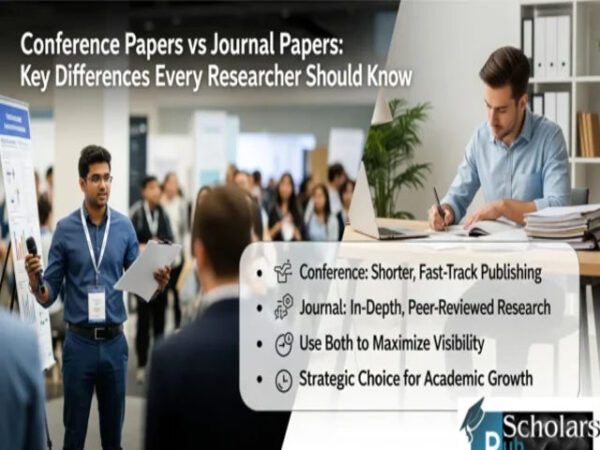
Conference Papers Vs Journal Papers are two popular ways researchers use to share their studies with other experts and the academic community. While both of them help you communicate research findings, they serve different purposes, follow different processes, and provide a variety of educational effects. 

As a researcher or academic, you will come across many types of research manuscripts during your career. To avoid confusion while writing, presenting or referring to your research, it is important to understand the significant difference between conference papers and journal papers. This blog conference papers vs. Journal Paper explains the structure, review process, type and major differences. Whether you are a student or a senior educationist, this guide will help you decide where and how to publish your work.

What is a conference paper?

 A conference paper is a short-written document presented to the organizing committee of a conference. Once accepted, the writer presents verbally research outcomes at the conference. The goal of a conference paper is to share  new, ongoing, or incomplete research, receiving feedback and starting interaction with fellow researchers and experts in the field.

These papers are usually reviewed for basic structure, clarity and subject relevance. Unlike Journal Papers, conference submissions generally do not undergo a detailed peer-review process. Based on the conference, the sanctioned letters can be published as the conference proceedings, which are often accessible in online or in prints.

Types of conference papers

1. Abstract:  An abstact is a brief summary of your research, usually about 200–250 words. This explains the purpose, methods, conclusions and importance of your work. Conference abstracts help conference reviewers decided whether your work the theme of the event. They are also useful for participants who want to know more about your study before participating in your presentation. 

2. Extended Abstract: An extended Abstract is beyond a standard Abstract, which often covers 1 to 2 pages. This includes your research solution, background literature, research methods, results and problems and references. It also includes writer details and affiliation. Extended abstract is useful when a conference wants more information before accepting your work.  

3. Small or brief paper:  This type of conference paper is usually limited to 4 pages and is suitable for presenting initial stage research. This includes the main findings, research questions, brief methods and the relevance of your study. However, brief, it should clearly explain the importance of your research.

4. Full research paper: This is a complete version of your research, usually 6-8 pages in length. It includes all sections: title, abstract, introduction, functioning, results, conclusions, reference and acknowledgment. A complete paper is ideal if you want to showcase the whole work at a conference.

What are journal paper?

A journal paper is a broad educational or scientific article published in a peer-reviewed magazine. Journal paper original, complete and important research conclusions offer. They are fully reviewed by experts, often in a double-blind peer-review system, which ensures that the research meets academic standards.

Publication in magazines is necessary to create an academic career, apply for grant, earn promotion and increase your professional reputation. Conference papers vs. Journal paper are the most clearly different in the required depth and review process.

Types of magazines

1. Original research:  This is the most common type of journal publication. It presents complete research tasks with a wide abstract, introduction, method, result and discussion sections. It often contains new principles, models or experimental results. These letters are huge quoted in future research.

2. Short communication: These are small versions of full articles, often focusing on new conclusions or immediate results that require rapid publishing. These papers are brief and include enough data to prove the importance of the study, but can leave the depth background or analysis. 

3. Review article: Review articles briefly present the existing literature on a particular subject. They do not have original experiments, but are widely used by beginners to understand a subject. Review articles are long, well -structured, and cite dozens of or even hundreds of other studies. 

4. Case study :Case studies describe specific examples of a theory or applications of the real world. They are common in clinical, medical and professional fields. They help to explain how academic principles work in practical settings.

5. Methods Paper: This paper introduces a new technique, tool or procedure. It can also improve an existing method. These are valuable for fellow researchers who can apply a new method in their work.

Differences Between Conference and Journal Papers

Let’s now explore the core differences between conference papers vs journal papers in a side-by-side format:

Aspect

Conference Paper

Journal Paper

Definition

A document submitted for a conference presentation.

A full scientific article published in a peer-reviewed journal.

Purpose

Share early findings, get feedback, and initiate discussion.

Present complete, original research with long-term value.

Peer Review

Generally minimal or basic review.

Rigorous peer review by multiple experts.

Length

Shorter (4–8 pages).

Longer (10–30+ pages).

Content

Work-in-progress or recent findings.

Final, in-depth analysis and conclusions.

Publication Time

Faster (weeks to a few months).

Slower (6 months to over a year).

Publication Medium

Conference proceedings (print or online).

Academic journals (indexed in Scopus, Web of Science).

Impact

Useful for feedback, networking, visibility.

High academic weight, citations, and career impact.

Which one should you choose?

Your decision among the Journal vs. Conference papers depends on the maturity of your research and your publication goals.

Choose the conference papers if:

• You are presenting initial results or pilot studies. 

• You need a response before writing full paper. 

• You are targeting networking and cooperation. 

• You want to create visibility quickly. 

Choose Journal Paper If:

• Your research is complete and well documented. 

• You aim to create an academic profile. 

• You are applying for promotion, jobs or grants. 

• You want long -term recognition and quotation.

Can a conference paper become a journal article?

Yes, many researchers start with a conference paper and later publish a long, enhanced version as a journal article. However, magazines expect adequate additions. You must:

• Include new data, discussion or section. 

• Write again to fit the journal format. 

• Apparently mention the previous conference version. 

• Follow moral publication guidelines.

Some magazines have specific policies on presenting extended versions of conference papers vs. Journal paper, so always read the rules presented carefully.

Final Thought: Understanding Conference Paper vs Journal Papers

In the world of academic research, selection between conference paper vs. journal papers is not just a matter of format – this is a strategic decision that can shape your visibility, recognition and development of career.

Conference papers are ideal when you are working on new ideas, pilot studies, or projects that are still developing. They give you the opportunity to present your findings quickly, join with experts in your field and get valuable response. These papers are perfect for researchers who want to share their work in progress, start interaction, and find out future cooperation.

On the other hand, journal paper is more mature, for intensive research. They require several rounds of time, effort and peer reviews. But the reward is worth it. The-geneal publication brings reliability, high quotes and long-term educational values. If you are applying for grants, educational publicity, or research positions, the journal paper is often seen as more prestigious than conference presentations.

When comparing journal vs conference papers, it’s important to recognize that both play unique roles in your research journey. You don’t have to choose one over the other. In fact, many researchers use conference papers as a stepping stone to develop full-length journal papers. A good practice is first to present its initial work at a conference, gather insights from peers, and and then revise and expand your study for submission to a journal. 

Therefore, whether you aim to test an idea, obtain quick response, or publish important results, understand the difference between conference papers and journal papers help you make better decisions. Each type of paper has its own strength, and when used wisely, they can complement each other to boost your academic profile.

FAQs

1. What is the main difference between a conference paper and a journal paper?

A conference paper is usually smaller, shared in academic conferences, and often represents work-in-progress or early stages research. A journal paper is long, peer reviewed, and this includes complete, original research published in academic journals.  

2. Are the conference papers considered to be a peer-reviewed?

Conference papers can undergo a basic review process, mostly for structure, relevance and clarity. However, they do not undergo rigorous peer-review like journal papers. Some top conferences can provide strict reviews, but generally, the journal reviews are more detailed. 

3. Can I publish the same research in both a conference and a journal?

Yes, you can. Researchers often present preliminary results at a conference and later publish a more detailed version in a journal. However, the journal article must have significant new data, analysis, or discussion, and clearly cite the previous conference version.  

4. How long should a conference paper be?

Conference papers are usually 4 to 8 pages long, depending on the type:  

• Abstract: ~ 250 words  

• Extended Abstract: 1-2 page  

• Brief paper: up to 4 pages  

• Full paper: 6–8 pages  

5. How long are the journal paper usually?

Journal papers are more comprehensive and usually range from 10 to 30+ pages depending on the subject, field and journal guidelines. They include detailed methodology, results, discussions and references.

6. Which is better for academic promotion: Conference or journal paper?

Journal paper takes more academic weight and is often essential for promotion, grant and tenure. The conference papers are important for feedback and networking, but usually provide a lower citation impact than the journal publications.  

7. When should I choose to publish a conference paper?

You should choose a conference paper when:  

• You are presenting preliminary findings or pilot studies  

• You want to share initial results and get quick response   

• You aim to network or cooperate with other researchers  

• You need faster publishing turnaround

8. When should I publish a journal paper?

Publish a journal paper when:  

• Your research is complete and well documented  

• You want high visibility, citations, and credibility 

• You are applying for research jobs, promotion or grant  

• You want long -term academic recognition

9. What are the types of conference papers?

Common types include:  

• Abstract  

• Extended abstract  

• Brief letter  

• Full research paper  

Each type varies in length and expansion depending on the requirements of the conference.

10. What are the types of journal paper?

Popular types include:  

• Basic Research Article  

• Short communication  

• Review article  

• Case Study  

• Methods paper  

Each type provides a different purpose, from introducing new methods to reviewing literature or reporting real -life matters.  

11. How long does it take to publish a journal paper vs. conference paper?

• Conference Paper: Usually takes a few weeks to a few months  

• Journal Paper: Can take 6 months to over a year due to peer review and revisions process

12. Does Journal Paper have more impact than conference papers?

A conference paper is usually smaller, shared in academic conferences, and often represents work-in-progress or early stages research. A journal paper is long, peer reviewed, and this includes complete, original research published in academic journals.  

Author Profile
Content Writer at 

I am a seasoned professional with over 9 years of transformative experience in the domains of molecular biology, immunology, and clinical research. With a career that spans from 2006 to 2018, my journey has been marked by a relentless pursuit of scientific excellence and an unwavering commitment to improving healthcare outcomes through groundbreaking research. I have worked at one of India’s premier medical institutions, AIIMS(All India Institute of Medical Sciences), where I contributed significantly to the fields of molecular biology and clinical research. My expertise in protein analysis and genetic studies allowed me to identify potential biomarkers and improve diagnostic accuracy, contributing to better healthcare outcomes for patients. Notably, the research work has been published in prestigious scientific journals such as the Indian Journal of Ophthalmology and the British Journal of Ophthalmology.

Publication in these esteemed journals reflects my commitment to advancing medical science and sharing insights with the global research community. These publications highlight my expertise in areas ranging from gene polymorphism and immune response mechanisms to the effects of chronic drug therapy, all contributing to the larger body of scientific knowledge. My passion for scientific communication led me to pursue an Executive Diploma in Medical Writing from CliMed Research Solutions and Curio Training and Research Institute (CTRI), India. This certification has further refined my ability to bridge the gap between complex scientific research and its practical applications in healthcare. My passion for content writing drives me to continuously create content that derives engagement ,build trust, and leaves a lasting impression on readers”.


Scroll to Top