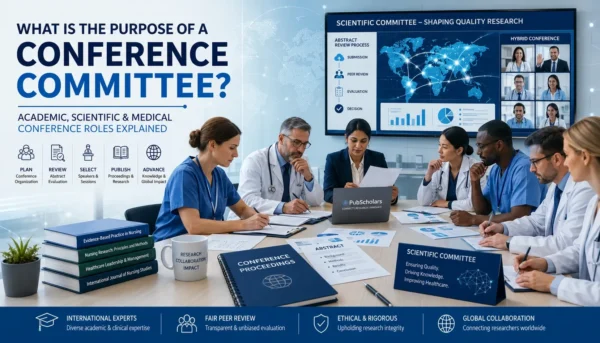
- Two Types of Conference Committees: A Quick Clarification
- What Is the Purpose of an Academic Conference Committee?
- The core purpose of a conference committee
- Conference Committee Roles and Responsibilities
- 1. General Chair (Conference Chair)
- 2. Scientific Committee (Programme Committee)
- 3. Publication Chair
- 4. Finance Chair
- 5. Marketing and Communications Chair
- 6. Local Organising Chair
- The Scientific Committee’s Role in Medical and Nursing Conferences
- What makes a medical conference scientific committee different?
- Who sits on a nursing and medical conference scientific committee?
- How the Abstract Review Process Works
- Step 1: Abstract submission
- Step 2: Initial screening by the publication or programme chair
- Step 3: Peer review by the scientific committee
- Step 4: Committee discussion and acceptance decision
- Step 5: Notification and publication
- What Does the Conference Committee Look for in a Strong Abstract?
- Originality and contribution to the field
- Methodological clarity and rigour
- Concrete, stated results
- Clinical relevance for medical and nursing conferences
- Alignment with the conference theme and tracks
- Language quality and writing clarity
- How Does a Conference Committee Differ from a Journal Editorial Board?
- How to Join a Conference Scientific Committee as a Reviewer
- Who is eligible to serve on a scientific committee?
- How to express interest in joining
- Frequently Asked Questions About Conference Committees
- What is the role of a conference committee?
- What does a programme committee do at a conference?
- Who is on a conference scientific committee?
- How are abstracts selected at a conference?
- What is the difference between an organising committee and a scientific committee?
- How do I submit an abstract to a conference committee?
- Can a conference committee member also submit an abstract?
- Final Thoughts: Why the Conference Committee Matters to You
If you have searched “what is the purpose of a conference committee,” you may have come across results about the United States legislative process — the joint committee of House and Senate members that resolves differences in a bill. That is one meaning of the term. But there is a second, equally important meaning that is far more relevant to researchers, nurses, doctors, and academics: the conference committee that plans, organises, and governs an academic or scientific conference.
This guide is about the second kind. Whether you are a researcher preparing to submit an abstract, a nurse considering attending an international conference, or a healthcare professional who wants to understand how academic events are organised and how research is selected for presentation — this is everything you need to know about the purpose, roles, and responsibilities of an academic conference committee.
Two Types of Conference Committees: A Quick Clarification
The phrase “conference committee” means different things in different contexts. Here is a simple breakdown so you can identify which type is relevant to your situation:
| Legislative Conference Committee | Academic / Scientific Conference Committee |
|---|---|
| A temporary joint panel of US House and Senate members | A group of academics, researchers, and organisers who plan and run a conference |
| Formed to resolve differences between two versions of a bill | Formed to ensure the quality, structure, and success of an academic event |
| Relevant to: lawmakers, political science students, citizens | Relevant to: researchers, nurses, doctors, academics, conference attendees |
| Examples: US Congress conference committees on budget legislation | Examples: International Nursing Conference, neurology symposiums, medical summits |
This guide focuses entirely on the academic and scientific conference committee –
the kind that matters to researchers, healthcare professionals, and anyone involved in submitting or presenting work at a professional or medical conference.
What Is the Purpose of an Academic Conference Committee?
In the world of academic and professional conferences, the conference committee is the engine that makes everything work. It is the group of people responsible for every major decision about the event — from defining the conference theme and issuing the call for papers, to selecting speakers, managing peer review, and overseeing publication of accepted research.
Without a well-organised conference committee, a research conference would have no coherent scientific programme, no quality control over the research presented, and no guarantee that the event delivers genuine educational value to its attendees.
The core purpose of a conference committee
At its most fundamental level, the conference committee exists to serve three groups of people:
- The research community — by creating a rigorous, fair, and transparent process for evaluating and presenting scientific work
- The conference attendees — by curating a programme of sessions, keynotes, and presentations that is genuinely educational, relevant, and well-organised
- The field itself — by advancing knowledge, surfacing new findings, and creating a published record of current research through conference proceedings
A strong conference committee does not just plan an event. It shapes the intellectual character of the conference, determines which research voices are heard, and sets the standard of quality that gives the conference its credibility and reputation.
Conference Committee Roles and Responsibilities
Most academic and professional conference committees are divided into several sub-roles, each with a specific area of responsibility. While the exact structure varies by event size and field, the following roles are standard across the majority of international conferences — including medical, nursing, and neurology conferences.
1. General Chair (Conference Chair)
The General Chair is the most senior member of the conference committee. This person has overall responsibility for the direction, success, and reputation of the conference. The General Chair:
- Sets the vision, theme, and overarching goals of the conference
- Coordinates all sub-committees and ensures they are working toward the same objectives
- Acts as the primary liaison between the conference committee and any parent organisation, sponsor, or governing body
- Chairs the main committee meetings and makes final decisions when consensus cannot be reached
- Prepares the post-conference report and evaluates whether the event met its stated goals
For large international conferences, the General Chair often works alongside a Co-Chair or a President-elect who provides continuity across conference editions. At the PubScholars International Nursing Conference, the General Chair works directly with the international scientific committee to ensure each edition builds on the standards set by the previous year.
2. Scientific Committee (Programme Committee)
The Scientific Committee — also called the Programme Committee or Technical Programme Committee depending on the field — is the most academically critical part of the conference structure. This is the group responsible for the intellectual content and research quality of the event.
The scientific committee:
- Defines the scope and topical focus of the conference programme
- Issues the call for abstracts and papers, specifying submission guidelines, deadlines, and review criteria
- Appoints peer reviewers and oversees the review process to ensure fairness and academic rigour
- Makes final decisions on which abstracts and papers are accepted, rejected, or recommended for revision
- Assigns accepted presentations to oral or poster sessions based on quality, relevance, and programme balance
- Ensures diversity of topics, methodologies, and presenter backgrounds across the programme
- Resolves conflicts of interest when a reviewer has a personal or professional relationship with an abstract author
The credibility of a conference’s scientific committee is one of the primary factors researchers consider when deciding whether to submit their work or attend the event. A committee composed of respected, internationally recognised experts signals that the conference is serious, selective, and worth the investment of time and registration fees.
3. Publication Chair
The Publication Chair manages everything related to the written record of the conference. This role is particularly important for conferences — like PubScholars events — that publish accepted papers in official conference proceedings or partner with academic journals for post-conference publication.
Key responsibilities include:
- Coordinating with peer reviewers and authors to ensure final manuscripts meet publication standards
- Managing the submission and manuscript workflow for all accepted papers
- Liaising with the publisher, indexing body (such as Scopus or Web of Science), or journal partner to ensure proceedings are properly archived
- Issuing digital object identifiers (DOIs) and ensuring papers are discoverable in academic search databases
- Preparing the final proceedings volume and overseeing its distribution to attendees and institutions
For researchers, publication is often the single most important outcome of conference participation. A strong Publication Chair ensures that accepted work reaches the widest possible academic audience and contributes meaningfully to the field’s published literature.
4. Finance Chair
The Finance Chair oversees the conference budget and ensures the event is financially sustainable. Responsibilities include:
- Preparing and managing the overall conference budget, including venue costs, speaker fees, catering, technology, and marketing
- Setting and adjusting conference registration fees to cover costs while remaining accessible to as many participants as possible
- Managing relationships with sponsors and exhibitors and ensuring sponsorship commitments are fulfilled
- Tracking income and expenditure throughout the planning process and reporting to the General Chair
- Preparing the financial report at the close of the conference
For international conferences with hybrid formats, the Finance Chair must also manage costs related to virtual platform licences, recording equipment, and digital certificate distribution for virtual attendees — a growing area of complexity in 2026.
5. Marketing and Communications Chair
The Marketing Chair is responsible for reaching potential attendees, abstract submitters, and sponsors with the right message at the right time. This role has expanded significantly with the growth of digital marketing and social media in academic conference promotion.
- Developing and executing the conference promotion strategy across email, social media, academic networks, and direct outreach
- Managing the conference website, ensuring all information is current, accurate, and clearly presented
- Writing and distributing the call for abstracts to relevant academic and professional communities
- Producing all conference publicity materials including brochures, registration pages, and email campaigns
- Managing media releases and handling press enquiries about the conference
- Coordinating with the Local Chair on place-specific promotion for in-person attendance
6. Local Organising Chair
For in-person and hybrid conferences, the Local Organising Chair manages everything related to the physical event — the venue, logistics, accommodation, catering, and on-the-day operations.
- Selecting and booking the venue in advance, ensuring it meets the technical and capacity requirements of the event
- Coordinating with catering, technology, and decor vendors and managing the event-day budget
- Arranging accommodation options and transportation guidance for international attendees
- Supervising on-site registration and check-in processes on conference days
- Managing student volunteers and support staff during the event
- Handling any on-site technical issues with audio-visual equipment, internet connectivity, or presentation systems
For hybrid conferences like PubScholars events — where some delegates attend in person in San Diego or Boston and others join virtually from 30+ countries — the Local Organising Chair also coordinates with the virtual platform team to ensure seamless integration between the physical and online conference experience.
The Scientific Committee’s Role in Medical and Nursing Conferences
In medical, nursing, and neurology conferences, the scientific committee carries a responsibility that goes beyond typical academic quality control. The research presented at a healthcare conference can directly influence clinical practice, patient care standards, nursing protocols, and healthcare policy. This raises the stakes for the review process considerably.
A nursing or medical conference scientific committee is not simply filtering out weak papers — it is actively curating a body of knowledge that nurses, doctors, and allied health professionals will carry back to their clinical environments and use in real patient care decisions.
What makes a medical conference scientific committee different?
| Standard Academic Conference | Medical / Nursing Conference |
|---|---|
| Reviewers drawn from academic researchers | Reviewers are practicing clinicians AND researchers |
| Focus on methodological rigour and originality | Focus on clinical relevance, patient outcomes, and evidence strength |
| Publication in general proceedings | Publication that may inform clinical guidelines and practice standards |
| Attendees are primarily academics | Attendees apply findings directly in patient care |
| One review cycle typical | Often includes clinical relevance check alongside academic peer review |
Who sits on a nursing and medical conference scientific committee?
The composition of a medical conference scientific committee directly determines the quality and credibility of the event. For an international nursing conference, a strong scientific committee typically includes:
- Registered Nurses (RNs) and Nurse Practitioners (NPs) with specialised clinical expertise in the conference’s focus areas
- Nursing academics and researchers from internationally recognised universities and medical schools
- Hospital nursing directors and clinical nurse specialists with direct experience in evidence-based practice implementation
- Healthcare policy experts who can evaluate the real-world applicability of submitted research
- Representatives from relevant professional nursing associations (ANCC, ANA, ONS, and equivalent international bodies)
- Interdisciplinary members from medicine, pharmacy, or allied health where the conference theme overlaps with other clinical disciplines
The geographic diversity of the scientific committee also matters significantly. An international nursing conference with committee members drawn from only one country will inevitably reflect a narrow clinical perspective. Conferences with genuinely international scientific committees — members from the USA, Europe, Asia, and beyond — deliver a more balanced, globally relevant programme.
How the Abstract Review Process Works
For many researchers and healthcare professionals, submitting an abstract to a conference scientific committee is the first step in sharing their work with an international audience. Understanding exactly how the review process works — from submission to acceptance — takes away much of the anxiety and helps you prepare a stronger submission.
Step 1: Abstract submission
The process begins when the conference committee issues the call for abstracts, specifying the submission portal, deadline, word limit, formatting requirements, and thematic tracks. Submitting authors create an account on the conference platform and upload their abstract — typically 250–500 words — along with author details, institutional affiliation, and their preferred presentation format (oral or poster).
At this stage, the author should ensure their abstract clearly states the background, objectives, methodology, results (even if preliminary), and conclusions of their research. If you are unsure how to structure this, our guide on how to write a conference abstract walks through the format, structure, and examples in detail. Vague abstracts that omit results or conclusions are routinely rejected at the initial screening stage.
Step 2: Initial screening by the publication or programme chair
Before abstracts reach the scientific committee, the programme chair or a designated sub-committee conducts an initial screening. This stage checks:
- Whether the abstract meets the basic formatting and word count requirements
- Whether the topic is relevant to the conference theme and at least one of the stated topical tracks
- Whether the abstract contains all required sections (background, methods, results, conclusions)
- Whether the abstract is written in clear, understandable language
Abstracts that fail this initial screening are typically returned to the author with feedback, rather than immediately rejected. This gives researchers the opportunity to revise and resubmit before the final deadline.
Step 3: Peer review by the scientific committee
Abstracts that pass initial screening are assigned to two or three peer reviewers from the scientific committee — selected based on their expertise in the abstract’s topic area. To ensure fairness, most medical and nursing conferences use a single-blind or double-blind review system:
| Single-blind review | Double-blind review |
|---|---|
| Reviewer knows the author’s name and institution | Neither reviewer nor author knows the other’s identity |
| Author does not know who is reviewing their work | Complete anonymity on both sides |
| More common in smaller or specialist conferences | More common in large international and medical conferences |
| Risk: unconscious bias toward prestigious institutions | Reduces institutional and geographic bias in review decisions |
Each reviewer evaluates the abstract against a standardised scoring rubric. For a nursing or medical conference, the criteria typically include:
- Originality and novelty of the research question or findings
- Clarity and appropriateness of the research methodology
- Strength and significance of the results presented
- Clinical relevance — the degree to which the findings are applicable to real-world nursing or medical practice
- Relevance to the conference theme and topical tracks
- Quality and clarity of written presentation
- Ethical standards — evidence that the research was conducted in accordance with ethical guidelines (IRB approval, patient consent, etc.)
Step 4: Committee discussion and acceptance decision
After individual reviews are completed, the scientific committee — or a designated sub-group of senior committee members — reviews the aggregated scores and comments. Where reviewers have significantly different scores for the same abstract, the committee discusses the abstract in detail before reaching a consensus decision.
Final outcomes are one of three:
- Accepted — the abstract is accepted for presentation, either as an oral presentation or a poster, and the author is notified with their presentation assignment
- Accepted with revisions — the abstract is conditionally accepted, with the author asked to address specific feedback before final acceptance is confirmed
- Rejected — the abstract does not meet the standards required for inclusion in the conference programme. Rejection notifications typically include brief feedback from reviewers to help authors improve future submissions
Step 5: Notification and publication
Accepted authors receive a formal acceptance notification from the conference, including details of their presentation slot (date, time, session track, presentation duration) and instructions for preparing their final paper or presentation.
For conferences that publish proceedings — including PubScholars events — accepted authors submit a full paper or extended abstract for publication. The publication chair oversees the final editing, formatting, and submission of these papers to the conference proceedings, which are archived and made available to researchers worldwide.
What Does the Conference Committee Look for in a Strong Abstract?
Understanding what a scientific committee evaluates is the most practical thing you can do before writing your abstract. The following criteria apply across the vast majority of medical, nursing, and neurology conference abstract reviews in 2026. For a deeper dive, read our full guide on how to write a high-quality conference paper.
Originality and contribution to the field
The scientific committee wants to know: what does this research add that does not already exist? This does not mean every abstract must present a groundbreaking discovery. Replication studies, systematic reviews, clinical audits, quality improvement initiatives, and case studies all have a place in nursing and medical conferences — provided they are framed in terms of what they contribute beyond current knowledge.
A weak abstract says: “This study examines the effect of sleep on nurse wellbeing.” A strong abstract says: “This study is the first to examine the effect of twelve-hour shift patterns on nurse wellbeing in ICU settings using validated burnout scales across three hospitals.” Specificity signals originality.
Methodological clarity and rigour
Reviewers need to understand how you conducted your research well enough to evaluate whether your conclusions are supported by your methods. This means stating clearly:
- The research design (randomised controlled trial, systematic review, qualitative interview study, observational cohort, clinical audit, etc.)
- The sample size and population (who was studied, where, and why they were selected)
- The data collection instruments or procedures used
- The analytical approach (statistical methods, thematic analysis, meta-analysis, etc.)
You do not need to explain every methodological detail in a 300-word abstract — but reviewers should be able to assess from your methods section whether the conclusions you draw are reasonably supported by the research you conducted.
Concrete, stated results
This is the single most common reason abstracts are rejected: vague or absent results.
Phrases like “results will be discussed” or “findings are pending” are almost universally rejected. Even if your research is ongoing at the time of submission, you should have at least preliminary findings to report. A strong abstract gives specific numbers, percentages, themes, or outcomes — not promises.
Weak: “Results showed that the intervention improved patient outcomes.”
Strong: “Patients in the intervention group showed a 34% reduction in hospital-acquired infections over a six-month period (p < 0.01), compared to a 6% reduction in the control group.”
Clinical relevance for medical and nursing conferences
For healthcare conferences specifically, the scientific committee applies an additional lens: so what does this mean for clinical practice? Research that is methodologically sound but has no discernible implications for patient care, nursing protocols, or healthcare delivery will score lower at a clinical conference than at a general academic symposium.
Always include a clear statement in your conclusions section about the practical implications of your findings. Who benefits from this research? How should nurses, doctors, or healthcare administrators act on these results?
Alignment with the conference theme and tracks
Each conference defines topical tracks that reflect its scientific scope. Submitting an abstract that is methodologically excellent but thematically misaligned with the conference’s focus is a common and easily avoidable mistake.
For the PubScholars International Nursing Conference 2026, the thematic tracks include:
- Evidence-based nursing practice
- Nursing informatics and technology
- Pediatric and neonatal nursing
- Oncology and palliative care nursing
- Midwifery and women’s health
- Acute and critical care nursing
- Nursing education and curriculum development
- Nursing leadership and healthcare management
- Mental health and psychiatric nursing
- Global health and nursing policy
Before you submit, read the call for abstracts carefully and identify which track your research fits most naturally. Reviewers who are assigned to a specific track are experts in that area — submitting to the right track ensures your abstract is evaluated by the people best qualified to assess it.
Language quality and writing clarity
A poorly written abstract — with grammatical errors, unclear sentence structure, or unexplained jargon — signals to reviewers that the research itself may be poorly conducted or documented. This does not mean your abstract must be elegant prose, but it does mean that every sentence should be clear, grammatically correct, and free of ambiguity.
If English is not your first language, consider asking a colleague or professional editor to review your abstract before submission. The scientific committee evaluates the quality of your research, not your language skills — but unclear writing makes it harder for reviewers to fairly assess your work.
How Does a Conference Committee Differ from a Journal Editorial Board?
Many researchers are more familiar with the peer review process for journal articles than for conference abstracts. The two processes share common principles — both involve expert review, both aim to maintain quality standards — but they differ in important ways. For a full breakdown, read our article on conference papers vs journal papers.
| Factor | Conference Committee | Journal Editorial Board |
|---|---|---|
| Scope of review | Abstract (250–500 words) + optional full paper | Full manuscript (5,000–10,000+ words) |
| Review speed | Weeks to 2 months | 3 months to over a year |
| Publication output | Conference proceedings | Peer-reviewed journal article |
| Revision opportunity | Limited — usually one cycle | Multiple revision rounds standard |
| Indexing | Varies by conference | Scopus, Web of Science, PubMed (journal-dependent) |
| Networking benefit | High — you present in person or virtually | Low — publication only, no event |
| Career value | Good — especially for early-career researchers | High — most valued for academic promotion and grants |
The right choice between conference and journal submission depends on the maturity of your research, your timeline, and your goals. Many researchers use the conference route first — presenting preliminary findings at an international event, collecting feedback from peers, and then developing the work into a full journal submission. This is a well-established and highly effective strategy, particularly in nursing and medical research.
How to Join a Conference Scientific Committee as a Reviewer
For experienced researchers and clinicians, serving on a conference scientific committee is both a professional privilege and a genuine contribution to your field. It gives you early access to emerging research, develops your critical appraisal skills, and builds your reputation within the academic community.
Who is eligible to serve on a scientific committee?
- Researchers with a doctoral degree (PhD, DNP, MD) or equivalent clinical expertise in the conference’s focus area
- Senior clinicians (RNs, NPs, physicians) with a track record of published research or significant clinical experience
- Nursing faculty and academic staff at accredited universities
- Healthcare policy experts and administrators with relevant research experience
- Early-career researchers with specific expertise in a niche topical area (may serve as associate reviewers under a senior committee member)
How to express interest in joining
Most conferences invite scientific committee applications through their official website or call for reviewers. To express interest in joining the PubScholars International Nursing Conference or Neurology Conference scientific committee:
- Visit nursingeducationconference.pubscholars.org or pubscholars.org
- Contact the organising committee directly at info@pubscholars.org
- Include your current role, institutional affiliation, area of expertise, and a brief list of relevant publications or clinical achievements
- Indicate your availability for the review period and the topical tracks you are most qualified to evaluate
Committee membership is confirmed by the General Chair in consultation with existing committee members, and is typically renewed on a conference-by-conference basis.
Frequently Asked Questions About Conference Committees
What is the role of a conference committee?
The role of a conference committee is to plan, organise, and govern an academic or professional conference. This includes setting the conference theme, issuing the call for abstracts, managing the peer review process, selecting speakers and sessions, overseeing publication of accepted research, and ensuring the event runs smoothly on the day. In medical and nursing conferences, the committee also ensures that all research presented meets the clinical and ethical standards expected of the healthcare community.
What does a programme committee do at a conference?
The programme committee — also called the scientific committee or technical programme committee — is specifically responsible for the intellectual content of the conference. It reviews submitted abstracts and papers, assigns them to peer reviewers, makes acceptance or rejection decisions, and builds the final programme of sessions, keynotes, workshops, and poster presentations. The programme committee’s decisions determine which research gets shared with the wider academic and clinical community.
Who is on a conference scientific committee?
A conference scientific committee typically includes senior academics and researchers with expertise in the conference’s topic areas, experienced clinicians (in the case of medical and nursing conferences), representatives from relevant professional associations, and faculty from internationally recognised universities. For international conferences, the committee ideally includes members from multiple countries to ensure diverse geographic and cultural perspectives are represented in the review process.
How are abstracts selected at a conference?
Abstracts submitted to a conference are first screened for basic formatting compliance and thematic relevance. Those that pass initial screening are assigned to two or three peer reviewers from the scientific committee, who evaluate each abstract against a standardised set of criteria — typically including originality, methodological quality, strength of results, clinical relevance, and alignment with the conference theme. Reviewers score each abstract independently, and the committee then makes a collective accept, revise, or reject decision based on the aggregated scores and comments.
What is the difference between an organising committee and a scientific committee?
The organising committee handles the logistics and operational aspects of the conference — venue, catering, registration, marketing, budget, and on-day management. The scientific committee handles the academic and intellectual aspects — abstract review, speaker selection, programme design, and publication. At smaller conferences these may overlap significantly, with the same people serving in both capacities. At larger international conferences they are typically distinct groups with clearly separated responsibilities.
How do I submit an abstract to a conference committee?
Abstract submission is done through the conference’s official submission portal. For the PubScholars International Nursing Conference 2026 (May 23–24, San Diego): visit nursingeducationconference.pubscholars.org, complete the abstract submission form with your research title, author details, institutional affiliation, preferred presentation format, and abstract text (250–500 words). Ensure your abstract clearly states the background, objectives, methodology, results, and conclusions of your research. Accepted abstracts are published in the official conference proceedings and presented to an international audience from 30+ countries.
Can a conference committee member also submit an abstract?
In most cases, yes — but with a strict conflict-of-interest policy applied. If a scientific committee member submits an abstract, that member is excluded from reviewing, scoring, or discussing their own submission. Their abstract is assigned to other committee members who have no professional or personal relationship with the author. This safeguard is standard practice in reputable academic conferences and is a key part of maintaining the integrity of the review process.
Final Thoughts: Why the Conference Committee Matters to You
Whether you are a nurse preparing to submit your first research abstract, a doctoral student wondering how your work will be evaluated, or a clinician considering whether an international conference is worth attending — understanding the conference committee changes how you engage with the entire process.
It tells you that a reputable conference is not just a gathering of people — it is a structured, carefully governed academic event with quality controls, peer review, and published outcomes. The scientific committee is the reason you can trust that the research presented at a high-quality nursing or medical conference is worth your time, worth acting on, and worth sharing with your clinical team.
It also tells you that your own research has a genuine pathway to an international audience. The abstract review process is rigorous, but it is fair — and a well-written, well-designed study with meaningful clinical implications will be recognised and accepted by a quality scientific committee, regardless of where you work or where you trained.

I am a seasoned professional with over 9 years of transformative experience in the domains of molecular biology, immunology, and clinical research. With a career that spans from 2006 to 2018, my journey has been marked by a relentless pursuit of scientific excellence and an unwavering commitment to improving healthcare outcomes through groundbreaking research. I have worked at one of India’s premier medical institutions, AIIMS(All India Institute of Medical Sciences), where I contributed significantly to the fields of molecular biology and clinical research. My expertise in protein analysis and genetic studies allowed me to identify potential biomarkers and improve diagnostic accuracy, contributing to better healthcare outcomes for patients. Notably, the research work has been published in prestigious scientific journals such as the Indian Journal of Ophthalmology and the British Journal of Ophthalmology.
Publication in these esteemed journals reflects my commitment to advancing medical science and sharing insights with the global research community. These publications highlight my expertise in areas ranging from gene polymorphism and immune response mechanisms to the effects of chronic drug therapy, all contributing to the larger body of scientific knowledge. My passion for scientific communication led me to pursue an Executive Diploma in Medical Writing from CliMed Research Solutions and Curio Training and Research Institute (CTRI), India. This certification has further refined my ability to bridge the gap between complex scientific research and its practical applications in healthcare. My passion for content writing drives me to continuously create content that derives engagement ,build trust, and leaves a lasting impression on readers”.