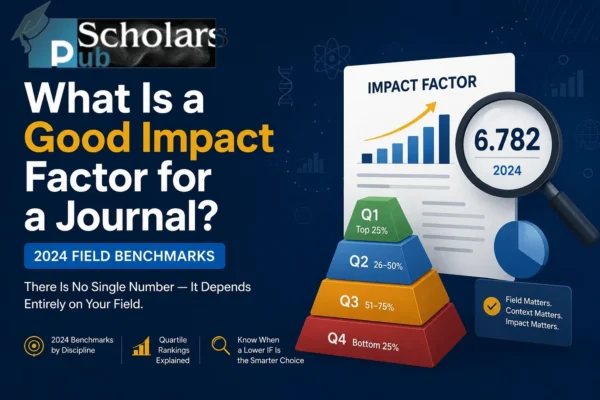
- Why “Good” Depends Entirely on Your Field
- Impact Factor Benchmarks by Discipline (2026)
- Quartile Rankings: The More Reliable Measure
- Why Quartile Matters More Than Raw IF
- What Is a Good Impact Factor in Biology?
- Molecular and Cell Biology
- Ecology and Environmental Biology
- Microbiology
- What Is a Good Impact Factor in Medicine and Clinical Research?
- What Is a Good Impact Factor in Chemistry?
- General Chemistry
- Analytical Chemistry
- Materials Science / Chemistry Interface
- What Is a Good Impact Factor in Physics?
- General Physics
- Astrophysics
- Condensed Matter / Materials Physics
- What Is a Good Impact Factor in Engineering?
- Biomedical Engineering
- Chemical Engineering
- Electrical and Electronic Engineering
- Civil and Mechanical Engineering
- What Is a Good Impact Factor in Social Sciences and Psychology?
- Psychology
- Economics
- Sociology and Political Science
- Education
- What Is a Good Impact Factor in Mathematics?
- How to Know If a Journal’s Impact Factor Is High Enough for You
- Step 1: Find the Journal’s Subject Category
- Step 2: Find Its Quartile
- Step 3: Compare to the Category Median
- Step 4: Match Your Paper’s Significance to the Journal’s Tier
- Step 5: Check Whether the IF Is Real
- When a Lower Impact Factor Is the Right Choice
- Frequently Asked Questions
- What is a good impact factor for a journal generally?
- What impact factor is considered good in biology?
- What is the average impact factor by discipline in 2026?
- How do I know if a journal impact factor is high enough?
- Is an impact factor of 1 good?
- Is an impact factor of 3 good?
- Is an impact factor of 5 good?
- Is an impact factor of 10 good?
- Can impact factor be too high to target?
- Conclusion
Quick answer: There is no single number that defines a “good” impact factor. A journal impact factor of 2.0 can represent the top 25% (Q1) of its field in mathematics, while the same score would rank in the bottom half of most biomedical categories. What matters is not the raw number — it is where that number sits relative to all other journals in the same subject category.
This guide gives you the 2026 field-by-field benchmarks, explains quartile rankings, and tells you exactly how to judge whether a journal’s impact factor is high enough for your discipline and career goals.
Why “Good” Depends Entirely on Your Field
Impact factors are a product of citation behaviour — and citation behaviour varies radically between academic disciplines. In molecular biology, a single landmark paper can attract thousands of citations within two years. In pure mathematics, an equally important proof may take a decade to accumulate the same number.
This happens because of structural differences between fields:
- Community size: Larger research communities generate more total citations, pushing average IFs higher
- Publication speed: Fast-moving fields (genomics, oncology) produce and cite papers rapidly; slower fields (geology, philosophy) do not
- Reference list length: A clinical medicine paper might cite 60 sources; a mathematics paper might cite 15
- Article type: Fields with many review articles have structurally higher IFs because reviews attract far more citations than original research
- Database coverage: Some fields are more completely indexed in Web of Science than others
These structural differences mean a raw impact factor number is meaningless without knowing which field it belongs to. An IF of 3.0 puts you in the top quartile in mathematics and the bottom half in immunology. This is the single most important thing to understand about benchmarking impact factors.
Impact Factor Benchmarks by Discipline (2026)
The table below shows approximate impact factor ranges across major research disciplines, based on 2026 Journal Citation Reports data. Use these as orientation guides — always verify specific journals by looking up their JCR quartile directly.
| Field | Low (Q3–Q4) | Average (Q2) | Good (Q1) | Elite (Top 10%) | Example top journals |
|---|---|---|---|---|---|
| Clinical Medicine | Below 3 | 3–8 | 8–25 | 25+ | NEJM (~130), The Lancet (~170), JAMA (~120) |
| Life Sciences / Biology | Below 2 | 2–6 | 6–18 | 18+ | Cell (~68), Nature Methods (~36) |
| Molecular Biology / Genetics | Below 3 | 3–8 | 8–20 | 20+ | Nature Genetics (~41), Genome Research (~7) |
| Neuroscience | Below 3 | 3–7 | 7–20 | 20+ | Nature Neuroscience (~20), Neuron (~18) |
| Immunology | Below 3 | 3–8 | 8–20 | 20+ | Nature Immunology (~30), Immunity (~32) |
| Chemistry | Below 2 | 2–6 | 6–15 | 15+ | Chemical Reviews (~52), JACS (~17) |
| Physics | Below 1.5 | 1.5–4 | 4–12 | 12+ | Reviews of Modern Physics (~45), PRL (~8) |
| Environmental Science | Below 2 | 2–5 | 5–12 | 12+ | Nature Climate Change (~36) |
| Engineering (general) | Below 2 | 2–5 | 5–10 | 10+ | Nature Energy (~56) |
| Biomedical Engineering | Below 3 | 3–7 | 7–15 | 15+ | Biomaterials (~14) |
| Computer Science | Below 2 | 2–5 | 5–10 | 10+ | IEEE T. Neural Networks (~14) |
| Psychology | Below 2 | 2–5 | 5–10 | 10+ | Psychological Bulletin (~18) |
| Social Sciences (general) | Below 1 | 1–3 | 3–7 | 7+ | Journal of Economic Perspectives (~10) |
| Economics | Below 1 | 1–3 | 3–7 | 7+ | American Economic Review (~7) |
| Mathematics | Below 0.8 | 0.8–2 | 2–4 | 4+ | Annals of Mathematics (~4) |
| Humanities | Rarely measured — monographs and book chapters dominate; JIF rarely used or meaningful |
Figures are approximate and based on JCR 2026 data. Individual journals fluctuate year to year. Always verify current values at scimago.org (free) or via your institution’s JCR access.
Quartile Rankings: The More Reliable Measure
Once you understand that raw IF numbers are field-relative, the next step is learning to use quartile rankings — which are the most practically useful tool for evaluating any journal.
Every journal indexed in the Journal Citation Reports is assigned a quartile within each of its subject categories:
| Quartile | What It Means | Who Targets It |
|---|---|---|
| Q1 | Top 25% of journals in the category | High-ambition submissions; tenure committees strongly prefer this |
| Q2 | 26–50% of journals | Solid, respected journals; widely acceptable for promotion |
| Q3 | 51–75% of journals | Average standing; acceptable for early-career output |
| Q4 | Bottom 25% of journals | Lower prestige; scrutinised in formal evaluations |
Why Quartile Matters More Than Raw IF
A journal with an IF of 1.8 that sits in Q1 of its mathematics category is a better publication venue — from a career standpoint — than a journal with an IF of 4.0 that sits in Q3 of its life sciences category. The quartile tells you the real story: where does this journal stand among its actual peers?
How to find any journal’s quartile for free: 1. Go to scimago.org 2. Search the journal by name or ISSN 3. Look at the quartile column for its primary subject category 4. Check the trend — is the journal moving up or down?
Most journals also display their current JCR quartile on their own “About” or “For Authors” page.
What Is a Good Impact Factor in Biology?
Biology is a broad field with significant internal variation. The benchmarks differ meaningfully between sub-disciplines.
Molecular and Cell Biology
This is one of the highest-citation environments in all of science. Papers spread rapidly through large, well-funded research communities and are cited extensively. A journal with an IF below 5 would be considered low in this space.
- Below 3: Low — limited reach or niche audience
- 3–8: Solid — respected specialist journals
- 8–18: Strong — leading field journals
- 18+: Elite — Cell (~68), Nature Cell Biology (~28), Molecular Cell (~18)
Ecology and Environmental Biology
Slower citation cycles and smaller communities bring IFs down significantly compared to molecular biology.
- Below 2: Low
- 2–5: Average for the field
- 5–10: Strong — top specialist journals
- 10+: Elite
Microbiology
- Below 3: Low
- 3–7: Solid
- 7–15: Strong
- 15+: Elite — Nature Microbiology (~20)
Key rule for biology: Compare within your specific sub-discipline, not biology as a whole. The IF of a top molecular biology journal has no relevance to what counts as “good” in evolutionary ecology.
What Is a Good Impact Factor in Medicine and Clinical Research?
Clinical medicine and biomedical research consistently produce the highest absolute impact factor scores of any discipline. This is driven by the enormous size of the global medical research community, the clinical urgency that drives rapid citation, and the breadth of readership that extends beyond academics to practising clinicians worldwide.
- Below 3: Low — limited reach within the medical community
- 3–8: Average — respectable specialist clinical journals
- 8–25: Good — well-regarded journals in most clinical specialties
- 25–60: Very high — top specialty journals (e.g., Gastroenterology ~33, JACC ~24)
- 60+: Exceptional — Cell class, flagship specialty journals (Blood ~25, Circulation ~37)
- 100+: Elite tier — NEJM (~130), The Lancet (~170), JAMA (~120), BMJ (~100)
Clinical medicine IF scores look dramatically higher than other fields because the same paper is cited by clinicians in practice, researchers in basic science, public health researchers, and policy analysts — a vastly broader citation pool than any other discipline.
Practical implication: A clinical journal with an IF of 6 might be completely solid and respected within a specialist area like geriatrics or ophthalmology, while the same score would be unremarkable in general internal medicine. Always check the JCR category, not just the overall medical field.
What Is a Good Impact Factor in Chemistry?
Chemistry spans a wide range of sub-disciplines, from theoretical and computational chemistry to materials science and synthetic organic chemistry. IF benchmarks vary across these areas.
General Chemistry
- Below 3: Low
- 3–7: Average — reputable specialist journals
- 7–15: Strong — leading disciplinary journals
- 15+: Elite — JACS (~17), Angewandte Chemie (~16), Nature Chemistry (~26)
Analytical Chemistry
- Below 2: Low
- 2–6: Average
- 6–10: Strong — Analytical Chemistry (~7.4)
- 10+: Elite
Materials Science / Chemistry Interface
Materials science journals that straddle chemistry and physics tend to have higher IFs because they draw citations from both communities.
- Advanced Materials (~27), ACS Nano (~17), Chemistry of Materials (~8)
Note on review journals: Chemical Reviews (~52) and Chemical Society Reviews (~40) have exceptional IFs because they publish authoritative review articles cited as reference texts across the entire field. Their IFs are not representative of original research chemistry journals and should not be used as benchmarks.
What Is a Good Impact Factor in Physics?
Physics is a lower-citation discipline than biology or medicine by structural default — reference lists are shorter, communities in specific subfields are smaller, and citation cycles are longer. Do not apply biology benchmarks here.
General Physics
- Below 2: Low
- 2–5: Average — solid field journals
- 5–12: Strong — Physical Review Letters (~8), Physical Review X (~14)
- 12+: Elite — Reviews of Modern Physics (~45), Nature Physics (~19)
Astrophysics
- Astrophysical Journal (~5.7), MNRAS (~5.3) — both Q1 and excellent journals despite “modest” IF numbers
Condensed Matter / Materials Physics
- npj Computational Materials (~9), Physical Review Materials (~4) — Q1 in their categories
Key point for physicists: An IF of 5 represents a genuinely strong journal in most physics subfields. Do not interpret low absolute numbers as low prestige when the field median is itself below 3.
What Is a Good Impact Factor in Engineering?
Engineering is broad — biomedical, chemical, civil, mechanical, electrical — and IF benchmarks differ considerably across these areas.
Biomedical Engineering
One of the higher-IF engineering categories because it draws citations from both engineering and clinical medicine communities. – Solid: 4–10 (Biomaterials ~14, Acta Biomaterialia ~9) – Elite: 10+ (Nature Biomedical Engineering ~27)
Chemical Engineering
- Solid: 4–8 (Chemical Engineering Journal ~16, AIChE Journal ~4)
- Elite: 8+ (Progress in Polymer Science ~22)
Electrical and Electronic Engineering
- Solid: 3–7 (IEEE Transactions on series: typically 3–10)
- Elite: 10+ (Nature Electronics ~33)
Civil and Mechanical Engineering
Lower citation rates than other engineering branches: – Solid: 2–5 (Structural Safety, Engineering Structures) – Elite: 5+
Engineering note: Conference proceedings in engineering (especially IEEE and ACM in computer science) carry significant weight as publications alongside journal papers — a distinction unique to this discipline. Evaluating an engineering publication record using only journal IFs misses a major component of the discipline’s output.
What Is a Good Impact Factor in Social Sciences and Psychology?
Social sciences have historically lower IFs than STEM fields — smaller research communities, longer citation half-lives, and the prominence of books as citation targets all reduce journal citation rates.
Psychology
Psychology has some of the highest IFs in the social sciences, partly because it straddles natural science and social science methodologies. – Solid: 3–7 – Strong: 7–12 — Psychological Medicine (~9), Journal of Abnormal Psychology (~5) – Elite: 12+ — Psychological Bulletin (~18), Perspectives on Psychological Science (~14)
Economics
- Solid: 2–5
- Strong: 5–8 — Journal of Finance (~6), American Economic Review (~7)
- Elite: 8+
Sociology and Political Science
- Solid: 1–3
- Strong: 3–5 — American Journal of Sociology (~5), World Politics (~3.5)
- Elite: 5+
Education
- Solid: 2–4
- Strong: 4–7 — Review of Educational Research (~11) is a notable outlier due to high-citation review articles
- Elite: 7+
What Is a Good Impact Factor in Mathematics?
Mathematics has the lowest impact factor benchmarks of any major scientific discipline — and this is not a reflection of the quality or importance of mathematical research. It reflects how mathematicians cite: sparingly, often citing books rather than journal articles, and with long citation cycles that frequently extend beyond the standard 2-year JIF window.
- Below 0.8: Low in most mathematical areas
- 0.8–2.0: Average — solid, reputable journals
- 2.0–3.5: Strong — leading journals in specific sub-disciplines
- 3.5+: Elite — Annals of Mathematics (~4), Inventiones Mathematicae (~3), Journal of the AMS (~3.9)
Critical reminder: Do not compare mathematics IFs to any other field. A mathematics journal with an IF of 1.5 can be a Q1 flagship journal. Anyone evaluating a mathematician’s publication record using unadjusted IF benchmarks from other fields is making a serious methodological error.
The 5-year impact factor is more meaningful in mathematics than the standard 2-year version, because important mathematical results are cited slowly but persistently for decades.
How to Know If a Journal’s Impact Factor Is High Enough for You
Here is a practical decision framework for determining whether a target journal’s IF is appropriate for your paper and your career stage:
Step 1: Find the Journal’s Subject Category
Every JCR-indexed journal is assigned to one or more subject categories. Look this up at scimago.org (free) or in JCR (institutional subscription). This tells you which journals you are actually being compared against.
Step 2: Find Its Quartile
- Q1: Actively target this. Strong preference from tenure committees and funding bodies.
- Q2: Solid choice. Widely accepted in most evaluation contexts.
- Q3–Q4: Acceptable for early-career researchers or specialist topics. Less competitive for promotion and grants.
Step 3: Compare to the Category Median
If the journal’s IF is above the median for its category, it is above-average for its field. If it is in the top 25%, it is Q1. These are more meaningful comparisons than any cross-field benchmark.
Step 4: Match Your Paper’s Significance to the Journal’s Tier
A paper that makes an incremental contribution to a specialised topic should not target a Q1 flagship journal — it will face near-certain desk rejection. A paper with genuinely broad significance should not be undersold in a Q3 journal. Honest self-assessment of your paper’s contribution is the most important factor in journal selection.
Step 5: Check Whether the IF Is Real
If a journal claims an impact factor but cannot be found in the Web of Science Master Journal List (mjl.clarivate.com), that IF is not legitimate. This is a common hallmark of predatory journals. Always verify before submitting.
When a Lower Impact Factor Is the Right Choice
Researchers sometimes assume they should always target the highest possible IF journal. This is a mistake in several common situations:
When scope fit matters more than prestige: A perfectly matched paper in a Q1 specialist journal with an IF of 3 will reach more of the right readers and accumulate more relevant citations than the same paper awkwardly placed in a Q1 generalist journal with an IF of 20. Mismatched placement consistently underperforms targeted placement.
When turnaround time is critical: High-IF flagship journals frequently have review cycles of 4–8 months and revision cycles of several more months. If you are approaching a job application deadline, a grant submission, or a thesis deposit date, a well-regarded journal with faster peer review may serve you better.
When your funder or institution mandates open access: Some high-IF journals offer only hybrid open access at very high APCs. A fully open-access Q1 journal at a lower IF may better serve your compliance requirements while reaching a broader readership.
When the paper type does not fit: High-IF flagship journals primarily publish papers of broad, field-changing significance. Methods papers, negative results, replication studies, and incremental findings are far more likely to be published in appropriate specialist journals — and will be read by more relevant researchers there.
When you are building a coherent research profile: A consistent record of Q1 and Q2 publications in your specialised area demonstrates deeper expertise than scattered high-IF publications outside your focus area.
Frequently Asked Questions
What is a good impact factor for a journal generally?
There is no universal answer. A good impact factor is one that places a journal in the top 50% — ideally top 25% (Q1) — of its specific subject category. In clinical medicine, an IF of 8 might represent average performance; in mathematics, an IF of 2 represents strong performance. Always benchmark within the discipline, not across all fields.
What impact factor is considered good in biology?
In molecular and cell biology, an IF above 6 is considered solid, above 10 is strong, and above 18 is elite. In ecology and environmental biology, benchmarks are significantly lower: above 3 is solid, above 6 is strong, and above 10 is elite. Sub-discipline matters enormously — always compare within your specific area of biology, not biology as a whole.
What is the average impact factor by discipline in 2026?
Based on 2026 JCR data, approximate category medians are: clinical medicine (3–5), life sciences (2–4), chemistry (2–4), physics (1.5–3), engineering (2–4), social sciences (1–2), mathematics (0.8–1.5). These are rough midpoints — the distribution within each category spans a very wide range above and below these figures.
How do I know if a journal impact factor is high enough?
Look up the journal’s quartile ranking in its JCR subject category at scimago.org. If it is Q1 (top 25%), the IF is high enough for most purposes. If it is Q2 (26–50%), it is solid. Whether that is “high enough” for your specific career goals depends on your institution’s promotion standards and your field’s norms.
Is an impact factor of 1 good?
It depends entirely on the field. In mathematics, an IF of 1 is roughly average. In humanities (where IF is rarely used), it would be exceptional. In molecular biology, it would be very low. In social sciences, it is below average but not disqualifying for specialist journals.
Is an impact factor of 3 good?
In most STEM fields, an IF of 3 is moderate — below average in high-citation fields like molecular biology or clinical medicine, but solid or even strong in physics, mathematics, social sciences, and engineering sub-disciplines. In Q1 terms, an IF of 3 represents Q1 standing in many mathematical and social science categories.
Is an impact factor of 5 good?
An IF of 5 is genuinely strong in most engineering, physics, computer science, and social science fields, where it typically represents Q1 standing. In life sciences and clinical medicine, an IF of 5 is average to moderate — solid, but not elite. Context is everything.
Is an impact factor of 10 good?
An IF of 10 is excellent in virtually every field. It represents Q1 standing across nearly all subject categories and places a journal in the top tier of its discipline in most cases. In absolute terms, a journal with an IF of 10 is a high-quality, respected publication regardless of field — though in clinical medicine the very top journals reach 100+.
Can impact factor be too high to target?
Not inherently — but journals with very high IFs (above 20–30) typically have acceptance rates of 5–10% and require research of broad, field-transforming significance. Targeting them with incremental or specialist work leads to predictable desk rejection and wasted months of submission time. Target the highest IF journal for which your paper’s significance is genuinely competitive.
Conclusion
The question “what is a good impact factor for a journal?” has only one correct first answer: it depends on the field. Once you understand that impact factors are structurally determined by citation culture, community size, and publication norms — none of which reflect research quality — you can use them effectively as one tool among several.
The most practical approach for any researcher:
- Identify your journal’s subject category in JCR or SCImago
- Find its quartile — this is the most field-neutral quality signal available
- Compare its IF to the category median — above median means above average for your field
- Choose based on scope fit and significance match, not maximum IF
A Q1 journal in your exact field, regardless of what its IF number looks like to outsiders, is the right target for strong work in that area. Use the field benchmarks in this guide to calibrate your expectations — and use the quartile to make your final decision.

I am a seasoned professional with over 9 years of transformative experience in the domains of molecular biology, immunology, and clinical research. With a career that spans from 2006 to 2018, my journey has been marked by a relentless pursuit of scientific excellence and an unwavering commitment to improving healthcare outcomes through groundbreaking research. I have worked at one of India’s premier medical institutions, AIIMS(All India Institute of Medical Sciences), where I contributed significantly to the fields of molecular biology and clinical research. My expertise in protein analysis and genetic studies allowed me to identify potential biomarkers and improve diagnostic accuracy, contributing to better healthcare outcomes for patients. Notably, the research work has been published in prestigious scientific journals such as the Indian Journal of Ophthalmology and the British Journal of Ophthalmology.
Publication in these esteemed journals reflects my commitment to advancing medical science and sharing insights with the global research community. These publications highlight my expertise in areas ranging from gene polymorphism and immune response mechanisms to the effects of chronic drug therapy, all contributing to the larger body of scientific knowledge. My passion for scientific communication led me to pursue an Executive Diploma in Medical Writing from CliMed Research Solutions and Curio Training and Research Institute (CTRI), India. This certification has further refined my ability to bridge the gap between complex scientific research and its practical applications in healthcare. My passion for content writing drives me to continuously create content that derives engagement ,build trust, and leaves a lasting impression on readers”.