

- What Is Journal Impact Factor?
- How Is Journal Impact Factor Calculated?
- Step-by-Step Worked Example
- What Counts as a “Citable Article”?
- Who Calculates It — and How Often?
- What Is a Good Impact Factor? (Field-by-Field Benchmark Table)
- Impact Factor Benchmarks by Discipline
- Quartile Rankings: The More Practical Benchmark
- The 2-Year vs 5-Year Impact Factor: Which to Use
- Side-by-Side Comparison
- When the 5-Year IF Is More Meaningful
- Why Impact Factor Matters for Researchers
- Tenure and Promotion
- Grant Applications
- Research Visibility and Citation Growth
- Institutional and University Rankings
- Journal Selection
- Impact Factor vs CiteScore vs SJR: Side-by-Side Comparison
- Which Should You Use?
- The Biggest Criticisms of Impact Factor
- It Is a Mean Applied to a Skewed Distribution
- It Systematically Advantages Certain Fields
- It Rewards Review Articles Disproportionately
- It Can Be Gamed
- It Penalises New and Emerging Journals
- The DORA and Leiden Manifesto Response
- How to Find a Journal’s Impact Factor for Free
- How to Look Up a Journal’s Standing in 3 Minutes (Free Method)
- How to Use Impact Factor Wisely in Your Career
- Submitting Papers: Build a Tiered Strategy
- Grant Applications
- Tenure and Promotion Portfolios
- When NOT to Use Impact Factor
- Frequently Asked Questions
- What is journal impact factor in simple terms?
- What is considered a good journal impact factor?
- How is journal impact factor calculated step by step?
- Who calculates and publishes the official impact factor?
- Does a high impact factor mean a paper is high quality?
- What is the difference between impact factor and CiteScore?
- Can impact factor be faked?
- How can I find a journal’s impact factor for free?
- Conclusion
- Related Articles on the PubScholars Blog
- References and Further Reading
Quick answer: The journal impact factor (JIF) is the average number of times articles published in a journal over the past two years were cited in the current year. Calculated annually by Clarivate Analytics, it is the most widely used — and most widely misunderstood — measure of a journal’s influence in academic publishing.
What Is Journal Impact Factor?
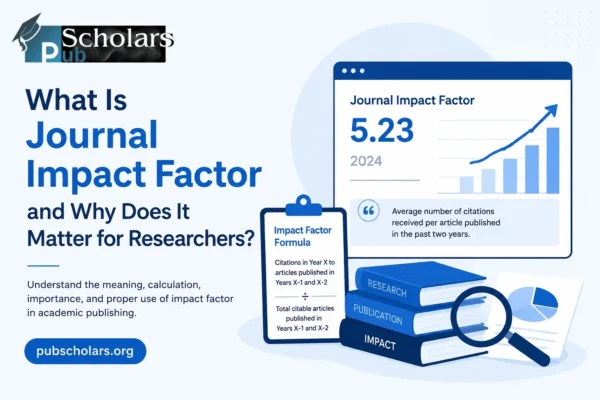
The journal impact factor (JIF) is a bibliometric index that reflects the average number of citations received per citable article published in a journal during the preceding two years. It is calculated and published once per year by Clarivate Analytics through the Journal Citation Reports (JCR), typically released each June.
The metric was created by Eugene Garfield, founder of the Institute for Scientific Information (ISI), in the 1960s. Its original purpose was modest: to help university librarians decide which journals were worth the subscription cost. Within a few decades, it had become one of the most consequential numbers in academic science — embedded in hiring processes, grant reviews, tenure decisions, and the daily publishing choices of millions of researchers.
In plain terms: if a journal has an impact factor of 5.0, it means that, on average, every article published in that journal during the previous two years was cited five times in the year being measured.
Three facts are essential to understand before using this metric:
- It is a journal-level metric, not an article-level or author-level metric
- It is field-dependent — a score of 2.0 can be outstanding in mathematics and unremarkable in molecular biology
- It is a mean value applied to a skewed distribution — a small number of highly cited papers can inflate the average for an entire journal
How Is Journal Impact Factor Calculated?
The formula is:
JIF (Year X) = Total citations in Year X to articles published in Years X−1 and X−2 ÷ Total citable articles published in Years X−1 and X−2
Step-by-Step Worked Example
Let us calculate the 2025 impact factor for a hypothetical journal:
| Data point | Value |
|---|---|
| Articles published in 2023 | 90 |
| Articles published in 2024 | 110 |
| Total citable articles (denominator) | 200 |
| Citations received in 2025 to those 200 articles | 1,000 |
| 2025 Impact Factor | 1,000 ÷ 200 = 5.0 |
What Counts as a “Citable Article”?
Not all content a journal publishes is treated equally in the formula:
Included in the denominator:
- Original research articles
- Review articles
Excluded from the denominator (but citations to these count in the numerator):
- Editorials
- Letters to the editor
- News items
- Corrections and errata
- Conference abstracts
This asymmetry matters. If a journal publishes heavily cited editorials, those citations increase the numerator without adding to the denominator — artificially raising the IF. This is one of the known avenues for gaming the metric.
Who Calculates It — and How Often?
Only Clarivate Analytics publishes the official JIF, through the Journal Citation Reports (JCR), updated annually in June. Only journals indexed in the Web of Science Core Collection or the Emerging Sources Citation Index (ESCI) receive an official impact factor.
Any impact factor displayed by a journal not indexed in these databases is self-reported, unverified, and not a legitimate JIF. This is a common red flag for predatory journals.
What Is a Good Impact Factor? (Field-by-Field Benchmark Table)
The most common mistake researchers make is comparing impact factors across disciplines. An IF of 3.0 is excellent in mathematics and mediocre in cell biology. Always benchmark within your field.
Impact Factor Benchmarks by Discipline
| Field | Average IF | Strong IF | Excellent IF | Example top journals |
|---|---|---|---|---|
| Clinical Medicine | 2–5 | 5–20 | 20+ | NEJM (~100), The Lancet (~170), JAMA (~120) |
| Life Sciences / Biology | 2–5 | 5–15 | 15+ | Cell (~68), Nature Genetics (~41) |
| Chemistry | 2–4 | 4–10 | 10+ | Chemical Reviews (~52), JACS (~17) |
| Physics | 1–3 | 3–10 | 10+ | Reviews of Modern Physics (~45) |
| Neuroscience | 3–6 | 6–15 | 15+ | Nature Neuroscience (~25), Neuron (~18) |
| Environmental Science | 2–4 | 4–10 | 10+ | Nature Climate Change (~36) |
| Engineering | 1–3 | 3–6 | 6+ | Nature Energy (~56) |
| Social Sciences | 1–3 | 3–6 | 6+ | Psychological Bulletin (~18) |
| Mathematics | 0.5–1.5 | 1.5–3 | 3+ | Annals of Mathematics (~4) |
| Humanities | Rarely measured — monographs dominate |
Note: IF figures are approximate and fluctuate annually. Always check the current year’s JCR for exact values.
Quartile Rankings: The More Practical Benchmark
Raw IF numbers are less meaningful than quartile rankings. JCR assigns every indexed journal a quartile within each of its subject categories:
- Q1: Top 25% — highly prestigious within the field
- Q2: 26–50% — solid, well-respected
- Q3: 51–75% — average standing
- Q4: Bottom 25% — lower prestige
A Q1 journal in mathematics with an IF of 1.8 carries equal prestige signals to a Q1 journal in oncology with an IF of 18. The quartile is the apples-to-apples comparison across fields. When presenting your publication record in grant applications or tenure portfolios, always cite the quartile alongside the raw IF.
The 2-Year vs 5-Year Impact Factor: Which to Use
Clarivate publishes two versions of the impact factor. Understanding the difference helps you choose the right benchmark for your field.
Side-by-Side Comparison
| Feature | Standard 2-Year IF | 5-Year IF |
|---|---|---|
| Citation window | Articles from the 2 preceding years | Articles from the 5 preceding years |
| Best suited for | Fast-citation fields (biomedicine, cell biology) | Slow-citation fields (mathematics, ecology, social sciences) |
| Stability | Fluctuates more year to year | More stable — less affected by single hot papers |
| Susceptibility to gaming | Higher | Lower |
| Availability | Standard JCR | Also available in JCR |
When the 5-Year IF Is More Meaningful
In fields where important papers take years to be read, cited, and built upon, the standard 2-year window systematically underestimates a journal’s true influence. The 5-year IF is more appropriate for:
- Mathematics and theoretical physics — proofs and frameworks accumulate citations slowly but persistently for decades
- Geology and earth sciences — long field campaigns mean longer publication cycles
- Ecology and environmental science — long-term dataset papers are cited incrementally over years
- Social sciences — books often dominate, and journal articles mature slowly
- Engineering subfields — methods and standards papers have long citation lives
In contrast, for molecular biology, genomics, and clinical medicine — where research is fast-moving and papers either get cited quickly or not at all — the 2-year IF is generally the more appropriate benchmark.
Why Impact Factor Matters for Researchers
Tenure and Promotion
A 2019 review study found that 40% of US and Canadian universities explicitly mention JIF in formal promotion and tenure review documentation. Despite the DORA declaration, impact factor remains embedded in evaluation processes at most research institutions worldwide. Publishing in a high-IF journal signals to non-specialist committee members that your work cleared a rigorous peer-review standard.
Grant Applications
National funders including NIH, UKRI, the European Research Council, and most national research councils ask applicants to list publications alongside journal impact factors. Reviewers who are not specialists in your subfield use IF as a rapid quality signal. In highly competitive funding environments, this shorthand meaningfully affects outcomes.
Research Visibility and Citation Growth
High-IF journals reach larger, more engaged readerships. Publication there increases the probability that your work is read, discussed, and cited — which builds your h-index and total citation count, both of which feed back into subsequent career evaluations.
Institutional and University Rankings
Global university rankings — QS, Times Higher Education, Shanghai Academic Ranking — incorporate research output metrics that correlate with faculty publication quality. Universities therefore have systemic incentives to encourage high-IF publication, which creates institutional pressure on researchers regardless of their personal views on the metric.
Journal Selection
For researchers choosing where to submit, a journal’s IF is a practical, widely accepted proxy for its standing in the field. Even researchers who are critical of the metric use it in their submission strategy.
Impact Factor vs CiteScore vs SJR: Side-by-Side Comparison
Impact factor is not the only measure of journal influence. Three major metrics are in widespread use, and understanding how they differ helps you choose the right tool for each purpose.
| Feature | Impact Factor (JIF) | CiteScore | SCImago Journal Rank (SJR) |
|---|---|---|---|
| Published by | Clarivate Analytics | Elsevier (Scopus) | SCImago Lab (Scopus data) |
| Citation window | 2 years | 4 years | 3 years |
| Document types counted | Articles and reviews only | All document types | Articles and reviews |
| Self-citations | Included | Included | Excluded |
| Citation weighting | All citations equal | All citations equal | Weighted by source prestige |
| Cost to access | JCR subscription | Free | Free |
| Journal coverage | ~21,000 | ~27,000 | ~27,000 |
| Published since | 1975 | 2016 | 1999 |
Which Should You Use?
For tenure and promotion packages: JIF — universally recognised by committees, even where other metrics are not.
For journal discovery and shortlisting: CiteScore or SJR — free, broader journal coverage, no subscription needed.
For cross-disciplinary comparisons: SJR — its prestige-weighted approach partially corrects for the citation culture differences between fields.
Best practice: Check all three. Consistent high standing across JIF, CiteScore, and SJR provides strong independent confirmation of a journal’s quality. Significant divergence between metrics is a signal to investigate the journal’s publication practices more carefully.
The Biggest Criticisms of Impact Factor
The research community’s relationship with impact factor is complicated. It is simultaneously one of the most useful shorthand tools in publishing decisions and one of the most widely criticised metrics in science policy. Every researcher should understand both sides.
It Is a Mean Applied to a Skewed Distribution
This is the fundamental statistical problem. Citation distributions within journals are extreme — the top 20% of papers in most high-IF journals account for 80% or more of total citations. The arithmetic mean of such a distribution is a poor representative statistic. It conceals the reality that most papers in even prestigious journals receive modest citation counts.
It Systematically Advantages Certain Fields
Fields with large research communities, short reference lists, and rapid publication cycles generate more citations and therefore higher IFs. This makes direct comparison between, say, a clinical medicine journal and a mathematics journal meaningless — they operate in completely different citation ecosystems.
It Rewards Review Articles Disproportionately
Review articles synthesise entire bodies of literature and attract citations from researchers across the field for years. Journals that publish more reviews structurally achieve higher IFs. This creates an incentive for journals to shift their publication mix toward reviews — a distortion of what a healthy research journal should look like.
It Can Be Gamed
Documented manipulation strategies include:
- Coercive self-citation: editors pressuring submitting authors to cite other articles in the same journal, inflating the numerator
- Citation stacking: coordinated mutual citation rings between a group of journals
- Document type misclassification: categorising editorial-type content as non-citable while benefiting from its citations in the numerator
Clarivate monitors citation patterns and can suppress a journal’s IF in the annual JCR release if manipulation is detected — an effective but imperfect deterrent.
It Penalises New and Emerging Journals
A journal cannot receive an official JIF until it has been indexed in Web of Science for at least two full years. This creates a structural disadvantage for new, potentially excellent journals regardless of the quality of their content.
The DORA and Leiden Manifesto Response
The San Francisco Declaration on Research Assessment (DORA), signed in 2012 by thousands of researchers and institutions, specifically calls for an end to using JIF as a proxy for individual research quality. The Leiden Manifesto (2015) offers ten principles for responsible use of research metrics. The Coalition for Advancing Research Assessment (CoARA), launched in 2022, represents over 700 institutions committed to reforming evaluation practices.
Despite this momentum, change in actual practice has been slow. JIF remains embedded in formal evaluation processes at most universities and funding bodies.
How to Find a Journal’s Impact Factor for Free
You do not need a paid subscription to research most journal metrics. Here are the most useful tools:
| Tool | Website | Cost | What you can find |
|---|---|---|---|
| SCImago Journal Rank | scimago.org | Free | SJR score, quartile, h-index, subject category, trends |
| Eigenfactor | eigenfactor.org | Free | Eigenfactor Score, Article Influence Score |
| Web of Science Master Journal List | mjl.clarivate.com | Free | Confirms whether a journal is WoS-indexed (verifies legitimate IF) |
| Think. Check. Submit. | thinkchecksubmit.org | Free | Full journal legitimacy checklist |
| Journal Citation Reports (JCR) | via Clarivate | Institutional subscription | Official JIF, 5-year IF, quartile, citation data |
| Scopus Sources | scopus.com | Institutional subscription | CiteScore, SJR, SNIP |
How to Look Up a Journal’s Standing in 3 Minutes (Free Method)
- Go to scimago.org
- Use the search bar to enter the journal name or ISSN
- View the SJR score, quartile ranking (Q1–Q4), and the subject categories the journal belongs to
- Check historical trend charts to see whether the journal’s ranking is rising, stable, or declining
- Cross-reference with the journal’s own website — most journals display their JCR-published IF in the “About” or “For Authors” section
To verify that a journal’s claimed impact factor is legitimate (and not a fake metric used by predatory journals), search for it at mjl.clarivate.com. If the journal does not appear there, it has no official JIF.
How to Use Impact Factor Wisely in Your Career
Submitting Papers: Build a Tiered Strategy
- Compare within your field only. Never use raw IF numbers to rank journals across disciplines.
- Use quartile as your primary filter, raw IF as a secondary reference. Q1 in your field is always the target — regardless of what the number looks like.
- Match your paper’s significance to the journal tier. Incremental findings in top-tier journals face near-certain desk rejection. Genuinely novel contributions in mid-tier journals get undersold. Be honest about where your work sits.
- Factor in acceptance rates. Journals with IF above 30 typically accept 5–10% of submissions. IF 5–10 journals accept 20–35%. IF 2–5 journals accept 30–55%.
- Build a submission waterfall. Have your top-choice, primary target, fallback, and safety journals identified before you submit anywhere — so rejection triggers immediate resubmission without wasted time.
Grant Applications
- List each journal’s IF in parentheses after the citation: Journal Name (IF: 8.4, Q1 in [Category])
- For journals with lower absolute IF but strong field standing, add a brief note: “the leading specialist journal in [subfield], Q1 in JCR [Category]”
- Never cite raw IF across fields as if the numbers were comparable
Tenure and Promotion Portfolios
- Report your personal h-index and total citation count alongside journal IFs — specify the database (Google Scholar gives higher counts than Scopus or Web of Science; committee members need to know which you are citing)
- Write a short research narrative explaining the arc and significance of your publication record, not just the numbers
- Highlight any papers cited in clinical guidelines, policy documents, or high-profile reviews — these demonstrate real-world impact that IF alone cannot capture
When NOT to Use Impact Factor
- Do not use IF to judge the quality of an individual paper you are reading or reviewing
- Do not use IF to compare journals across completely different disciplines
- Do not submit to a journal solely because its IF is the highest you can target — always verify scope fit first
Frequently Asked Questions
What is journal impact factor in simple terms?
Journal impact factor is a number that shows, on average, how many times articles in a journal were cited by other researchers. A journal with an impact factor of 5 means its recent articles were cited approximately 5 times each, on average, in the year being measured. It gives a rough indication of how influential a journal is within its field.
What is considered a good journal impact factor?
A good impact factor is one that is high relative to other journals in the same subject category — not high in absolute terms. In life sciences, an IF above 5 is generally strong. In physics, above 3. In mathematics, above 1.5. The quartile ranking (Q1 = top 25% of journals in the category) is a more reliable cross-disciplinary guide than the raw number.
How is journal impact factor calculated step by step?
Divide the total number of citations received in the current year to articles published in the two previous years by the total number of citable articles published in those two years. For example: if a journal published 200 articles in 2023 and 2024, and those articles were collectively cited 1,000 times in 2025, the 2025 impact factor is 1,000 ÷ 200 = 5.0. Only Clarivate Analytics performs this calculation officially, publishing results each June.
Who calculates and publishes the official impact factor?
Clarivate Analytics is the sole authority that calculates and publishes the official Journal Impact Factor, through the Journal Citation Reports (JCR). Only journals indexed in the Web of Science Core Collection or the Emerging Sources Citation Index receive an official JIF. Any impact factor claimed by a journal not listed there is not a legitimate JIF.
Does a high impact factor mean a paper is high quality?
No. Impact factor is a journal-level average. It tells you nothing about any individual paper. A paper in a high-IF journal may receive very few citations, while a transformative paper in a lower-IF specialist journal may become one of the most cited works in its field. Use article-level citation counts and expert peer assessment to evaluate individual papers, not the journal’s IF.
What is the difference between impact factor and CiteScore?
Impact factor is published by Clarivate using Web of Science data and a 2-year citation window. CiteScore is published by Elsevier using Scopus data and a 4-year citation window. CiteScore is free to access and counts all document types in its denominator; IF requires a JCR subscription and counts only articles and reviews. Both measure journal influence through citations but use different methodologies and will sometimes rank journals differently.
Can impact factor be faked?
Yes. Known tactics include coercive self-citation (editors pressuring authors to cite the journal’s own articles), coordinated citation stacking between a group of journals, and misclassification of document types. Clarivate monitors for anomalous citation patterns and can suppress a journal’s IF if manipulation is detected. Any impact factor claimed by a journal not indexed in Web of Science is not an official JIF and should be treated with scepticism.
How can I find a journal’s impact factor for free?
The best free starting point is scimago.org, which lists SJR scores and quartile rankings for over 27,000 journals. Most journals also display their JCR-published impact factor on their own website under “About the Journal” or “For Authors.” To verify a journal is legitimately indexed, search for it at mjl.clarivate.com — the official Web of Science Master Journal List.
Conclusion
The journal impact factor is one of the most consequential numbers in academic research — and one that every researcher encounters, relies on, debates, and sometimes resents throughout their career.
Used wisely — within its disciplinary context, alongside quartile rankings and complementary metrics like CiteScore and SJR, and always combined with qualitative judgements about scope fit and audience — it provides genuine practical value for choosing journals, building grant applications, and structuring tenure portfolios.
Used carelessly — as an absolute number compared across fields, or as a proxy for individual paper quality — it misleads and distorts the evaluation of research.
The researchers who build the strongest long-term careers are not necessarily those who chase the highest IF at every submission. They are those who understand what the metric measures, where it has real value, where it falls short, and how to communicate their publication record compellingly to the committees and agencies that evaluate them.
Related Articles on the PubScholars Blog
- What Is a Good Impact Factor for a Journal? Field-by-Field Benchmarks
- How Is Journal Impact Factor Calculated? Step-by-Step Formula and Examples
- Impact Factor vs CiteScore: Which Metric Should You Use?
- Which Journals Have the Highest Impact Factor in 2026?
- Does Impact Factor Affect Manuscript Acceptance Chances?
References and Further Reading
- Garfield, E. (1972). Citation analysis as a tool in journal evaluation. Science, 178(4060), 471–479. https://doi.org/10.1126/science.178.4060.471
- Clarivate Analytics. (2025). Journal Citation Reports methodology. clarivate.com/academia-government/essays/impact-factor/
- San Francisco Declaration on Research Assessment (DORA). (2012). sfdora.org
- Hicks, D., Wouters, P., Waltman, L., de Rijcke, S., & Rafols, I. (2015). The Leiden Manifesto for research metrics. Nature, 520, 429–431. https://doi.org/10.1038/520429a
- Seglen, P. O. (1997). Why the impact factor of journals should not be used for evaluating research. BMJ, 314(7079), 498–502. https://doi.org/10.1136/bmj.314.7079.497
Last updated: May 2026. Reviewed by the PubScholars editorial team.

I am a seasoned professional with over 9 years of transformative experience in the domains of molecular biology, immunology, and clinical research. With a career that spans from 2006 to 2018, my journey has been marked by a relentless pursuit of scientific excellence and an unwavering commitment to improving healthcare outcomes through groundbreaking research. I have worked at one of India’s premier medical institutions, AIIMS(All India Institute of Medical Sciences), where I contributed significantly to the fields of molecular biology and clinical research. My expertise in protein analysis and genetic studies allowed me to identify potential biomarkers and improve diagnostic accuracy, contributing to better healthcare outcomes for patients. Notably, the research work has been published in prestigious scientific journals such as the Indian Journal of Ophthalmology and the British Journal of Ophthalmology.
Publication in these esteemed journals reflects my commitment to advancing medical science and sharing insights with the global research community. These publications highlight my expertise in areas ranging from gene polymorphism and immune response mechanisms to the effects of chronic drug therapy, all contributing to the larger body of scientific knowledge. My passion for scientific communication led me to pursue an Executive Diploma in Medical Writing from CliMed Research Solutions and Curio Training and Research Institute (CTRI), India. This certification has further refined my ability to bridge the gap between complex scientific research and its practical applications in healthcare. My passion for content writing drives me to continuously create content that derives engagement ,build trust, and leaves a lasting impression on readers”.

