- The General Relationship: IF and Acceptance Rates
- Approximate Acceptance Rates by IF Tier
- Why High-IF Journals Have Lower Acceptance Rates
- What Drives Acceptance at High-IF Journals: Checklist
- How Review Cycles Vary by IF Tier
- Field-Specific Acceptance Rate Context
- Strategic Implications: How to Build a Smarter Submission Strategy
- Strategy 1: Match Paper Significance to Journal Tier
- Strategy 2: Account for Time Costs in Your Career Planning
- Strategy 3: Use Cascade Submission Services
- Strategy 4: Write for the Target Audience From the Start
- Strategy 5: Build a Submission Waterfall
- What Rejection From a High-IF Journal Actually Means
- Frequently Asked Questions
- Does a higher impact factor always mean lower acceptance rates?
- What is Nature’s acceptance rate?
- Does submitting to a high-IF journal improve my chances of getting cited?
- How long does peer review take at high-IF journals?
- Does a higher IF always mean stricter peer review?
- What causes desk rejection at high-IF journals?
- Does impact factor predict my paper’s eventual citation count?
- Useful guides for researchers choosing journals
- Conclusion
The intuition seems obvious: a higher impact factor means stricter standards, which means lower acceptance rates. But the relationship between IF and manuscript acceptance is more nuanced than this simple assumption, and misunderstanding it leads researchers to make systematic submission strategy errors — wasting months on predictable rejections or underselling work that deserved a better home.
This guide explains the real relationship between IF and acceptance rates, why the drivers of rejection at high-IF journals are often misunderstood, and how to build a submission strategy that maximises both your chances of acceptance and the visibility of your published work.
The General Relationship: IF and Acceptance Rates
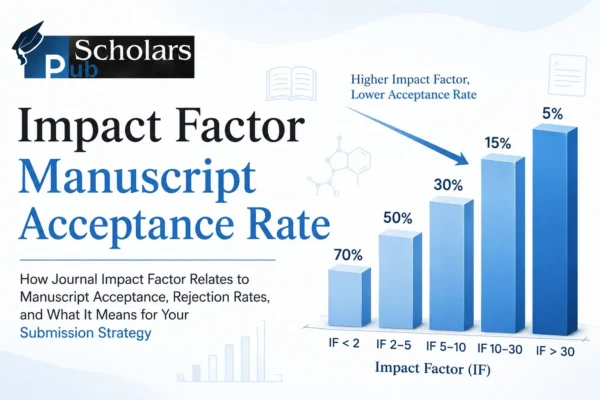
There is a broadly positive correlation between a journal’s impact factor and its rejection rate. High-IF journals receive more submissions and publish fewer papers as a proportion of those submissions.
Approximate Acceptance Rates by IF Tier
| IF Range | Typical Acceptance Rate | Reason |
|---|---|---|
| Above 30 | 5–10% | Extreme volume + high significance bar |
| 10–30 | 10–20% | High volume + strong significance bar |
| 5–10 | 20–35% | Moderate volume + solid standards |
| 2–5 | 30–55% | Lower volume + technical correctness sufficient |
| Below 2 | 50–80% | Limited submissions + specialist audience |
These are approximate estimates across fields. Acceptance rates vary significantly even within IF tiers. A Q1 specialist journal with IF 5 may have a lower acceptance rate than a Q2 generalist journal with IF 8 simply because the specialist journal attracts a more targeted audience of highly competitive submissions.
Why High-IF Journals Have Lower Acceptance Rates
Several distinct factors combine to create low acceptance rates at high-IF journals. Understanding which factor dominates helps you calibrate your submission decisions.
Factor 1: Volume of Submissions
Prestigious journals attract submissions far out of proportion to their publication capacity. Nature reportedly receives more than 10,000 manuscripts annually and publishes fewer than 1,000. Science and The Lancet operate at similar scales.
This volume alone creates competition independent of quality. Even genuinely excellent papers compete against other excellent papers, and many are rejected not because they are poor but because they face fierce competition for limited pages.
Factor 2: The Significance Bar — the Most Important Factor
High-IF journals do not simply seek technically correct research. They seek research of broad significance that will interest a wide readership and generate many citations. This is a fundamentally different evaluation criterion from technical quality, and it disqualifies most manuscripts not because of their quality but because of their scope.
This distinction matters enormously for submission strategy. A technically flawless study of a highly specific mechanism in a rare cell type is not rejected because it is bad — it is rejected because it is not of sufficient interest to Nature’s broad readership. That same paper is exactly right for a Q1 specialist journal in its field.
Factor 3: Desk Rejection Rates
A large proportion of rejections at high-IF journals happen before peer review begins. Estimates suggest that Nature and Science desk-reject approximately 60–70% of submissions — meaning only 30–40% of manuscripts even reach external reviewers.
Editors performing desk review are assessing:
- Does this paper have findings of broad significance to our readership?
- Would our readers find this compelling enough to read?
- Is this within our scope?
Desk rejection is not a quality judgment. It is a significance and fit judgment. This is why papers desk-rejected by Nature are routinely published in excellent specialist journals and go on to be highly cited.
Factor 4: Higher Reviewer Expectations
Peer reviewers at high-IF journals tend to be senior, highly accomplished scientists with correspondingly high standards. They are more likely to identify minor methodological limitations, request additional experiments, or recommend rejection for papers that would pass at other journals.
The combination of reviewer excellence and high competition means the bar for acceptance is genuinely higher — both for significance and for execution.
What Drives Acceptance at High-IF Journals: Checklist
Before submitting to a high-IF generalist journal, assess your paper against these criteria:
Significance criteria (most important)
- Does your finding matter beyond your specific field or subfield?
- Would a biologist find your chemistry paper interesting? Would a neuroscientist find your genetics paper compelling?
- Does your finding challenge or substantially advance a widely held assumption?
- Would a non-specialist editor’s eyes light up reading your abstract?
Technical criteria
- Is your methodology rigorous and fully reported?
- Are your statistical approaches appropriate and correctly applied?
- Do your conclusions follow proportionately from your data — no overclaiming?
- Are controls comprehensive and clearly described?
Presentation criteria
- Is your abstract compelling and understandable to a broad scientific audience?
- Does your introduction establish the broad importance before drilling into specifics?
- Are your figures self-explanatory and publication-ready?
How Review Cycles Vary by IF Tier
One dimension of the IF-acceptance relationship that often surprises researchers is the variation in total timeline across tiers.
| IF Tier | Typical first decision | Typical total time to acceptance |
|---|---|---|
| Above 20 (elite) | 6–16 weeks | 12–24+ months (with revisions) |
| 10–20 (flagship specialist) | 6–12 weeks | 8–18 months |
| 5–10 (strong specialist) | 4–10 weeks | 6–14 months |
| 2–5 (solid mid-tier) | 4–8 weeks | 4–10 months |
| Below 2 | 3–6 weeks | 3–8 months |
For early-career researchers with concrete career milestones approaching — a job market cycle, thesis deposit deadline, or grant renewal — this timeline difference has real consequences. A strategy that involves two failed attempts at high-IF journals before a successful Q1 specialist submission can cost 12–18 months of calendar time, which can matter enormously at critical career junctures.
Field-Specific Acceptance Rate Context
Acceptance rates vary significantly across disciplines even at comparable IF levels.
Biomedical and life sciences: Some of the lowest acceptance rates in academia. Nature, Science, Cell, Nature Medicine all have acceptance rates below 10%. Q1 specialist journals in this space typically accept 15–25%.
Physical sciences: Slightly higher acceptance rates at comparable IF levels. Physical Review Letters accepts approximately 30% of submissions. The higher rates reflect the more technical, less interpretive nature of physics results.
Social sciences and humanities: Higher acceptance rates at high-quality journals. Even top psychology journals may accept 20–30% of submissions.
Engineering: Conference papers carry significant weight alongside journal papers. Journal acceptance rates vary but are generally higher than in life sciences at comparable IF levels.
Strategic Implications: How to Build a Smarter Submission Strategy
Strategy 1: Match Paper Significance to Journal Tier
The most common submission strategy error is targeting journals at the wrong significance tier. Incremental findings in flagship journals face near-certain desk rejection; field-changing findings in low-tier journals get undersold.
Ask honestly: Does my finding matter to researchers outside my immediate subfield? If yes to a broad audience, target high-IF generalist journals. If yes only within your field, target Q1 specialist journals in your area. If mainly incremental within a specialised context, target Q2 specialist journals.
Strategy 2: Account for Time Costs in Your Career Planning
A rejection from a high-IF journal after full peer review (3–6 months) plus a subsequent revision cycle at another journal can cost you 9–12 months of publishing time. For early-career researchers facing job market timelines or funding deadline pressure, this delay has real career costs.
Calculate the expected time cost of your submission strategy against the prestige benefit before committing.
Strategy 3: Use Cascade Submission Services
Many publishers now offer cascade submission — if your paper is rejected at their flagship journal, it is offered to a sister journal at a lower IF tier with your reviewer reports transferred. This preserves reviewer reports and saves time. Springer Nature, Wiley, and Elsevier all offer cascade systems between their journals.
Strategy 4: Write for the Target Audience From the Start
Papers targeting high-IF generalist journals need to be written for a broad scientific audience, not just specialists. Your introduction must establish broad significance before drilling into specifics. Your abstract must be compelling to a non-specialist editor. This requires a different writing approach than papers targeting specialist journals — and it pays to make this decision before writing, not after.
Strategy 5: Build a Submission Waterfall
Before submitting anywhere, rank your target journals:
- Aspirational: highest-IF journal for which your paper has genuine merit
- Primary target: best-fit Q1 specialist journal in your field
- Fallback: strong Q2 journal with perfect scope fit
- Safety: Q2–Q3 journal where acceptance is reasonably certain
If rejected at level 1, revise based on any feedback and move to level 2. This prevents the trap of endlessly resubmitting to unsuitable journals.
What Rejection From a High-IF Journal Actually Means
Rejection from Nature, Science, or any high-IF generalist journal does not mean your paper is poor quality. It most commonly means one of three things:
- Scope or significance mismatch: Your work is excellent but too specialised for their broad readership
- Competition in a peak submission period: Your paper was strong but others in the same cycle were stronger
- Missing a piece of evidence: The editors or reviewers want one more experiment that would make the significance clearer
The appropriate response depends on which type of rejection you received. A desk rejection based on scope requires only a change of target journal, not revision. A peer-reviewed rejection with substantive comments may require genuine improvements before resubmission elsewhere.
Frequently Asked Questions
Does a higher impact factor always mean lower acceptance rates?
Generally yes, but the correlation is imperfect. A well-funded Q1 specialist journal with IF 5 may have a lower acceptance rate than a Q2 generalist journal with IF 8, because the specialist journal attracts a more competitive pool of directly relevant submissions.
What is Nature’s acceptance rate?
Nature accepts approximately 7–8% of all manuscripts submitted. Desk rejection accounts for approximately 60–70% of submissions, meaning roughly 30–40% of manuscripts reach peer review.
Does submitting to a high-IF journal improve my chances of getting cited?
Not directly. Citation rates vary enormously within any journal. A paper published in a high-IF journal but mismatched to its audience may receive fewer citations than the same paper in a well-matched Q1 specialist journal where it reaches the researchers who actually need to cite it.
How long does peer review take at high-IF journals?
High-IF journals typically have longer total timelines due to submission volume and multi-round revisions. Nature and Science typically reach a first decision in 6–12 weeks. Including revision and resubmission cycles, total time from first submission to acceptance can exceed 12 months at top-tier journals.
Does a higher IF always mean stricter peer review?
Generally yes, but the driver matters. High-IF journals apply higher significance standards, not just higher methodological ones. A technically flawless paper can be rejected from a high-IF journal for being insufficiently significant to their readership, even if it would easily pass muster methodologically.
What causes desk rejection at high-IF journals?
The most common causes are: scope mismatch (the paper’s topic is too specialised for the journal’s broad readership), insufficient significance (the finding advances the field but does not transform it), and presentation issues (the abstract and cover letter do not clearly communicate the paper’s significance). Desk rejection is almost always about fit and significance, not technical quality.
Does impact factor predict my paper’s eventual citation count?
Only weakly. Across a journal’s entire publication portfolio, higher-IF journals tend to produce papers with more citations on average. But within any journal, citation distributions are highly skewed — the top 20% of papers account for most citations. Your individual paper’s citation trajectory depends far more on topic relevance, accessibility, timing, promotion, and open-access status than on the journal’s average IF.
Useful guides for researchers choosing journals
These PubScholars resources will help you go deeper on impact factor:
What is journal impact factor? – the complete foundational guide covering what JIF means, how it is used, and its limitations
What is a good impact factor for a journal? – field-by-field benchmarks for medicine, biology, chemistry, physics, and social sciences
How is journal impact factor calculated? – https://pubscholars.org/blog/how-is-journal-impact-factor-calculated/
Which journals have the highest impact factor? – field-by-field rankings across medicine, biology, chemistry, and physics
Conclusion
Impact factor and acceptance rate are correlated, but the key driver of rejection at top journals is not technical quality — it is perceived significance relative to a broad readership. Developing an honest assessment of your paper’s significance — both to specialists and to the broader research community — is the most important single factor in choosing where to submit. Target journals where your work genuinely belongs, calibrate your ambition honestly against your timeline constraints, and use the submission waterfall approach to ensure every rejection moves you efficiently to the next best option.

I am a seasoned professional with over 9 years of transformative experience in the domains of molecular biology, immunology, and clinical research. With a career that spans from 2006 to 2018, my journey has been marked by a relentless pursuit of scientific excellence and an unwavering commitment to improving healthcare outcomes through groundbreaking research. I have worked at one of India’s premier medical institutions, AIIMS(All India Institute of Medical Sciences), where I contributed significantly to the fields of molecular biology and clinical research. My expertise in protein analysis and genetic studies allowed me to identify potential biomarkers and improve diagnostic accuracy, contributing to better healthcare outcomes for patients. Notably, the research work has been published in prestigious scientific journals such as the Indian Journal of Ophthalmology and the British Journal of Ophthalmology.
Publication in these esteemed journals reflects my commitment to advancing medical science and sharing insights with the global research community. These publications highlight my expertise in areas ranging from gene polymorphism and immune response mechanisms to the effects of chronic drug therapy, all contributing to the larger body of scientific knowledge. My passion for scientific communication led me to pursue an Executive Diploma in Medical Writing from CliMed Research Solutions and Curio Training and Research Institute (CTRI), India. This certification has further refined my ability to bridge the gap between complex scientific research and its practical applications in healthcare. My passion for content writing drives me to continuously create content that derives engagement ,build trust, and leaves a lasting impression on readers”.