- What Is Duplicate Publication?
- What Duplicate Publication Is Not
- Duplicate Publication vs Self-Plagiarism vs Salami Slicing
- Duplicate Publication
- Self-Plagiarism (Text Recycling)
- Salami Slicing (Least Salami Publishing) H3
- Case Studies: What Duplicate Publication Looks Like in Practice
- Case Study 1: The salami-sliced clinical trial
- Case Study 2: The translated paper without disclosure
- Case Study 3: Legitimate methods reuse
- When to Contact the Editor Before Submitting
- The Methods Section Exception
- What Happens in the Numerator: Conference Abstracts and Journal Papers
- Legitimate Secondary Publication
- How Journals Detect Duplicate Publication
- CrossCheck/iThenticate
- Citation and Reference Analysis
- Reader Reports and Post-Publication Scrutiny
- The Role of the Corresponding Author
- Consequences of Duplicate Publication
- Conclusion
- Useful guides for researchers preparing to submit
- Frequently Asked Questions
- What is the difference between duplicate publication and redundant publication?
- Can I publish my thesis research as journal articles?
- Is it duplicate publication to publish the same data in a different language?
- What about preprints?
- Can I publish conference proceedings and then a journal paper?
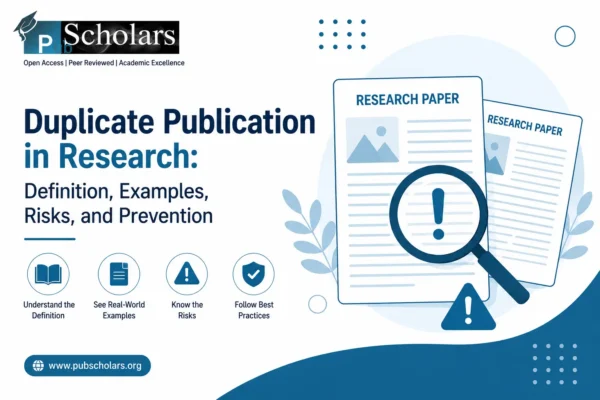
Duplicate publication — publishing the same research findings more than once without appropriate disclosure — is one of the most common forms of publication misconduct, and one of the least understood. Many researchers stumble into it inadvertently, genuinely unsure of where acceptable text reuse ends and problematic duplication begins.
This guide explains precisely what counts as duplicate publication, how it differs from legitimate secondary publication, how journals detect it, and what happens when it is found.
What Is Duplicate Publication?
Duplicate publication — also called redundant publication — refers to publishing the same data, findings, or conclusions in two or more journals without appropriate disclosure, editor permission, or explicit attribution to the earlier work.
The core ethical problem is deception: readers, editors, and the scientific literature are led to believe that a new, independent finding has been reported when it has not. This inflates the apparent evidence base, wastes reviewer and reader time, and corrupts the literature that subsequent researchers rely on.
What Duplicate Publication Is Not
Duplicate publication is not:
- Citing your own prior work (always appropriate and encouraged)
- Summarising your prior work in a review or methods paper with full attribution
- Presenting the same work at multiple conferences
- Posting a preprint followed by journal publication (most journals explicitly permit this)
- Translating a paper into another language with appropriate disclosure and editor permission
Duplicate Publication vs Self-Plagiarism vs Salami Slicing
These related concepts are distinct in important ways:
Duplicate Publication
Publishing the same data or conclusions in two or more journals. The harm is to the scientific literature — inflating the apparent evidence base with redundant reports.
Example: Publishing a study showing Drug X reduces cardiovascular events in the European Heart Journal, then publishing the same data and conclusions in the American Journal of Cardiology without disclosure.
Self-Plagiarism (Text Recycling)
Reproducing your own previously published text (words and sentences) without attribution. The harm is to journal integrity and to readers who cannot assess originality.
Example: Copying an entire methods section verbatim from a previous paper without acknowledging that the methods were previously published.
Salami Slicing (Least Salami Publishing) H3
Artificially dividing a coherent body of research into multiple papers — each reporting a small slice — to maximise publication count. The harm is a fragmented literature that is harder to interpret and a distorted record of what was actually a single study.
Example: Conducting a clinical trial measuring five outcomes and publishing five separate papers, one per outcome, when the scientific question and methodology are inseparable.
Case Studies: What Duplicate Publication Looks Like in Practice
Case Study 1: The salami-sliced clinical trial
A research team conducts a randomised controlled trial measuring six primary outcomes. Rather than publishing a single comprehensive paper reporting all outcomes, they publish six separate papers — one per outcome — over 18 months. Each paper references the trial registration number but does not explicitly disclose that five other papers from the same trial are planned or published.
This is a clear case of salami slicing. The harm: clinical reviewers and systematic review authors encounter six apparently independent studies, all pointing in the same direction — but they are all the same trial. The apparent evidence base is inflated. Treatment guidelines may be influenced by what appears to be convergent evidence from multiple studies but is actually one study fragmented.
Case Study 2: The translated paper without disclosure
A researcher publishes a study in an English-language international journal. Two years later, they submit what appears to be a new paper on the same topic to a national journal in a different language — but it reports the same data and conclusions. No disclosure is made to either journal.
This is duplicate publication regardless of the language difference. The original publisher may have legitimate copyright claims to the data. The national journal has been deceived into publishing what it believes is original research.
Had the researcher sought explicit permission from both editors upfront, disclosed the primary publication in the secondary submission, and framed it explicitly as a secondary publication for a different audience, this would have been ethically acceptable.
Case Study 3: Legitimate methods reuse
A researcher publishes an original method paper describing a new cell culture protocol. Over the next three years, they publish four further papers all using this protocol. Each paper’s methods section references the original method paper rather than re-describing the protocol in full. Some language from the original description is reproduced with citation.
This is legitimate and appropriate text reuse. The original method is properly cited. Readers are directed to the full description. The reproduction of some language with citation is acceptable when describing a previously published method.
The distinction from self-plagiarism: citation and transparency make the repetition honest rather than deceptive.
When to Contact the Editor Before Submitting
If you are uncertain whether your submission creates a duplicate publication concern, contact the target journal editor before submitting. Explain:
- The prior publication (or prior submission) that might be related
- How the new submission differs
- What you believe the appropriate path forward is
Most editors appreciate this proactive transparency and will provide clear guidance. The brief delay from seeking clarification is far preferable to a post-publication duplicate publication finding.
The Methods Section Exception
The most frequently contested grey area is the methods section. When a researcher conducts multiple studies using the same experimental protocol, reusing methods language from a prior publication is both common and generally acceptable — under specific conditions.
Acceptable: Brief repetition of standard methods with an explicit citation to the original paper where they were described in full: “Cell culture and treatment protocols followed those described previously [Citation X].”
Unacceptable: Reproducing multiple paragraphs of previously published methods text verbatim without disclosure or citation, presenting it as if it were novel methods description.
The key principle: citation and disclosure make repetition transparent; absence of citation and disclosure makes repetition deceptive.
What Happens in the Numerator: Conference Abstracts and Journal Papers
A common and completely acceptable practice is presenting research at a conference (as an abstract or poster) and then publishing a full paper in a journal. Conference abstracts are not considered prior publication under most journal policies. The journal paper represents a substantially more complete presentation of the work.
However, a paper published as a full conference proceedings paper — particularly in engineering and computer science where full conference papers are major publications — is a different matter. Many journals consider full conference papers as prior publication. Check the specific journal’s policy.
Legitimate Secondary Publication
There are situations where publishing substantially the same work in two different journals is ethically permissible. ICMJE guidelines allow secondary publication when:
- Both editors have been informed and both have approved the arrangement
- The secondary paper clearly identifies the primary paper and cites it in the first paragraph
- The secondary paper is intended for a different readership (e.g., a different language audience, a practitioner journal after an academic journal, or a national journal after an international journal)
- The primary paper has already been published
- The secondary paper is not simply a translation for commercial purposes
Secondary publication with proper disclosure is not misconduct — it is a legitimate and sometimes valuable way of reaching additional audiences.
How Journals Detect Duplicate Publication
CrossCheck/iThenticate
Most major publishers run submitted manuscripts through iThenticate, which compares text against:
- Published papers in the CrossRef database (millions of papers)
- Submitted manuscripts from other journals (through CrossCheck)
- Preprint servers (arXiv, bioRxiv, medRxiv)
A high similarity score triggers editorial review. Scores above approximately 20% are common threshold points for further investigation, though thresholds vary by journal and context.
Citation and Reference Analysis
If a paper cites itself as a prior publication or references data already published, reviewers or editors may notice and investigate. An experienced reviewer who knows the field will recognise re-reported data even if the writing differs.
Reader Reports and Post-Publication Scrutiny
Researchers who know the literature may recognise previously published data and report it to the journal. PubPeer and similar post-publication comment platforms have been instrumental in identifying duplicate publication cases.
The Role of the Corresponding Author
The corresponding author is responsible for ensuring that duplicate publication policies are understood and complied with by all authors. When submitting:
- Confirm that the manuscript has not been previously published (beyond preprint/conference abstract)
- Confirm it is not under simultaneous consideration elsewhere
- Disclose any prior presentations, preprints, or related publications — even those that share methods or preliminary data
Lack of awareness is not a defence against duplicate publication findings. The corresponding author’s responsibility is to ensure compliance.
Consequences of Duplicate Publication
If duplicate publication is detected — before or after publication — the consequences can include:
Before publication: Desk rejection or immediate rejection without review.
After publication: Retraction of the duplicate paper (and sometimes both papers). Retraction notices are permanent and publicly visible in all major databases.
Institutional consequences: Formal investigation by the institution’s research integrity office; potential findings of research misconduct; disciplinary action up to and including dismissal.
Career consequences: Retractions are permanent marks on a researcher’s record. Multiple retractions can effectively end a research career.
Conclusion
Duplicate publication crosses the line from acceptable text reuse to research misconduct when the same data or conclusions are represented as new findings without disclosure. The boundaries are primarily about transparency: disclosed and approved repetition is legitimate; concealed repetition is misconduct. When in doubt about whether a prior publication or presentation creates a duplicate publication concern, contact the target journal’s editor directly before submission. Most editors appreciate proactive disclosure and will provide clear guidance.
Useful guides for researchers preparing to submit
These PubScholars resources cover the full journal selection and submission process:
How to Choose the Right Journal for Your Paper — a practical framework for matching scope, audience, and impact factor to your manuscript
How to Publish a Research Paper — the complete step-by-step guide from manuscript prep to post-publication promotion
Impact Factor vs CiteScore: Which Matters More? — how the two metrics differ and when to use each
Does Impact Factor Affect Manuscript Acceptance Chances? — what IF signals about desk rejection rates and submission strategy
Which Journals Have the Highest Impact Factor? — field-by-field rankings across medicine, biology, chemistry, and physics
Frequently Asked Questions
What is the difference between duplicate publication and redundant publication?
The terms are often used interchangeably. Some sources distinguish them by severity: duplicate publication is an exact or near-exact replication, while redundant publication involves substantial overlap without being identical. In practice, both are considered publication ethics violations requiring correction.
Can I publish my thesis research as journal articles?
Yes — thesis-derived papers are entirely acceptable. Most journals explicitly permit this with appropriate acknowledgement that the work was included in a thesis. Check the specific journal’s policy. Some thesis repositories make the full thesis publicly available before journal submission; this is generally not considered prior publication for journal purposes, but verify with your target journal.
Is it duplicate publication to publish the same data in a different language?
With proper disclosure and editor permission, publishing in a second language for a different audience is acceptable under ICMJE guidelines. Without disclosure and permission, it is duplicate publication.
What about preprints?
Most journals explicitly allow preprint posting before or during journal submission. A preprint followed by a journal publication is not duplicate publication. However, a preprint should be cited in the journal submission so reviewers and editors can assess it.
Can I publish conference proceedings and then a journal paper?
Usually yes. Conference abstracts are never an issue. Full conference papers (common in engineering and computer science) require checking the specific journal’s policy on prior conference publication.

I am a seasoned professional with over 9 years of transformative experience in the domains of molecular biology, immunology, and clinical research. With a career that spans from 2006 to 2018, my journey has been marked by a relentless pursuit of scientific excellence and an unwavering commitment to improving healthcare outcomes through groundbreaking research. I have worked at one of India’s premier medical institutions, AIIMS(All India Institute of Medical Sciences), where I contributed significantly to the fields of molecular biology and clinical research. My expertise in protein analysis and genetic studies allowed me to identify potential biomarkers and improve diagnostic accuracy, contributing to better healthcare outcomes for patients. Notably, the research work has been published in prestigious scientific journals such as the Indian Journal of Ophthalmology and the British Journal of Ophthalmology.
Publication in these esteemed journals reflects my commitment to advancing medical science and sharing insights with the global research community. These publications highlight my expertise in areas ranging from gene polymorphism and immune response mechanisms to the effects of chronic drug therapy, all contributing to the larger body of scientific knowledge. My passion for scientific communication led me to pursue an Executive Diploma in Medical Writing from CliMed Research Solutions and Curio Training and Research Institute (CTRI), India. This certification has further refined my ability to bridge the gap between complex scientific research and its practical applications in healthcare. My passion for content writing drives me to continuously create content that derives engagement ,build trust, and leaves a lasting impression on readers”.