- The 6 Essential Tools for Finding Journal Metrics
- Tool 1: SCImago Journal & Country Rank (Free — Best Starting Point)
- Tool 2: Journal Citation Reports (Institutional Subscription — Official JIF)
- Tool 3: Eigenfactor.org (Free)
- Tool 4: Web of Science Master Journal List (Free)
- Tool 5: Scopus Sources (Free Verification)
- Tool 6: Think. Check. Submit. (Free — Legitimacy Check)
- How to Look Up Metrics for Any Journal in Under 5 Minutes
- Step-by-Step: How to Look Up Any Journal’s Metrics in Under 10 Minutes
- Minute 1–2: Start at scimago.org
- Minute 3–4: Check the journal’s own website
- Minute 5: Verify WoS indexing at mjl.clarivate.com
- Minute 6–7: Cross-check at JCR (if institutional access available)
- Minute 8: Run the legitimacy check at thinkchecksubmit.org
- Minute 9–10: Browse recent published content
- Building a Journal Metrics Reference List for Your Field
- What to include in your reference list
- Comparing Multiple Journals at Once
- Red Flags to Watch For When Checking Metrics
- Useful guides for researchers preparing to submit
- Frequently Asked Questions
- How do I find a journal’s impact factor for free?
- Is scimago.org reliable enough for formal evaluation?
- How do I find all journals in my specific field ranked by metric?
- How often are journal metrics updated?
- Conclusion
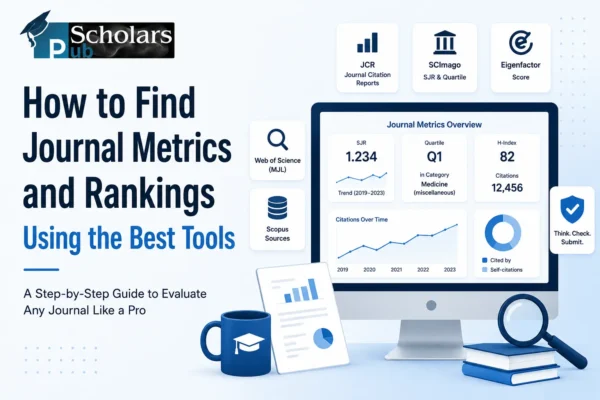
You have identified a journal you are considering for submission. Now you need to verify its impact factor, check its quartile ranking in your specific field, confirm it is indexed in major databases, and compare it to two or three alternatives. This guide tells you exactly where to find all of that information — efficiently, and mostly for free.
The 6 Essential Tools for Finding Journal Metrics
Tool 1: SCImago Journal & Country Rank (Free — Best Starting Point)
URL: scimago.org
Cost: Completely free
What you get: SJR score, quartile ranking (Q1–Q4), h-index, subject category placement, document and citation counts, country and publisher information, historical trend charts, open-access status
How to use:
- Go to scimago.org
- Click “Journal Rankings” or use the search bar
- Enter journal name or ISSN (ISSN is more precise if the name has variants)
- Select the correct journal from the results
- View the current SJR, quartile for each subject category, and historical trends
Scimago is the best free resource for comprehensive journal assessment. Its coverage of approximately 27,000 journals based on Scopus is broader than JCR, and the historical trend data allows you to assess whether a journal’s standing is rising or declining.
Tool 2: Journal Citation Reports (Institutional Subscription — Official JIF)
URL: clarivate.com (JCR section)
Cost: Requires institutional subscription (most universities provide access through their library)
What you get: Official JIF, 5-year IF, Journal Citation Indicator (JCI), quartile ranking, subject category placement, citation distribution data, h-index, immediacy index, citing and cited journal networks
How to use:
- Log in via your institution’s library portal
- Search by journal name or ISSN
- View current and historical JIF, quartile, and citation data
- The quartile ranking within each subject category is particularly valuable
If your institution does not have JCR access, many journals display their current official JIF on their own website under “About the Journal” or “Journal Metrics” — though always check the year this figure refers to.
Tool 3: Eigenfactor.org (Free)
URL: eigenfactor.org
Cost: Free
What you get: Eigenfactor Score, Article Influence Score for all Web of Science-indexed journals, with historical data
How to use:
Search by journal name for results showing the Eigenfactor Score and Article Influence Score. Also available within JCR for institutions with access.
The Eigenfactor Score is particularly useful for identifying journals that may be gaming simpler metrics, since it excludes self-citations and weights citations by source influence.
Tool 4: Web of Science Master Journal List (Free)
URL: mjl.clarivate.com
Cost: Free
What you get: Confirmation of whether a journal is indexed in Web of Science, which collections it belongs to (SCIE, SSCI, AHCI, ESCI), ISSN, publisher details
Critical use case: Before submitting to any journal that claims an impact factor, search for it here. Only journals indexed in Web of Science have official JIFs. If the journal is not in the Master Journal List, its claimed impact factor is not a legitimate JCR impact factor.
Tool 5: Scopus Sources (Free Verification)
URL: scopus.com/sources (some features require institutional access)
Cost: Partial free access for source verification
What you get: CiteScore, SJR, SNIP, document counts, citation counts for Scopus-indexed journals
Use this to verify Scopus indexing and access CiteScore alongside SJR for Scopus-covered journals.
Tool 6: Think. Check. Submit. (Free — Legitimacy Check)
URL: thinkchecksubmit.org
Cost: Free
What you get: A structured checklist for evaluating journal legitimacy, covering editorial board transparency, contact information, peer review description, indexing verification, and publisher membership of ethical publishing organisations
Always use this before submitting to an unfamiliar journal. It takes 5 minutes and protects you from predatory journal submission.
How to Look Up Metrics for Any Journal in Under 5 Minutes
For a quick free check:
- Go to scimago.org
- Search the journal name or ISSN
- Note the SJR score, quartile ranking (Q1–Q4) for the relevant subject category, and h-index
- Check the trend — is the journal’s standing rising, stable, or declining?
- Cross-reference with the journal’s own website for the JCR-published JIF
For a thorough institutional assessment:
- Scimago.org — SJR, quartile, trends, h-index
- JCR (institutional access) — official JIF, 5-year IF, JCI, citation distribution
- eigenfactor.org — Eigenfactor Score and Article Influence Score
- mjl.clarivate.com — verify WoS indexing
- thinkchecksubmit.org — legitimacy verification
This comprehensive check takes 10–15 minutes and gives you a complete, multi-metric picture of any journal.
Step-by-Step: How to Look Up Any Journal’s Metrics in Under 10 Minutes
Here is the complete workflow for evaluating any journal before submitting:
Minute 1–2: Start at scimago.org
Search the journal by name or ISSN. Note: SJR score, quartile ranking in the most relevant subject category, h-index, and the historical trend (is the journal rising or declining?).
Minute 3–4: Check the journal’s own website
Go to the journal’s “About,” “For Authors,” or “Journal Metrics” page. Note the displayed JIF, any CiteScore figure, and the year each metric refers to.
Minute 5: Verify WoS indexing at mjl.clarivate.com
Search by ISSN. Confirm the journal is indexed in SCIE, SSCI, or ESCI. If the journal is not listed here and claims an impact factor, the IF is not official.
Minute 6–7: Cross-check at JCR (if institutional access available)
Search the journal. Note the official JIF, 5-year IF, and JCI. Check the self-citation rate. Note whether the JIF quartile matches the scimago.org quartile.
Minute 8: Run the legitimacy check at thinkchecksubmit.org
For any journal you are unfamiliar with, work through the checklist. Takes 2–3 minutes and screens for predatory indicators.
Minute 9–10: Browse recent published content
Navigate to the journal’s website and look at the last 2–3 issues. Do papers published there belong alongside your work in topic, methodology, and contribution level?
Total time: under 10 minutes for a comprehensive assessment that gives you both quality metrics and legitimacy verification.
Building a Journal Metrics Reference List for Your Field
One of the most time-efficient things you can do for your publication strategy is build a reference list of the 20–30 journals most relevant to your research area, with their current metrics noted. Update this annually.
What to include in your reference list
| Journal | ISSN | JIF | SJR | Quartile | Notes |
|---|---|---|---|---|---|
| [Journal A] | 0000-0000 | 8.4 | 2.1 | Q1 Biochem | Fast review ~8 wks |
| [Journal B] | 0000-0001 | 5.2 | 1.6 | Q1 Biochem | OA preferred |
| [Journal C] | 0000-0002 | 3.1 | 0.9 | Q2 Biochem | Good for methods |
This reference list means you can make journal selection decisions in minutes rather than hours for any new paper, because the research is already done.
Comparing Multiple Journals at Once
For publication strategy — comparing 5–10 journals simultaneously — the most efficient approach is:
- Go to scimago.org → Journal Rankings
- Filter by subject category (use the Subject Area and Category dropdowns)
- Sort by SJR, CiteScore, or H-Index to see the full ranked list in your field
- Identify Q1 and Q2 journals in your category
- Download the filtered results as CSV for comparison
- Cross-reference your shortlist in JCR for official JIF and quartile
This workflow can be completed in under 30 minutes and gives you a comprehensive comparative picture of all journals in your target field — far more efficient than searching each journal individually.
Red Flags to Watch For When Checking Metrics
Journal claims an IF but is not in the WoS Master Journal List: The claimed IF is not official. This is a common sign of predatory or low-quality journals.
Very large gap between JIF and SJR (JIF much higher): May indicate high self-citation rates or citation network gaming.
Declining trend in SJR or CiteScore: The journal’s influence may be eroding. Check whether editorial leadership has changed recently.
IF from an unofficial source (Index Copernicus, Global Impact Factor, etc.): These are not legitimate JIF scores. Only Clarivate’s JCR produces official impact factors.
Not indexed in either Web of Science or Scopus: The journal lacks independent quality verification. Investigate thoroughly before submitting.
Useful guides for researchers preparing to submit
These PubScholars resources can help you evaluate journals and prepare for successful publication:
- How Long Does Peer Review Take? — Know what to expect after submission.
- Does Impact Factor Affect Manuscript Acceptance Chances? — Learn how impact factors influence acceptance.
- What Is H-Index in Research? — Understand a key measure of research impact.
- SCImago Journal Rank vs Impact Factor — Compare two important journal metrics.
- What Is a Good Impact Factor for a Journal? — Learn how to assess journal quality.
Frequently Asked Questions
How do I find a journal’s impact factor for free?
Check the journal’s own “For Authors” page — most legitimate JCR-indexed journals display their current official JIF there. For SJR and quartile ranking, use scimago.org (fully free). To verify the JIF is official, confirm the journal appears at mjl.clarivate.com.
Is scimago.org reliable enough for formal evaluation?
Yes — scimago.org uses Scopus data with transparent methodology and is widely cited in bibliometric research. SJR quartile rankings are accepted by most institutions and funders alongside or instead of JIF quartile. For the most formal evaluation contexts (certain grant applications), also verify with JCR.
How do I find all journals in my specific field ranked by metric?
Go to scimago.org → Journal Rankings → use the Subject Area and Category dropdowns to filter to your specific category → sort by SJR or h-index. This gives you a complete ranked list of all Scopus-indexed journals in your field. Download as CSV for a permanent reference.
How often are journal metrics updated?
JIF is updated once per year (June). SJR and CiteScore are updated annually. Eigenfactor scores are updated annually. The Scimago website typically reflects the most recent annual release.
Conclusion
Finding journal metrics is fast and mostly free once you know the right tools. Scimago.org is the best starting point for comprehensive, free journal assessment. JCR (institutional access) provides official JIF and detailed citation analysis. Eigenfactor.org adds network-based influence data. The WoS Master Journal List verifies legitimacy. Think. Check. Submit. screens for predatory journals. Used together, these tools give you a thorough, multi-metric picture of any journal in under 15 minutes — more than enough to make confident, well-informed submission decisions.

I am a seasoned professional with over 9 years of transformative experience in the domains of molecular biology, immunology, and clinical research. With a career that spans from 2006 to 2018, my journey has been marked by a relentless pursuit of scientific excellence and an unwavering commitment to improving healthcare outcomes through groundbreaking research. I have worked at one of India’s premier medical institutions, AIIMS(All India Institute of Medical Sciences), where I contributed significantly to the fields of molecular biology and clinical research. My expertise in protein analysis and genetic studies allowed me to identify potential biomarkers and improve diagnostic accuracy, contributing to better healthcare outcomes for patients. Notably, the research work has been published in prestigious scientific journals such as the Indian Journal of Ophthalmology and the British Journal of Ophthalmology.
Publication in these esteemed journals reflects my commitment to advancing medical science and sharing insights with the global research community. These publications highlight my expertise in areas ranging from gene polymorphism and immune response mechanisms to the effects of chronic drug therapy, all contributing to the larger body of scientific knowledge. My passion for scientific communication led me to pursue an Executive Diploma in Medical Writing from CliMed Research Solutions and Curio Training and Research Institute (CTRI), India. This certification has further refined my ability to bridge the gap between complex scientific research and its practical applications in healthcare. My passion for content writing drives me to continuously create content that derives engagement ,build trust, and leaves a lasting impression on readers”.