

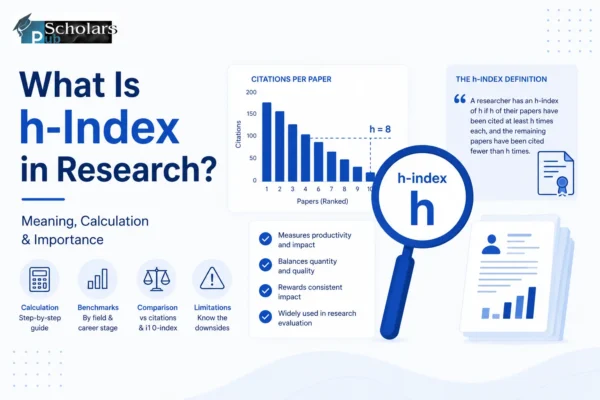
- The h-Index Definition
- How to Calculate Your h-Index Step by Step
- Worked Example
- How to Check Your h-Index Automatically
- What Is a Good h-Index? Field and Career Stage Benchmarks
- h-Index vs Total Citation Count
- h-Index vs i10-Index
- Limitations of the h-Index
- It Never Decreases
- It Disadvantages Early-Career Researchers
- It Is Field-Dependent
- It Does Not Account for Author Order
- It Is Database-Dependent
- It Rewards Quantity
- H-Index Variants: Addressing the Core Limitations
- G-index
- m-quotient (m-index)
- i-index (i10 and i100)
- H-Index in Different Academic Systems
- North America
- United Kingdom
- Europe
- Australia
- How to Present Your h-Index in Applications
- Frequently Asked Questions
- What h-index is good for tenure?
- Should I include self-citations when reporting my h-index?
- How can I increase my h-index?
- Is h-index or total citation count more important?
- Conclusion
The h-index is one of the most widely used metrics for measuring a researcher’s scientific productivity and citation impact. Created by physicist Jorge Hirsch in 2005, it was designed to capture both productivity (how many papers you have published) and impact (how many times those papers have been cited) in a single number.
It appears in tenure packages, grant applications, hiring evaluations, and on every major researcher profile platform.Understanding what it measures, how to calculate it, and how it fits alongside other research metrics such as journal impact factor is essential for any researcher navigating academic evaluation.
The h-Index Definition
A researcher has an h-index of h if exactly h of their papers have been cited at least h times each, and their remaining papers have been cited fewer than h times.
Example: If you have published 60 papers and 20 of them have each been cited at least 20 times, your h-index is 20 — regardless of how many total citations your other 40 papers have received.
The elegance of this definition is that it balances both quantity and quality: to increase your h-index, you need both more papers AND more citations. A single viral paper cannot inflate it the way it inflates total citation count.
How to Calculate Your h-Index Step by Step
Step 1: Compile a complete list of all your publications.
Step 2: Sort them in descending order by citation count.
Step 3: Working down the list, identify the point where the paper’s rank number equals or exceeds its citation count.
Step 4: Your h-index is that rank number.
Worked Example
| Rank | Paper | Citations |
|---|---|---|
| 1 | Paper A | 187 |
| 2 | Paper B | 94 |
| 3 | Paper C | 67 |
| 4 | Paper D | 45 |
| 5 | Paper E | 30 |
| 6 | Paper F | 22 |
| 7 | Paper G | 14 |
| 8 | Paper H | 9 |
| 9 | Paper I | 5 |
| 10 | Paper J | 2 |
At rank 7, the paper has 14 citations — more than 7. At rank 8, the paper has 9 citations — more than 8. At rank 9, the paper has only 5 citations — fewer than 9.
h-index = 8 (8 papers each with at least 8 citations)
Total citations = 475. The h-index of 8 captures sustained impact across multiple papers, not the influence of any single paper.
How to Check Your h-Index Automatically
- Google Scholar typically gives the highest value (broadest source coverage including preprints and conference papers), making it important to understand the differences between citation-based metrics such as h-index and impact factor.
- Scopus: Log in through your institution — provides h-index alongside citation data, with peer-reviewed filtering
- Web of Science: Institutional access required — h-index calculated from the more selective WoS journal set
Important: Your h-index will differ across databases. Google Scholar typically gives the highest value (broadest source coverage including preprints and conference papers). Scopus and Web of Science give more conservative figures. Always specify which database you are using when quoting your h-index.
What Is a Good h-Index? Field and Career Stage Benchmarks
The h-index is completely field-dependent. These approximate benchmarks are based on aggregated researcher profile data:
| Career stage | Natural sciences | Social sciences | Humanities |
|---|---|---|---|
| Early career (0–5 yrs post-PhD) | 3–8 | 2–5 | 1–3 |
| Mid-career (6–15 yrs) | 10–20 | 5–12 | 3–8 |
| Senior (15+ yrs) | 20–50+ | 12–25+ | 8–20+ |
| Distinguished / award-level | 40–100+ | 20–40+ | 15–30+ |
Nobel Prize winners in physics and chemistry typically have h-indices of 40–100+. A highly respected career mathematician might have h-index 15–25. A leading clinical researcher might have h-index 40–60.
These numbers are not targets — they are reference points for understanding whether your h-index is typical, above, or below average for your career stage and field when evaluating research impact.
h-Index vs Total Citation Count
The h-index and total citation count measure different things and are not interchangeable, which is why researchers should understand the strengths and limitations of different research impact metrics.
| Metric | What it measures | Can be inflated by |
|---|---|---|
| h-index | Consistent impact across multiple papers | Cannot be inflated by a single paper |
| Total citation count | Aggregate attention to all your work | A single viral or highly cited paper |
Example comparison:
- Researcher A: 1 paper with 10,000 citations, 50 papers with 0–5 citations each. Total citations: ~10,050. h-index: 1.
- Researcher B: 30 papers each with 30–50 citations. Total citations: ~1,200. h-index: 30.
By total citations, Researcher A appears more impactful. By h-index, Researcher B demonstrates far more consistent, sustained contribution across their career. Most evaluators in academic contexts would consider Researcher B’s record stronger for most purposes.
The h-index is specifically designed to reward consistent impact. Total citation count rewards breakthrough discoveries, including accidental viral citations.
h-Index vs i10-Index
The i10-index is a simpler metric reported automatically by Google Scholar: the number of papers with at least 10 citations. It is easier to understand than h-index but provides less nuanced differentiation among high-impact researchers.
For most career evaluation purposes, h-index is more informative than i10-index because it scales with actual impact rather than using a fixed threshold.
Limitations of the h-Index
It Never Decreases
The h-index can only increase — papers already above the threshold cannot fall below it. This means older researchers will always have higher h-indices than younger ones, regardless of whether their recent work has had any impact. The h-index is not a current measure of productivity or influence; it is a cumulative career record.
It Disadvantages Early-Career Researchers
Building a high h-index takes years of productive research and accumulating citations. A researcher 3 years post-PhD with h-index 5 and strong recent momentum may be more impressive than a researcher 15 years post-PhD with h-index 10. The h-index must always be interpreted in the context of career length.
It Is Field-Dependent
As shown in the benchmarks above, h-indices vary enormously across fields. Evaluating researchers from different disciplines using the same h-index threshold is a significant methodological error. Always contextualise with field and career stage.
It Does Not Account for Author Order
A researcher who is corresponding author and intellectual leader on 20 papers with h-index 15 has a very different record from one who is middle author on 100 papers with h-index 15. The h-index does not distinguish between leading and supporting authorship.
It Is Database-Dependent
The same researcher can have significantly different h-indices from different databases, highlighting the importance of knowing which research databases and citation tracking platforms are being used. Always specify which database produced the h-index you are quoting.
It Rewards Quantity
Prolific researchers who produce many papers of moderate citation rates can achieve higher h-indices than researchers who produce fewer but more transformative works. Some Nobel Prize-winning discoveries were by researchers with relatively modest h-indices at the time of the discovery.
H-Index Variants: Addressing the Core Limitations
The standard h-index has known limitations, and several variants have been proposed to address them. While none has replaced the original, knowing they exist helps you interpret h-index discussions more critically.
G-index
The g-index is the largest number g such that the top g papers have accumulated at least g² citations in total. It gives more weight to highly cited papers than the standard h-index and does not plateau as quickly.
Example: If your top 5 papers have 5, 10, 15, 20, and 25 citations (total 75 = 5² + 50), and your top 10 papers total 200 > 10² = 100, your g-index would be 10.
The g-index better captures the contribution of transformative, highly cited papers but is less widely used in practice.
m-quotient (m-index)
The h-index divided by the number of years since your first publication. Useful for comparing researchers at different career stages by normalising for time in field.
Example: h-index 20 after 10 years = m-quotient 2.0. h-index 20 after 5 years = m-quotient 4.0 — a substantially higher rate of h-index growth.
i-index (i10 and i100)
- i10-index: number of papers with at least 10 citations (reported by Google Scholar)
- i100-index: number of papers with at least 100 citations (sometimes used for senior researchers)
These are simpler and more interpretable than h-index but use fixed citation thresholds rather than the self-referential h-index threshold.
H-Index in Different Academic Systems
North America
H-index is widely used in tenure and promotion decisions at research universities, typically alongside total citation count and JIF of publication venues. The database used should always be specified — Google Scholar values are typically 20–30% higher than Scopus or Web of Science values.
United Kingdom
The Research Excellence Framework (REF) — the UK’s periodic national research quality assessment — uses expert panel evaluation rather than bibliometric thresholds, but h-index figures are often included in institutional reporting and in individual faculty promotion cases.
Europe
Usage varies significantly by country. Some national systems (e.g., Italy’s national academic qualification system) have historically used bibliometric thresholds including h-index explicitly. Nordic countries tend toward qualitative peer assessment.
Australia
ERA (Excellence in Research for Australia) uses a mix of bibliometric and expert evaluation. Individual h-index figures are used in promotions at most Go8 and research-intensive universities.
How to Present Your h-Index in Applications
In grant applications and tenure packages:
“h-index: 18 [Web of Science, May 2026], 22 [Scopus, May 2026], 27 [Google Scholar, May 2026]; total citations: 1,847 [Web of Science]”
Specifying the database and date prevents ambiguity. Presenting multiple databases demonstrates transparency.Using Web of Science or Scopus for the primary figure is generally more credible in formal evaluation contexts because they filter to peer-reviewed literature, a process that helps ensure research quality and reliability.
In informal contexts:
For conference bios, lab websites, and informal introductions, Google Scholar h-index is most commonly used because it is free, widely accessible, and auto-updating.
Frequently Asked Questions
What h-index is good for tenure?
There is no universal threshold — expectations vary by institution, discipline, and career stage. In biomedical sciences at a research-intensive US university, an h-index of 15–25 at the point of tenure review might be competitive for many positions. In mathematics, an h-index of 8–15 might be strong at the same career stage. Always ask departmental colleagues what is typical for successful tenure cases in your specific field and institution.
Should I include self-citations when reporting my h-index?
Standard h-index calculation includes self-citations. Most formal reporting contexts use this standard figure. Some databases offer self-citation-excluded h-index calculations — if you use this variant, specify it clearly. Note that evaluators increasingly check for patterns of excessive self-citation.
How can I increase my h-index?
Your h-index increases when a new paper exceeds the current threshold, or when a paper that was below the threshold accumulates enough citations to cross it. The most effective strategies are: publishing consistently in appropriate journals, making work open access, promoting publications actively, collaborating internationally, and writing review articles — all of which increase citation accumulation rates over time.
Is h-index or total citation count more important?
For most formal evaluation contexts, h-index is considered more meaningful because it cannot be inflated by a single highly-cited paper and requires sustained output. Total citation count is valuable as a complement. Present both, with database and date specified.
Conclusion
The h-index is a useful, intuitive measure of cumulative research impact — more robust than total citation count for assessing consistent scientific contribution, easy to explain to non-specialists, and widely recognised across evaluation contexts. Its limitations — field-dependence, career-stage sensitivity, inability to distinguish author order, database variation — mean it should always be one part of a broader record presentation, never the sole measure of a researcher’s contribution.Used and contextualised correctly, the h-index tells a meaningful story about the breadth and depth of your scientific influence and complements other measures used to assess research impact and publication quality.

I am a seasoned professional with over 9 years of transformative experience in the domains of molecular biology, immunology, and clinical research. With a career that spans from 2006 to 2018, my journey has been marked by a relentless pursuit of scientific excellence and an unwavering commitment to improving healthcare outcomes through groundbreaking research. I have worked at one of India’s premier medical institutions, AIIMS(All India Institute of Medical Sciences), where I contributed significantly to the fields of molecular biology and clinical research. My expertise in protein analysis and genetic studies allowed me to identify potential biomarkers and improve diagnostic accuracy, contributing to better healthcare outcomes for patients. Notably, the research work has been published in prestigious scientific journals such as the Indian Journal of Ophthalmology and the British Journal of Ophthalmology.
Publication in these esteemed journals reflects my commitment to advancing medical science and sharing insights with the global research community. These publications highlight my expertise in areas ranging from gene polymorphism and immune response mechanisms to the effects of chronic drug therapy, all contributing to the larger body of scientific knowledge. My passion for scientific communication led me to pursue an Executive Diploma in Medical Writing from CliMed Research Solutions and Curio Training and Research Institute (CTRI), India. This certification has further refined my ability to bridge the gap between complex scientific research and its practical applications in healthcare. My passion for content writing drives me to continuously create content that derives engagement ,build trust, and leaves a lasting impression on readers”.

