

- How Tenure and Promotion Committees Actually Evaluate Publications
- The Metrics Committees Most Commonly Request
- Journal Impact Factor (Most Commonly Required)
- Quartile Ranking (Increasingly Standard)
- Personal H-Index (Frequently Requested)
- Total Citation Count
- i10-Index
- Field-Specific Expectations
- Natural and Life Sciences
- Clinical and Health Sciences
- Social Sciences
- Humanities
- Engineering
- Field-Specific Tenure Metric Benchmarks
- Biomedical and Life Sciences
- Chemistry and Physical Sciences
- Social Sciences
- Mathematics
- How to Present Metrics Strategically in Your Tenure Dossier
- The opening metrics summary
- For each publication in your list
- The research narrative
- Red Flags in Publication Records That Tenure Committees Notice
- The Qualitative Layer: What Numbers Cannot Capture
- How to Present Your Publication Record in a Tenure Dossier
- Common Mistakes in Presenting Your Record
- Useful guides for researchers preparing to submit
- Frequently Asked Questions
- Do tenure committees actually look at individual journal IFs?
- Should I include preprints in my publication list?
- What if my h-index is lower than my peers because I work in a slow-citation field?
- Can strong qualitative evidence compensate for modest metrics?
- Conclusion
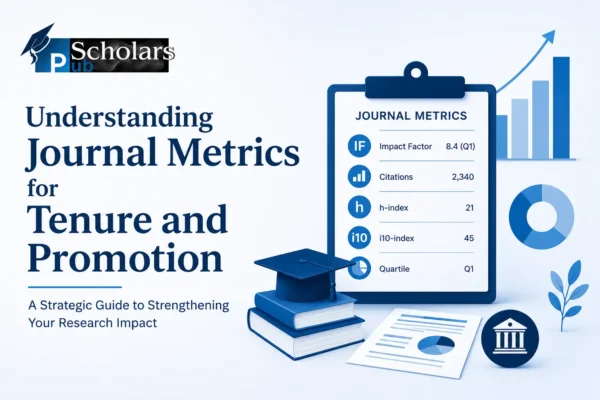
For academic researchers, understanding journal metrics for tenure and promotion is essential when evaluating the strength of a publication record. Most research institutions consider journal and citation metrics during promotion reviews, but their role is often misunderstood. Committees look for evidence of meaningful research impact, not just high numbers. Knowing which metrics they value, how to present them effectively, and which qualitative factors matter alongside the data can significantly strengthen your tenure and promotion profile.
How Tenure and Promotion Committees Actually Evaluate Publications
Publication evaluation in tenure and promotion reviews typically involves several layers:
Quantity: How many peer-reviewed publications do you have, and at what trajectory?
Quality: In what journals did you publish? What do the metrics signal about those journals?
Impact: How many times has your work been cited? Has it influenced the field?
Independence: Have you led papers as first or corresponding author, or are you consistently a middle author?
Trajectory: Is your output growing in both quantity and quality over time?
External recognition: Have your papers been cited by prominent researchers, adopted in guidelines, or featured in media?
Metrics play a role in assessing quality and impact, but they are never the whole story. A compelling research narrative that situates your metrics in context is essential.
The Metrics Committees Most Commonly Request
Journal Impact Factor (Most Commonly Required)
Despite widespread criticism from the research community and the DORA declaration, journal impact factor remains the single most commonly reported metric in tenure packages globally Most evaluation committees expect to see it, and many institutional templates explicitly request it.
Best practice for presentation:
- List the IF in brackets after each journal citation: *Journal Name* (IF: 8.4, Q1)
- Use the IF from the year of publication, not the current year
- Always add the quartile ranking and JCR subject category — this contextualises the number for non-specialist reviewers: “Q1 in JCR Oncology”
- For journals in different fields, briefly note field context if the absolute IF looks misleading: “IF 1.8, Q1 in Mathematics (field median: 1.1)”
Quartile Ranking (Increasingly Standard)
Many institutions — particularly those that have moved toward responsible research assessment practices — now emphasise quartile ranking within JCR or Scopus subject categories alongside or instead of raw IF. Q1 publications are the clearest quality signal that transcends field-specific IF variation.
Personal H-Index (Frequently Requested)
Your h-index is frequently requested in tenure packages. It captures cumulative impact across your entire body of work and is resistant to the single-paper inflation problem of raw citation count. Always specify the database (Google Scholar, Scopus, or Web of Science) and the date, since values differ across sources.
Total Citation Count
Report from multiple databases as explained in databases to track research impact: “Total citations: 1,847 [Web of Science], 2,340 [Scopus], 3,100 [Google Scholar].”
i10-Index
Google Scholar automatically reports your i10-index (number of papers with at least 10 citations). Some committees request this as a simple, interpretable complement to h-index.
Field-Specific Expectations
Natural and Life Sciences
Committees expect: strong h-index relative to career stage, multiple Q1/Q2 publications in field-relevant journals, growing citation count, several first-author or corresponding-author papers in peer-reviewed journals, and ideally one or two highly cited papers that have influenced the field.
Clinical and Health Sciences
Similar to life sciences, with additional weight on papers in clinical journals with direct practice implications, clinical guideline citations, and in some specialties, evidence of impact on patient care or policy.
Social Sciences
A mix of journal publications and book chapters; IF less central; quartile ranking within social science categories more important. Solo and lead-author papers signal intellectual independence. Strong citation impact within the field matters.
Humanities
Monographs (single-authored books with peer-reviewed presses) often outweigh journal publications entirely. Bibliometrics are less used; qualitative peer assessment by external letter writers is dominant. Journal metrics matter but are secondary to book publications and the assessments of distinguished external reviewers.
Engineering
Conference publications (IEEE, ACM, and other top conferences) carry significant weight alongside journal papers — unique to this discipline. Journal IF combined with conference prestige. Patent activity may also be evaluated.
Field-Specific Tenure Metric Benchmarks
What counts as a strong publication record varies significantly by discipline. These approximate benchmarks reflect expectations at research-intensive universities for associate professor or tenured full professor positions.
Biomedical and Life Sciences
- h-index (Scopus): 15–25 for associate tenure; 25–45+ for full professor
- Q1 publications: majority of papers in Q1 or high Q2 journals
- First/corresponding author papers: at least 40–50% of total papers at time of tenure
- Total citations (Web of Science): 500+ for associate tenure; 2,000+ for full professor in many institutions
Chemistry and Physical Sciences
- h-index (Scopus): 12–20 for associate tenure; 20–35+ for full professor
- Q1 publications: majority in Q1, with some publications in top specialty journals
- Citations: 300–800 for associate tenure
Social Sciences
- h-index varies significantly by specific discipline (economics vs. sociology vs. political science)
- Mix of journal articles and book publications expected depending on sub-discipline
- Citation counts notably lower than natural sciences but compared within discipline
Mathematics
- h-index: 8–15 for associate tenure (very low absolute numbers but high within-field significance)
- Quality of publications (prestige of venue) matters more than quantity
- Invited review articles and book contributions weighted alongside journal papers
These are approximations. Always seek specific information from your department and institution — formal written criteria take precedence over informal benchmarks.
How to Present Metrics Strategically in Your Tenure Dossier
The opening metrics summary
Place a brief, clearly formatted metrics summary near the beginning of your research statement or publication list. This should include:
- Total peer-reviewed publications with breakdown by first/corresponding author
- h-index from two databases (e.g., Web of Science and Scopus), with database and date specified
- Total citation count from each database
- Number of Q1 publications
Example format:
*Research metrics [May 2026]: 48 peer-reviewed publications (22 first or corresponding author). h-index: 18 [Web of Science], 21 [Scopus]. Total citations: 1,847 [WoS], 2,310 [Scopus]. 31 publications in Q1 journals.*
For each publication in your list
After the citation, add: *(IF: 8.4; Q1 in JCR Oncology)*
If a journal has a modest absolute IF but strong field standing, add context: *(IF: 1.9; Q1 in Mathematics, field median: 1.1)*
The research narrative
A two-to-four paragraph narrative before your publication list should explain:
- The central scientific questions your programme addresses
- How your papers collectively build a coherent research trajectory
- Your most significant individual contributions and why they matter
- Where your research programme is heading
Evaluators often read this section most carefully. Metrics without narrative context are less persuasive than metrics embedded in a compelling research story.
Red Flags in Publication Records That Tenure Committees Notice
All middle-author papers: Suggests contributing to others’ programmes rather than leading your own. A strong record includes clear first and corresponding author leadership.
Very low IF journals with high paper count: Many publications in Q3–Q4 journals may be interpreted as difficulty competing at higher-tier venues, particularly for senior positions.
Papers in predatory journals, discussed in what is predatory publishing, are identifiable by lack of major database indexing. These are often excluded from evaluation counts and may raise integrity concerns.
Unexplained gaps in output: Career interruptions happen and should be acknowledged in the narrative. Unexplained multi-year gaps in publication output without explanation attract committee attention.
Citation counts far below field peers with similar publication counts: May indicate papers are not being read or built upon by the research community.
The Qualitative Layer: What Numbers Cannot Capture
Strong tenure committees understand that metrics alone give an incomplete picture. The qualitative dimensions that matter alongside metrics include:
Research narrative coherence: Your papers should collectively tell a compelling story about a research programme. A coherent trajectory of questions, methods, and contributions is more persuasive than a list of disconnected papers.
Leadership signals: Papers where you are first or corresponding author, especially as your career advances, signal intellectual independence and leadership. Committees distinguish between leading a body of work and contributing to others’ programmes.
Field recognition: Invited talks, editorial board memberships, review requests, mentions in other researchers’ review articles, and citations from prominent figures in your field signal that the community values your contributions.
High-impact specific papers: A single paper cited in clinical guidelines, policy documents, or another researcher’s Nobel Prize lecture demonstrates impact that metrics can only partially capture.
How to Present Your Publication Record in a Tenure Dossier
Practical formatting:
- List papers in reverse chronological order with full citation information
- Include the journal’s IF (year of publication) in brackets: *Journal Name* (IF: 8.4)
- Add quartile where space permits: [Q1, JCR Environmental Science]
- Place your h-index and total citation count prominently near the start of your publications section, with database and date specified
- Note if any papers are in review or revisions, with journal names if appropriate
Research narrative:
Write a 2–4 paragraph narrative section before your publication list explaining:
- The central questions your research addresses
- How your publications collectively represent a coherent programme
- What your most significant contributions have been and why they matter
- Where your research is heading
This narrative is often the section committee members read most carefully. Numbers without context are less persuasive than numbers embedded in a compelling story about your intellectual contribution.
Common Mistakes in Presenting Your Record
Quoting impact factors without field context: An IF of 2 looks modest; Q1 in Mathematics looks excellent. Always include quartile for any journal that might appear low by absolute IF.
Listing middle-author papers without noting authorship position: Committees care about where you appear in the author list. Note “first author” or “corresponding author” explicitly for your most important papers.
Reporting only Google Scholar metrics: These are higher than peer-reviewed database figures. Committees may expect the more conservative Scopus or Web of Science figures. Report both.
No research narrative: A list of papers with no contextualisation of why they matter as a body of work is a missed opportunity.
Useful guides for researchers preparing to submit
These PubScholars resources cover the full journal selection and submission process:
How to Choose the Right Journal for Your Paper — a practical framework for matching scope, audience, and impact factor to your manuscript
How to Publish a Research Paper — the complete step-by-step guide from manuscript prep to post-publication promotion
Impact Factor vs CiteScore: Which Matters More? — how the two metrics differ and when to use each
Does Impact Factor Affect Manuscript Acceptance Chances? — what IF signals about desk rejection rates and submission strategy
Which Journals Have the Highest Impact Factor? — field-by-field rankings across medicine, biology, chemistry, and physics
Frequently Asked Questions
Do tenure committees actually look at individual journal IFs?
Most do, particularly in STEM fields. Committee members who are non-specialists use IF as a quality proxy when they cannot independently evaluate the paper’s content. Presenting IFs clearly — and contextualising them with quartile and field benchmarks — serves both the committee and you.
Should I include preprints in my publication list?
Preprints can be listed separately from peer-reviewed publications, clearly distinguished, and noted as “under review” or “submitted” if applicable. Do not present them as peer-reviewed publications. Some evaluation systems and institutions do not count preprints in formal metrics — check your institution’s policies.
What if my h-index is lower than my peers because I work in a slow-citation field?
Acknowledge this explicitly in your research narrative. State your h-index alongside the field average or typical h-index for researchers at your career stage in your specific discipline. Most sophisticated tenure committees understand disciplinary differences, but you should not rely on that understanding — make the context explicit.
Can strong qualitative evidence compensate for modest metrics?
Yes. Strong qualitative evidence—such as research quality, originality, real-world impact, and expert recognition—can complement modest metrics. In many evaluations, qualitative achievements provide important context that metrics alone cannot capture.
Conclusion
Tenure and promotion evaluation of publications combines quantitative metrics — JIF, quartile ranking, h-index, citation counts — with qualitative assessment of research significance, intellectual independence, and career trajectory. Metrics provide the standardised reference points that committees use to make cross-disciplinary comparisons; your research narrative provides the context that makes those numbers meaningful. Invest in both: build your metrics through strong publication choices, and invest equally in articulating why your record represents a coherent, significant contribution to your field.
Yes, particularly in fields where metrics are less central (social sciences, humanities, engineering). Policy citations, clinical guideline inclusion, major grants won, invited talks at prestigious venues, editorial board positions at leading journals, and strong letters from distinguished external evaluators all provide qualitative evidence of impact that complements or compensates for metric limitations.

I am a seasoned professional with over 9 years of transformative experience in the domains of molecular biology, immunology, and clinical research. With a career that spans from 2006 to 2018, my journey has been marked by a relentless pursuit of scientific excellence and an unwavering commitment to improving healthcare outcomes through groundbreaking research. I have worked at one of India’s premier medical institutions, AIIMS(All India Institute of Medical Sciences), where I contributed significantly to the fields of molecular biology and clinical research. My expertise in protein analysis and genetic studies allowed me to identify potential biomarkers and improve diagnostic accuracy, contributing to better healthcare outcomes for patients. Notably, the research work has been published in prestigious scientific journals such as the Indian Journal of Ophthalmology and the British Journal of Ophthalmology.
Publication in these esteemed journals reflects my commitment to advancing medical science and sharing insights with the global research community. These publications highlight my expertise in areas ranging from gene polymorphism and immune response mechanisms to the effects of chronic drug therapy, all contributing to the larger body of scientific knowledge. My passion for scientific communication led me to pursue an Executive Diploma in Medical Writing from CliMed Research Solutions and Curio Training and Research Institute (CTRI), India. This certification has further refined my ability to bridge the gap between complex scientific research and its practical applications in healthcare. My passion for content writing drives me to continuously create content that derives engagement ,build trust, and leaves a lasting impression on readers”.

