

- What Is Peer Review?
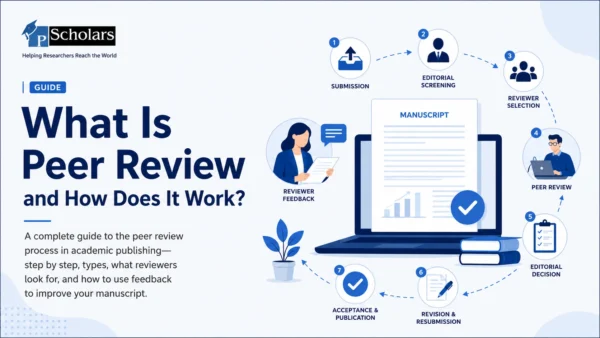
- The Peer Review Process: Step by Step
- Stage 1: Manuscript Submission
- Stage 2: Editorial Desk Review (1–4 weeks)
- Stage 3: Reviewer Identification and Invitation (1–3 weeks)
- Stage 4: Peer Review (4–12 weeks)
- Stage 5: Editorial Decision
- Stage 6: Revision and Resubmission
- Stage 7: Second Review and Final Decision
- Stage 8: Acceptance and Production
- Types of Peer Review
- Single-Blind Peer Review (Most Common)
- Double-Blind Peer Review
- Open Peer Review
- Post-Publication Peer Review
- Registered Reports
- What Reviewers Are Looking For
- Common Reasons for Rejection During Peer Review
- How to Respond to Reviewer Comments
- How Long Does Peer Review Take?
- The Reviewer’s Perspective: What It Is Like to Review a Paper
- Who reviews papers and why
- What a typical review week looks like
- How reviewers write their reports
- The Future of Peer Review
- Registered Reports
- Open Peer Review
- Post-Publication Review Platforms
- Artificial Intelligence in Peer Review
- What to Expect From Different Peer Review Models as an Author
- Submitting to a single-blind journal
- Submitting to a double-blind journal
- Submitting to an open review journal
- Frequently Asked Questions
- Why does peer review take so long?
- Can I appeal a peer review rejection?
- Should I suggest reviewers when submitting?
- What if I think I know who my reviewers are?
- What should I do if I have not heard from a journal after 3 months?
- What is the difference between major and minor revision?
- Are peer reviewer comments always right?
- Can I see who reviewed my paper?
- Useful guides for researchers preparing to submit
- Conclusion
Peer review is the cornerstone of academic publishing. It is the process by which scientific manuscripts are evaluated by qualified experts in the same field before publication — a quality filter designed to identify errors, strengthen conclusions, and ensure that only credible research enters the permanent scientific record.
Despite its centrality to academic publishing, peer review remains partially understood by many researchers who submit papers regularly. This guide explains exactly what happens at each stage, what reviewers evaluate, how different peer review models affect your experience as an author, and how to use reviewer feedback productively.
What Is Peer Review?
Peer review is a formal evaluation process in which a submitted manuscript is assessed by two or more independent experts (peers) in the same field. These reviewers examine the manuscript’s scientific validity and rigour, originality and significance, appropriateness of methodology, accuracy of statistical analysis, quality of presentation, and soundness of conclusions relative to the data.
Based on reviewer reports, the journal editor makes a publication decision. Peer review does not guarantee that published research is correct — errors and even fraud sometimes pass through. But it provides a structured, expert check on quality before publication that substantially improves the reliability of the published literature.
The Peer Review Process: Step by Step
Stage 1: Manuscript Submission
The author submits a manuscript via the journal’s online submission system, along with a cover letter and required declarations (ethics approval, conflicts of interest, author contributions). At this point, the manuscript enters the editorial queue.
Stage 2: Editorial Desk Review (1–4 weeks)
Before the manuscript reaches external reviewers, one or more editors evaluate it. They assess:
- Does the paper fall within the journal’s scope?
- Is it technically complete (all required sections, appropriate length, proper formatting)?
- Does it represent a sufficient contribution to warrant the use of reviewer time?
- Does the abstract and framing suggest findings of appropriate significance for this journal?
Papers that fail this assessment are desk-rejected — sometimes within days — without going to external reviewers. At highly selective journals, 50–70% of submissions are desk-rejected at this stage. This is not usually a quality judgment — it is a significance and fit judgment.
Stage 3: Reviewer Identification and Invitation (1–3 weeks)
If the paper passes desk review, the editor identifies potential reviewers — typically 2 to 4 experts in the manuscript’s specific subject area. Editors identify reviewers by:
- Their own knowledge of the field
- The manuscript’s reference list (researchers who work on related topics)
- Reviewer suggestion databases and recommendation systems
- Author suggestions (if the journal requests these)
Invited reviewers can accept or decline. Because peer review is unpaid voluntary work, editors frequently need to invite 5–10 researchers before 2 accept. This invitation process alone takes 1–3 weeks.
Stage 4: Peer Review (4–12 weeks)
Accepted reviewers read the full manuscript — typically multiple times — and prepare a detailed report. They submit:
- A confidential recommendation to the editor (accept, revise, or reject)
- A detailed report for the authors (comments, criticisms, questions, suggestions for improvement)
- Sometimes a confidential note to the editor with concerns not shared with the authors
The review period typically takes 4–12 weeks, though delays are common because reviewers are busy researchers with their own deadlines and competing commitments.
Stage 5: Editorial Decision
The editor reads all reviewer reports, evaluates them in context of the journal’s standards, and issues one of four decisions:
Decision Meaning Typical next step
Accept as is Publish without changes Very rare on first submission; move to production
Minor revisions Small changes needed; overall decision is positive Revise and resubmit; usually re-evaluated by editor only
Major revisions Significant work required; outcome uncertain Revise thoroughly and resubmit; usually goes back to reviewers
Reject Paper is not suitable for this journal Consider feedback; revise and submit elsewhere
Stage 6: Revision and Resubmission
For revision decisions, authors receive the reviewer reports and must prepare:
- A revised manuscript clearly showing all changes (tracked changes, highlighted text, or change summary)
- A point-by-point response letter addressing every reviewer comment
This is a critical stage. Thorough, respectful, well-reasoned responses to reviewer comments significantly increase acceptance probability at the resubmission stage.
Stage 7: Second Review and Final Decision
For major revision submissions, the editor typically returns the paper to the original reviewers, who assess whether the concerns have been adequately addressed. If satisfied, they recommend acceptance. If not, they may request further revisions or recommend rejection.
For minor revision submissions, the editor usually makes the final decision without returning the paper to reviewers.
Stage 8: Acceptance and Production
Once accepted, the manuscript moves to production: copyediting, typesetting, author proofing, and eventual online and print publication.
Types of Peer Review
Different journals use different peer review models. Understanding the model your target journal uses affects both how you write your manuscript and what to expect as an author.
Single-Blind Peer Review (Most Common)
Reviewers know the identity of the authors, but authors do not know who reviewed their paper.
Advantages: Reviewers can assess the authors’ track record and institutional context; may help identify genuine experts
Disadvantages: Potential for prestige bias (famous researchers or elite institutions may receive more lenient reviews); potential for competitive bias
Double-Blind Peer Review
Neither reviewers nor authors know each other’s identities.
Advantages: Reduces prestige bias, gender bias, and institutional bias; evaluates the science on its merits
Disadvantages: True anonymity is often compromised — experienced reviewers frequently identify authors from writing style, institutional context, or citation patterns
For double-blind submission, you must prepare a blinded manuscript: remove your names, affiliations, and self-identifying references from the main text.
Open Peer Review
Reviewers and authors know each other’s identities. Published reviewer reports may be visible to readers after publication.
Advantages: Increases reviewer accountability; promotes transparency in scientific evaluation; reduces frivolous or vindictive reviews; enables published reviewer contributions to be cited
Disadvantages: Some reviewers are less candid when their identity is known; junior researchers may hesitate to critique senior authors
Open peer review is increasingly adopted — by BMJ, PLOS journals, eLife, F1000Research, and others.
Post-Publication Peer Review
Community comment on papers after publication, through platforms like PubPeer, journal commenting systems, or formal post-publication review services.
Registered Reports
A growing model in which peer review evaluates the research question and methodology before data collection. If accepted, the paper is published regardless of results (positive or negative). This eliminates publication bias and encourages honest reporting of null results.
What Reviewers Are Looking For
Understanding the reviewer’s perspective helps you write a stronger manuscript. Reviewers evaluate manuscripts against criteria that typically include:
Novelty: Has this been published before? Does it advance knowledge in a meaningful way beyond confirming what was already known?
Rigour: Is the methodology appropriate for the research question? Are controls adequate? Are statistical analyses correct and appropriate?
Validity: Do the conclusions follow from the data? Are claims calibrated to the strength of the evidence? Is there overclaiming?
Reproducibility: Is there sufficient methodological detail for another researcher to replicate the study? Are data and code available where appropriate?
Clarity: Is the paper well-written, logically structured, and accessible to the journal’s readership? Are figures and tables self-explanatory?
Ethics: Were appropriate ethics approvals obtained? Is participant data properly anonymised? Are conflicts of interest declared?
Literature engagement: Does the paper accurately represent the existing literature? Are relevant prior studies cited and discussed fairly?
Common Reasons for Rejection During Peer Review
- Conclusions that overreach what the data actually support
- Methodological weaknesses: inadequate controls, small sample size, inappropriate statistics
- Lack of novelty — the finding was already known or was recently published elsewhere
- Poor writing that obscures the scientific content and makes the work inaccessible
- Incomplete literature review — important related work not cited or discussed
- Missing ethical declarations or inadequate ethics approvals
- Figures or data presentation that are unclear or inconsistent with the text
How to Respond to Reviewer Comments
Receiving reviewer comments — even harsh ones — is one of the most valuable forms of free expert consultation you will receive on your work. The researchers who advance fastest are those who treat reviewers as collaborators rather than adversaries.
Principles for effective revision responses:
- Address every comment without exception. Even comments you disagree with require a substantive response.
- Be specific about what you changed. “We have revised the methods section on page X, lines Y–Z, to clarify the statistical approach” is useful. “We have improved the methods section” is not.
- Disagree respectfully and with evidence. If you believe a reviewer is factually incorrect, explain why with citations. Polite, evidence-based disagreement is entirely appropriate.
- Do not just appease reviewers. Make genuine improvements to the paper, not superficial changes designed to satisfy reviewer checklists.
- Thank reviewers sincerely. Even if their comments are frustrating, reviewers are contributing their expertise unpaid. Acknowledge this in your response.
How Long Does Peer Review Take?
Stage Typical Duration
Desk review 1–4 weeks
Reviewer invitation 1–3 weeks
First peer review 4–12 weeks
Total to first decision 6–20 weeks
Revision by authors 1–3 months
Second review 2–8 weeks
The median time from submission to first decision across all fields is approximately 12–16 weeks. High-volume journals with large reviewer pools tend to be faster; specialist journals in smaller fields tend to be slower due to reviewer scarcity.
The Reviewer’s Perspective: What It Is Like to Review a Paper
Understanding peer review from the reviewer’s side illuminates why the process takes the time it does and why reviewer comments vary so widely in quality and tone.
Who reviews papers and why
Peer reviewers are typically mid-career to senior researchers in the same speciality as the manuscript. They review because:
- It is a professional norm and expectation in academic science
- It provides early visibility into upcoming research in their field
- It is a way to maintain awareness of the literature without reading everything
- Some reviewers find genuine intellectual satisfaction in the work
Reviewers are not paid by journals (with rare exceptions in some newer OA models). They receive no financial compensation for what is typically 4–8 hours of careful work per manuscript. This context is important for authors to understand when interpreting reviewer comments — a reviewer who takes the time to write detailed, constructive feedback is providing a genuine service at personal cost.
What a typical review week looks like
An active researcher in most biomedical or life science fields receives 1–4 review invitations per week. Accepting all of them is impossible — most researchers accept roughly 1 in 3–5 invitations, targeting reviews where they have genuine expertise and can provide useful feedback. After accepting, a reviewer typically needs 2–3 weeks to fit the review into their schedule alongside their own research, teaching, and administrative commitments.
This is the structural reason peer review takes months: even after a reviewer accepts, the actual review work typically happens in fragments over 2–4 weeks.
How reviewers write their reports
Most experienced reviewers use a consistent structure:
- Brief summary of the paper’s claims (1–2 sentences)
- Overall assessment of merit and significance
- Major concerns (methodological, analytical, or interpretive issues that must be addressed)
- Minor concerns (presentation, clarity, citation gaps, figure quality)
- A recommendation to the editor (accept, minor revision, major revision, reject)
The recommendation to the editor is confidential and may differ from the tone of the visible reviewer comments. A reviewer may write relatively gentle comments to the authors while privately recommending rejection to the editor, particularly when the concerns are fundamental.
The Future of Peer Review
Peer review is under significant pressure to change, and several meaningful reforms are gaining traction.
Registered Reports
In the Registered Reports model, peer review evaluates the research question and methodology before data are collected. If the protocol is approved (Stage 1 acceptance), the completed paper is published regardless of the direction of results — positive, negative, or null. This eliminates publication bias and rewards honest reporting of null results.
Registered Reports are now offered by more than 300 journals across many disciplines. They are particularly valuable in psychology, clinical research, and social sciences — fields where replication crises have been most severe.
Open Peer Review
Open peer review — where reviewer identities and reports are published alongside the paper — is expanding. eLife, PLOS Medicine, BMJ, and dozens of other journals now publish reviewer reports. Evidence suggests this modestly reduces the incidence of destructive reviewer comments without reducing substantive critique.
Post-Publication Review Platforms
PubPeer (pubpeer.com) has become the de facto platform for post-publication community scrutiny. Researchers can post comments, questions, and concerns about any published paper, and authors are notified when comments appear. PubPeer has been instrumental in identifying image manipulation and data irregularities in published papers.
Artificial Intelligence in Peer Review
AI tools are beginning to assist — though not replace — peer review. Several journals now use AI to screen submitted manuscripts for:
- Statistical irregularities (GRIM test, SPRITE test)
- Image manipulation
- Plagiarism and text similarity
- Reference accuracy
These tools work alongside human reviewers, not instead of them. Full AI peer review of scientific manuscripts is not current practice and remains many years away from being reliable for complex scientific judgment.
What to Expect From Different Peer Review Models as an Author
Submitting to a single-blind journal
Your identity is known to reviewers. Reviewers may look up your prior work to assess credibility and expertise — this can work for or against you. Established authors at prominent institutions may receive somewhat more generous reviews; unknown authors at less prominent institutions may face higher skepticism. Prepare your manuscript to stand entirely on its scientific merits.
Submitting to a double-blind journal
Your identity is hidden from reviewers. Prepare a blinded manuscript by removing all author names and affiliations from the manuscript text, acknowledgements, and any self-identifying method references. Do not remove self-citations — this would require misrepresenting your own prior work. Instead, phrase citations neutrally: “as described in [Reference X]” rather than “as we previously showed.”
Submitting to an open review journal
Your identity is known to reviewers and their identity is known to you. If accepted, the reviewer reports are published alongside your paper. This transparency tends to produce somewhat more balanced and constructive reviews. Respond to reviewers with this public accountability in mind — your revision response may also be published.
Frequently Asked Questions
Why does peer review take so long?
Peer review is unpaid voluntary work done by busy researchers. Editors typically need to invite 5–10 potential reviewers before 2 accept, and accepted reviewers frequently miss deadlines and request extensions. This is the most significant bottleneck in academic publishing.
Can I appeal a peer review rejection?
Appeals are occasionally appropriate but usually unsuccessful. A valid basis for appeal is a factual error in a reviewer’s evaluation (misread your methods, made an incorrect claim about the literature) or a clear procedural problem. Disagreement with reviewers’ opinions is not a valid basis for appeal.
Should I suggest reviewers when submitting?
If the journal invites author suggestions, provide them. Suggest genuine experts who are not close collaborators. Editors do not necessarily use suggested reviewers, but the suggestion can be helpful when reviewer pools are small.
What if I think I know who my reviewers are?
In single-blind review, reviewers know who you are. You do not know who they are, and you should not attempt to identify them. Acting on suspected reviewer identity is a serious breach of publishing ethics.
What should I do if I have not heard from a journal after 3 months?
Check your submission system for the current status. If still “Under Review” or “With Editor,” send a brief, polite email to the editorial office asking for an update. Do not contact the editor-in-chief directly or attempt to identify reviewers.
What is the difference between major and minor revision?
Minor revision means the editor and reviewers are broadly satisfied and the decision is effectively positive — address the specific points raised and your paper will likely be accepted without going back to reviewers. Major revision means significant work is required and the outcome is genuinely uncertain — the revised paper will typically go back to the original reviewers, who may recommend rejection if they are not satisfied.
Are peer reviewer comments always right?
No. Reviewers are experts, not oracles. Reviewers make factual errors, misread manuscripts, apply inappropriate standards, and occasionally have undisclosed biases. If you believe a reviewer has made a factual error, address it respectfully and with evidence in your revision response. Your obligation is to respond substantively to every comment — not to agree with every comment.
Can I see who reviewed my paper?
In single-blind review, no — reviewer identities are confidential. In open peer review (increasing in prevalence), reviewer identities may be disclosed on publication. You should never attempt to identify anonymous reviewers through writing style analysis or other indirect methods — this is considered a serious breach of peer review ethics.
Useful guides for researchers preparing to submit
These PubScholars resources cover the full journal selection and submission process:
How to Choose the Right Journal for Your Paper — a practical framework for matching scope, audience, and impact factor to your manuscript
How to Publish a Research Paper — the complete step-by-step guide from manuscript prep to post-publication promotion
Impact Factor vs CiteScore: Which Matters More? — how the two metrics differ and when to use each
Does Impact Factor Affect Manuscript Acceptance Chances? — what IF signals about desk rejection rates and submission strategy
Which Journals Have the Highest Impact Factor? — field-by-field rankings across medicine, biology, chemistry, and physics
Conclusion
Peer review is an imperfect but essential part of scientific publishing. Understanding how it works — from desk review through to final acceptance — helps you submit more strategically, respond to feedback more productively, and view rejection and revision as normal parts of the process rather than personal failures. Every paper improves through rigorous peer review. The goal is not to survive it but to benefit from it.

I am a seasoned professional with over 9 years of transformative experience in the domains of molecular biology, immunology, and clinical research. With a career that spans from 2006 to 2018, my journey has been marked by a relentless pursuit of scientific excellence and an unwavering commitment to improving healthcare outcomes through groundbreaking research. I have worked at one of India’s premier medical institutions, AIIMS(All India Institute of Medical Sciences), where I contributed significantly to the fields of molecular biology and clinical research. My expertise in protein analysis and genetic studies allowed me to identify potential biomarkers and improve diagnostic accuracy, contributing to better healthcare outcomes for patients. Notably, the research work has been published in prestigious scientific journals such as the Indian Journal of Ophthalmology and the British Journal of Ophthalmology.
Publication in these esteemed journals reflects my commitment to advancing medical science and sharing insights with the global research community. These publications highlight my expertise in areas ranging from gene polymorphism and immune response mechanisms to the effects of chronic drug therapy, all contributing to the larger body of scientific knowledge. My passion for scientific communication led me to pursue an Executive Diploma in Medical Writing from CliMed Research Solutions and Curio Training and Research Institute (CTRI), India. This certification has further refined my ability to bridge the gap between complex scientific research and its practical applications in healthcare. My passion for content writing drives me to continuously create content that derives engagement ,build trust, and leaves a lasting impression on readers”.

