- The ICMJE Criteria for Authorship
- What Is Ghost Authorship?
- What Is Honorary Authorship?
- The CRediT Contributor Roles Taxonomy
- Author Order: What It Signals
- Preventing and Resolving Authorship Disputes
- Before the project begins
- During the project
- If a dispute arises
- Authorship in Collaborative and Large-Scale Research
- Authorship Disputes: How They Arise and How to Resolve Them
- Most common causes of authorship disputes
- Resolving authorship disputes: a practical framework
- Useful guides for researchers preparing to submit
- Conclusion
- Frequently Asked Questions
- Does contributing funding qualify someone for authorship?
- What if a supervisor insists on authorship without contributing?
- Can I list a deceased researcher as an author?
- Is the author order negotiable?
- What happens if an author refuses to sign off on the final version?
- Can I remove an author after submission?
Authorship in academic research carries both credit and responsibility. Yet authorship practices remain among the most disputed and violated areas of publication ethics. Ghost authorship, honorary authorship, disputes about author order, and disagreements about who qualifies as an author are pervasive across disciplines from medicine to social sciences to engineering.
Understanding the established criteria for authorship, recognising problematic authorship practices, and implementing transparent contribution tracking protects both your research integrity and your professional relationships.
The ICMJE Criteria for Authorship
The International Committee of Medical Journal Editors (ICMJE) has established the most widely adopted criteria for authorship across biomedicine and beyond. To be listed as an author, a researcher must meet ALL four criteria:
- Substantial contribution to the conception or design of the work, OR to the acquisition, analysis, or interpretation of data
- Drafting the work or critically revising it for important intellectual content
- Approval of the final version for publication
- Accountability agreement to be accountable for all aspects of the work, ensuring that questions related to the accuracy or integrity of any part are appropriately investigated and resolved
The keyword is AND. A researcher must satisfy all four criteria, not just one or two. Contributing only funding, providing laboratory space, collecting samples under supervision, or running standard assays — without intellectual contribution to the work’s conception and interpretation does not qualify for authorship under ICMJE criteria.
Researchers who contribute substantially but do not meet all four authorship criteria should be acknowledged in the acknowledgements section rather than listed as authors.
What Is Ghost Authorship?
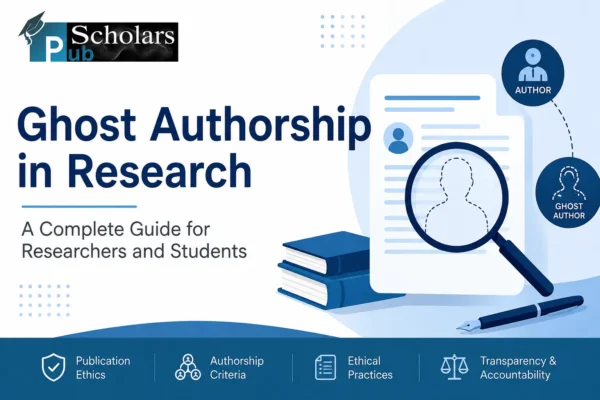
Ghost authorship occurs when someone who meets the ICMJE authorship criteria is not listed on the published paper. The ghost author has made real intellectual contributions but receives no recognition and is invisible to readers.
This is most common when:
Professional medical writers are employed by pharmaceutical companies or contract research organisations to draft or substantially revise manuscripts. If the writer makes qualifying intellectual contributions, they should be listed as an author. Not listing them conceals the involvement of parties who may have conflicts of interest.
Laboratory heads or senior supervisors who designed the study and supervised the analysis are sometimes excluded for political or competitive reasons, particularly in contentious lab environments.
Statisticians or methodologists who designed the analysis and interpreted the results may be relegated to acknowledgements despite qualifying contributions.
Ghost authorship is an ethical violation because it conceals real contributions, potentially including contributions from parties with undisclosed conflicts of interest, and misrepresents how the research was conducted.
What Is Honorary Authorship?
Honorary authorship (also called guest or gift authorship) occurs when someone is listed as an author despite not meeting the established criteria.
Common scenarios:
- A department head who is listed on all papers from their group regardless of their actual contribution
- A senior colleague added to improve the paper’s perceived prestige or improve acceptance prospects
- A collaborator added as professional reciprocity, expecting to be listed in return on future papers
- A funder’s representative added at the funder’s implicit or explicit request
Honorary authorship is problematic because it misrepresents who did the work, dilutes the accountability that authorship implies, and inflates the publication records of those who did not earn the recognition. In medicine, it can conceal conflicts of interest when industry representatives receive authorship credit.
The CRediT Contributor Roles Taxonomy
The Contributor Roles Taxonomy (CRediT) was developed to address authorship disputes and improve transparency by specifying exactly who did what. CRediT defines 14 distinct contributor roles:
| Role | Description |
|---|---|
| Conceptualisation | Ideas; formulation of research questions and goals |
| Data curation | Management and annotation of data |
| Formal analysis | Application of statistical or mathematical techniques |
| Funding acquisition | Securing financial support |
| Investigation | Conducting the research experiments |
| Methodology | Development or design of methodology |
| Project administration | Coordination and management |
| Resources | Provision of materials, reagents, samples |
| Software | Programming and implementation |
| Supervision | Oversight and leadership |
| Validation | Verification of results |
| Visualisation | Preparation of published visualisations |
| Writing – original draft | Preparation of the initial manuscript |
| Writing – review & editing | Critical review and revision |
Authors assign roles to each contributor, and this information is published with the paper. CRediT does not replace ICMJE authorship criteria; it supplements them by clarifying specific contributions among authors who all meet the criteria.
Author Order: What It Signals
Author order conventions vary by field and should be discussed explicitly at the outset of a project.
In most natural, life, and social sciences:
- First author: conducted the primary research, wrote the first draft, led the work intellectually
- Middle authors: contributed significantly but less centrally
- Last (senior) author: principal investigator, research supervisor, or most senior contributor; responsibility for the work
Equal contribution: When two authors contributed equally, journals typically allow “these authors contributed equally to this work” notation with the first two authors listed.
In mathematics: Author order is often alphabetical, with no first-author significance.
In large collaborations: Author order may follow a consortium policy, with a group authorship statement.
Preventing and Resolving Authorship Disputes
Most authorship disputes arise from lack of early communication. Prevention is far easier than resolution.
Before the project begins
- Discuss authorship expectations explicitly with all potential contributors
- Document provisional author list and each person’s role using CRediT or a similar framework
- Establish clear criteria for authorship and acknowledgement
During the project
- Update the contributor list as roles evolve some people contribute more than expected, others less
- Keep a record of contributions (meeting notes, data access logs, manuscript versions) that could serve as documentation if a dispute arises
- Address concerns about authorship early — do not let them fester until submission
If a dispute arises
- Discuss the dispute directly between the parties involved
- Reference the journal’s authorship guidelines and ICMJE criteria
- Involve your institution’s research integrity officer if direct discussion fails
- Do not attempt to add or remove authors after submission without explicit editorial approval — most journals require formal justification and approval for any post-submission authorship changes
Authorship in Collaborative and Large-Scale Research
In large multi-centre trials, genomics consortia, and other large collaborative projects, individual authorship lists can be impossible to manage. Common approaches:
Consortium authorship: The paper is published under a group name (e.g., “The CORONA Study Group”) with a supplementary list of all contributors and their roles.
Writing committee authorship: A smaller group of named authors who coordinated the writing, with the broader group listed as contributors.
CRediT contribution statements: Increasingly used to document contributions across large author lists transparently.
Authorship Disputes: How They Arise and How to Resolve Them
Authorship disputes are among the most common interpersonal conflicts in research teams, and among the most damaging to professional relationships and careers when handled poorly. Understanding how they arise and how to resolve them protects both scientific integrity and working relationships.
Most common causes of authorship disputes
Different expectations about what qualifies for authorship. A graduate student who contributed significant analytical work may expect first authorship; a principal investigator who conceptualised the study may expect first authorship for a different set of reasons. Without explicit early discussion, both expectations can be entirely sincere and entirely incompatible.
Contribution scope changing during the project. A researcher brought in for a specific task may end up making substantially larger contributions than originally anticipated — or substantially smaller ones. Provisional authorship agreements made at the start need to be revisited as projects evolve.
Lab culture norms vs. international standards. In some research environments, senior researchers are routinely added to all papers from their group regardless of contribution — a practice that violates ICMJE criteria but may feel normal and expected to junior researchers trained in that environment.
Post-submission changes. Disputes sometimes arise after submission when authors disagree on revisions or one author refuses to approve the final version. Most journals freeze authorship changes after submission without explicit editor approval.
Resolving authorship disputes: a practical framework
Step 1: Direct conversation, with ICMJE criteria as the reference point. Initiate a calm discussion among all parties, using the ICMJE criteria as a neutral, published standard rather than personal judgment. Focus on what each person contributed against each of the four criteria.
Step 2: Document contributions prospectively. If the dispute arises during a project, begin documenting contributions immediately using CRediT taxonomy or similar. This creates an objective record that prevents further escalation.
Step 3: Involve a neutral mediator. If direct conversation does not resolve the dispute, involve a neutral senior researcher, department head, or ombudsperson. Many institutions have formal mediation processes for research disputes.
Step 4: Escalate to research integrity if necessary. Persistent authorship disputes involving suspected ghost authorship, honorary authorship, or intentional exclusion of qualified contributors may require formal research integrity investigation.
Useful guides for researchers preparing to submit
These PubScholars resources cover the full journal selection and submission process:
How to Find Journal Metrics and Rankings Using the Best Tools — Learn how to evaluate academic journals using trusted metrics and ranking tools to identify high-quality publications for research and manuscript submission.
Understanding Journal Metrics for Tenure and Promotion — Discover how journal metrics influence tenure and promotion decisions and learn which indicators best demonstrate the impact and quality of your research publications.
Open Access vs Traditional Publishing: Which is Better for Researchers? — Compare open access and traditional publishing models to understand their benefits, limitations, costs, and impact on research visibility and academic success.
What Is h-Index in Research? A Complete Guide for Researchers — Learn what the h-index is, how it is calculated, and why it is an important metric for measuring a researcher’s academic impact and publication performance.
What to do When Research Paper is Rejected? — Learn how to respond to research paper rejection, improve your manuscript based on reviewer feedback, and increase your chances of acceptance in your next journal submission.
Conclusion
Authorship is a serious responsibility, not a gift or a courtesy. The ICMJE criteria exist to ensure that authorship accurately represents intellectual contribution and shared accountability. Ghost authorship conceals real contributors; honorary authorship misrepresents the work. Implementing CRediT contribution statements, having explicit authorship conversations early in every project, and documenting contributions throughout the research process are the most effective ways to prevent the disputes and violations that damage careers and scientific records.
Frequently Asked Questions
Does contributing funding qualify someone for authorship?
No. Funding acquisition alone does not meet the ICMJE criteria. A funder who had no intellectual contribution to the research design, analysis, or interpretation should not be listed as an author. They may be acknowledged.
What if a supervisor insists on authorship without contributing?
This is unfortunately common. Start by referring to published authorship guidelines from the target journal and ICMJE criteria. Document your concerns and communications. If the situation is not resolved, consult your institution’s research integrity officer or ombudsperson.
Can I list a deceased researcher as an author?
Yes, if they met the authorship criteria during their lifetime. Note their death with the date in the author note or acknowledgements.
Is the author order negotiable?
Within a lab or collaboration, yes — and it should be negotiated explicitly and early. First authorship is the most significant position in most fields and should reflect genuine intellectual leadership.
What happens if an author refuses to sign off on the final version?
This is a serious situation that can delay or prevent publication. Contact the journal editor early and explain the situation. The journal will advise on the appropriate process, which may involve submission of documentation about contributions. Most journals have procedures for handling authorship disputes during review.
Can I remove an author after submission?
Only with explicit editor approval and a clear rationale. Most journals require all current and proposed author lists to be approved by all involved parties when authorship changes are requested post-submission. Attempting to remove an author without proper process is itself a potential ethics violation.

I am a seasoned professional with over 9 years of transformative experience in the domains of molecular biology, immunology, and clinical research. With a career that spans from 2006 to 2018, my journey has been marked by a relentless pursuit of scientific excellence and an unwavering commitment to improving healthcare outcomes through groundbreaking research. I have worked at one of India’s premier medical institutions, AIIMS(All India Institute of Medical Sciences), where I contributed significantly to the fields of molecular biology and clinical research. My expertise in protein analysis and genetic studies allowed me to identify potential biomarkers and improve diagnostic accuracy, contributing to better healthcare outcomes for patients. Notably, the research work has been published in prestigious scientific journals such as the Indian Journal of Ophthalmology and the British Journal of Ophthalmology.
Publication in these esteemed journals reflects my commitment to advancing medical science and sharing insights with the global research community. These publications highlight my expertise in areas ranging from gene polymorphism and immune response mechanisms to the effects of chronic drug therapy, all contributing to the larger body of scientific knowledge. My passion for scientific communication led me to pursue an Executive Diploma in Medical Writing from CliMed Research Solutions and Curio Training and Research Institute (CTRI), India. This certification has further refined my ability to bridge the gap between complex scientific research and its practical applications in healthcare. My passion for content writing drives me to continuously create content that derives engagement ,build trust, and leaves a lasting impression on readers”.