

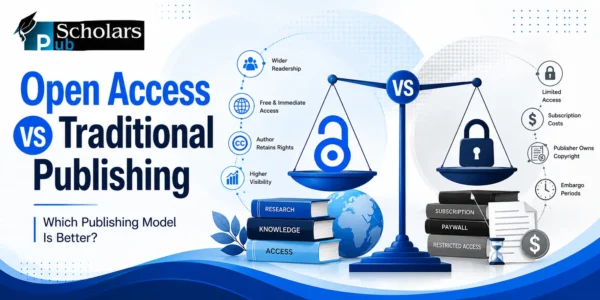
- How Traditional (Subscription) Publishing Works
- Who has access
- Who benefits
- How Open Access Publishing Works
- The Four Types of Open Access
- The APC Cost Question
- Funder and Institutional Mandates — Check These First
- Readership and Citation Impact
- Traditional Publishing
- Open Access (CC BY Licence)
- Predatory Open Access: A Real Risk
- How to Decide: A Practical Framework
- Open Access Business Models: Who Pays and How
- Gold OA with APCs (most commonly discussed)
- Diamond OA (no APCs — often overlooked)
- Subscribe-to-Open (S2O)
- Read and Publish / Transformative Agreements
- Green OA: The Free Route for Any Journal
- What version can you deposit?
- Where to deposit
- How to Evaluate Whether an OA Journal Is Legitimate
- Useful guides for researchers preparing to submit
- Frequently Asked Questions
- Does open access publishing cost the author money?
- Is open access lower quality than traditional publishing?
- Can I publish in a traditional journal and still make my paper OA? h4
- My funder requires open access. What is the cheapest route?
- What is a Creative Commons licence and which should I use?
- Conclusion
Academic publishing has changed fundamentally over the past two decades. In the debate of open access vs traditional publishing, open access journals have moved from a fringe experiment to a mainstream publishing model, driven by funder mandates, institutional policies, and a growing commitment to making research freely available to everyone. Evidence also suggests that open access articles can reach broader audiences and increase research visibility.
For researchers today, the choice between open access and traditional subscription publishing is one of the most consequential practical decisions in the publication process. It affects compliance with funder mandates, the cost of publication, your paper’s readership, and the legal terms under which your work can be used. This guide explains both models clearly and helps you decide which is right for your paper.
How Traditional (Subscription) Publishing Works
In the traditional publishing model:
- Authors submit manuscripts at no direct cost
- The journal funds operations through subscriptions paid by libraries, institutions, and individual readers
- Published articles are behind a paywall — accessible only to those with subscription access
- Authors typically assign copyright to the publisher
- Authors retain limited rights to share their work (usually the accepted manuscript after an embargo period)
Who has access
Researchers at well-funded institutions with broad library subscriptions can access most content they need. Researchers at smaller institutions, practitioners in low-income countries, independent researchers, and the general public face paywalls that can charge $30–50 per individual article.
Who benefits
Publishers generate revenue from institutional subscriptions. Authors at well-resourced institutions benefit from free submission.
How Open Access Publishing Works
In open access publishing:
- Published articles are immediately and permanently freely available online to anyone
- Funding typically comes from article processing charges (APCs) paid by authors, their institutions, or funders
- Authors usually retain copyright under Creative Commons licences (most commonly CC BY)
- Anyone can legally read, share, translate, and build on the work with attribution
The Four Types of Open Access
Gold OA: The final published version is immediately and permanently freely available on the journal’s website upon publication. APCs are typically required from authors or their funders.
Green OA: Authors self-archive a preprint or accepted manuscript version in an institutional repository (e.g., their university’s repository) or a subject repository (e.g., PubMed Central, arXiv). The publisher’s formatted version remains paywalled, but the accepted manuscript is freely accessible.
Diamond (Platinum) OA: Fully open access journals with no APCs — funded by institutions, academic societies, or grants. Examples include many society journals and government-funded publications in certain countries.
Hybrid OA: Traditional subscription journals that offer authors the option to make their individual article open access for an APC, while the rest of the journal remains paywalled. This model has been criticised as “double dipping” when libraries continue to pay subscription fees while also paying APCs.
The APC Cost Question
The most significant practical difference for authors is cost. APCs vary enormously:
| Publisher model | Typical APC range | Examples |
|---|---|---|
| Diamond OA | Free (no APC) | Many society journals, PLOS ONE waiver countries |
| Mid-tier OA journals | $500–$2,000 | Many MDPI, Frontiers journals |
| Major publisher OA | $2,000–$5,000 | Springer Nature, Elsevier, Wiley OA options |
| Nature Portfolio OA | $5,000–$11,500 | Nature, Nature Medicine, Nature Communications |
Most funders that mandate OA also provide APC funding. Check whether your grant includes an OA budget before assuming you cannot afford it.
APC waivers are widely available for researchers from low- and middle-income countries. Major publishers including Elsevier, Springer Nature, Wiley, and Taylor & Francis offer geographic waivers — check each journal’s specific policy.
Funder and Institutional Mandates — Check These First
Open access is no longer simply a choice for many researchers. It is a legal requirement under their funding conditions.
| Funder / Policy | Requirement |
|---|---|
| Plan S (Europe: ERC, Wellcome, many national funders) | Immediate OA with CC BY licence for all funded research |
| NIH (USA) | Deposit in PubMed Central within 12 months (moving to immediate OA) |
| UKRI (UK) | Immediate OA for all funded research |
| Gates Foundation | Immediate OA with CC BY licence |
| Most major European national funders | Immediate OA, licence varies |
If you have received public funding, check your grant conditions carefully before choosing a traditional paywalled journal. Failure to comply can result in sanctions, ineligibility for future funding, and reputational damage.
Even without a specific mandate, many institutions now have institutional OA policies requiring deposit in their repository. Check your institution’s research office requirements.
Readership and Citation Impact
A widely cited argument for open access is that it increases citations by removing access barriers. The evidence is mixed but generally positive:
- Multiple studies across different fields find an open-access citation advantage of 18–36% for OA articles compared to paywalled equivalents
- The effect is strongest in fields where non-institutional readership matters: clinical medicine, public health, applied sciences, social sciences
- In fields where preprints are universal (physics, mathematics, economics), the OA advantage is less clear because freely available preprints reduce the access barrier regardless of journal policy
Beyond the citation question, OA ensures your work is readable by a broader audience, while journal selection decisions are often influenced by metrics such as Impact Factor and CiteScore.
- Clinicians and practitioners without academic library access
- Researchers in low-income countries
- Independent researchers, consultants, and policy analysts
- Journalists, policymakers, and the public
- Future researchers whose institutions may not maintain subscriptions
Copyright: Who Owns Your Work?
This is one of the most consequential differences between the two models.
Traditional Publishing
Authors typically assign copyright to the publisher. This means:
- Reusing your own figures in presentations, teaching materials, or subsequent papers requires permission (usually granted, but cumbersome)
- Including the paper in your thesis may require written permission
- Sharing the paper freely on your website may violate your agreement unless it is the accepted manuscript version
Open Access (CC BY Licence)
Authors retain copyright. The Creative Commons Attribution licence (CC BY) permits anyone to:
- Read, share, download, and distribute the paper
- Translate, adapt, or build upon it
- Use it commercially
- Include it in compendia and databases
The only requirement is attribution to the original authors. This is substantially more permissive and increasingly preferred by funders and institutions.
Predatory Open Access: A Real Risk
The OA APC model has been exploited by predatory publishers who charge fees without providing genuine peer review. This is a risk unique to OA — traditional subscription journals do not typically charge authors.
Key warning signs: unsolicited email invitations, implausibly fast acceptance, no verifiable editorial board, not indexed in major databases.
Always use Think. Check. Submit. (thinkchecksubmit.org) to verify any unfamiliar OA journal before submitting.
How to Decide: A Practical Framework
Use this decision tree before submitting any paper:
Step 1: Check your funder’s requirements. If you have a funder mandate for OA, you must comply. Identify journals that meet the mandate requirements (immediate OA, CC BY licence, indexed databases) and proceed to Step 3.
Step 2: Check your institution’s policy. Even without a funder mandate, your institution may require deposit in a repository (green OA), which is free and compatible with traditional journal publication.
Step 3: Choose based on audience and scope fit. OA if your work has broad relevance beyond institutional subscribers, particularly when targeting journals evaluated through metrics such as journal impact factor. Traditional if the best-fit journal for your work is a traditional subscription journal and your funder does not mandate OA.
Step 4: Check APC costs and availability. If OA is appropriate, confirm your funding covers the APC or that you qualify for a waiver, and review whether impact factor affects manuscript acceptance chances at your target journal.
Open Access Business Models: Who Pays and How
The economics of open access publishing are more varied than the APC-focused conversation suggests. Understanding the full landscape helps you identify OA options that may cost you nothing.
Gold OA with APCs (most commonly discussed)
Author or funder pays an article processing charge. The final published version is immediately and freely available. APCs range from zero at some society journals to over $11,000 at the highest-tier Nature Portfolio journals.
Diamond OA (no APCs — often overlooked)
The journal charges no APCs because it is funded by an institution, academic society, research council, or government. Dozens of well-regarded journals operate on this model, including many published by learned societies, university presses, and national academies.
Finding diamond OA options: search the Directory of Open Access Journals (doaj.org) filtered by “no APCs.” In many fields, genuinely high-quality Q1 journals operate on this model.
Subscribe-to-Open (S2O)
A newer model in which libraries collectively subscribe to a journal on the condition that the publisher makes all content OA. If subscription revenue is maintained, the journal flips to OA for that year at no APC. PLOS and the Annual Reviews have pioneered this model.
Read and Publish / Transformative Agreements
Increasingly common in Europe and the UK: institutions negotiate “transformative agreements” with major publishers that cover both reading access (subscriptions) and OA publishing for institution-affiliated authors at no direct author cost. If your institution has such an agreement with a publisher (increasingly common with Elsevier, Springer, Wiley, Taylor & Francis), you may be able to publish OA with no APC charge.
Check with your institution’s library whether transformative agreements are in place. In 2025, the majority of major European research universities have at least one such agreement, covering tens of thousands of journals.
Green OA: The Free Route for Any Journal
Green OA — depositing a version of your paper in a repository — is available for most papers regardless of whether the journal is OA. This is the most underused and most universally available OA route.
What version can you deposit?
Version Content
Typically permitted?
Preprint (submitted version) Pre-peer review draft
Almost always
Accepted manuscript (postprint) Peer-reviewed, author's final version
Usually after embargo (6–12 months)
Version of record (VoR)
Publisher's final formatted PDF Rarely permitted for non-OA journals
Check the specific policy for your journal at sherpa.ac.uk/romeo — the definitive database of publisher self-archiving policies.
Where to deposit
- Your institution’s repository (free, permanent, usually satisfies funder mandates)
- PubMed Central (required for NIH-funded research)
- arXiv, bioRxiv, medRxiv (subject repositories — also serve as preprint servers)
- Zenodo (CERN-operated, free, permanent DOI, any discipline)
How to Evaluate Whether an OA Journal Is Legitimate
The growth of predatory OA publishing — journals that charge APCs without providing genuine peer review — makes verification essential for any unfamiliar OA journal.
Quick verification checklist
- DOAJ listing: doaj.org — listed journals have passed a quality assessment including peer review verification
- COPE membership: cope.org/members — publisher is committed to ethical publication standards
- Web of Science or Scopus indexing: mjl.clarivate.com or scopus.com/sources
- OASPA membership: oaspa.org — Open Access Scholarly Publishers Association membership
- Think. Check. Submit.: thinkchecksubmit.org — structured verification checklist
A journal that passes 3 of these 5 checks is almost certainly legitimate. A journal that passes none should be treated as suspect regardless of how its website appears.
Useful guides for researchers preparing to submit
These PubScholars resources cover the full journal selection and submission process:
How to Choose the Right Journal for Your Paper — a practical framework for matching scope, audience, and impact factor to your manuscript
How to Publish a Research Paper — the complete step-by-step guide from manuscript prep to post-publication promotion
Impact Factor vs CiteScore: Which Matters More? — how the two metrics differ and when to use each
Does Impact Factor Affect Manuscript Acceptance Chances? — what IF signals about desk rejection rates and submission strategy
Which Journals Have the Highest Impact Factor? — field-by-field rankings across medicine, biology, chemistry, and physics
Frequently Asked Questions
Does open access publishing cost the author money?
Not always. Diamond OA journals charge no APCs. Green OA (self-archiving an accepted manuscript) is always free. Gold OA typically costs $500–$11,000+ in APCs, but funders increasingly cover these costs, and transformative agreements may eliminate them entirely at your institution.
Is open access lower quality than traditional publishing?
No. Many of the world’s highest-impact journals are fully OA, including PLOS Biology, eLife, Nature Communications, and the BMJ. OA status says nothing about peer review quality. The peer review process determines quality — independently of the access model.
Can I publish in a traditional journal and still make my paper OA? h4
Yes, through green OA. Most traditional journals allow deposit of the accepted manuscript in an institutional repository after an embargo period of 6–12 months. Check your journal’s policy at sherpa.ac.uk/romeo.
My funder requires open access. What is the cheapest route?
First, check whether your institution has a transformative agreement that covers OA publishing at your target journal — this may be free. If not, check whether your funder provides an APC budget as part of your grant. If not, look for diamond OA alternatives in your field (doaj.org), or use green OA by depositing in your institutional repository after the embargo period.
What is a Creative Commons licence and which should I use?
A Creative Commons licence specifies what others can legally do with your published work. CC BY (Attribution) is the most permissive — anyone can use, share, translate, and build on the work as long as they credit you. Most major funders require CC BY. CC BY-NC restricts commercial use. Check your funder’s specific licence requirement before selecting.
Conclusion
Open access and traditional publishing are increasingly complementary rather than competing models. The choice between them depends on your funder requirements, your institution’s policies, your target audience, your APC budget, and the specific journals available in your field. Check funder compliance requirements first — they are non-negotiable.Then choose the model that best serves your paper’s dissemination goals and aligns with your target journals, including those with the highest impact factors in your discipline. The research community is clearly moving toward greater openness; understanding the landscape positions you to navigate it confidently.

I am a seasoned professional with over 9 years of transformative experience in the domains of molecular biology, immunology, and clinical research. With a career that spans from 2006 to 2018, my journey has been marked by a relentless pursuit of scientific excellence and an unwavering commitment to improving healthcare outcomes through groundbreaking research. I have worked at one of India’s premier medical institutions, AIIMS(All India Institute of Medical Sciences), where I contributed significantly to the fields of molecular biology and clinical research. My expertise in protein analysis and genetic studies allowed me to identify potential biomarkers and improve diagnostic accuracy, contributing to better healthcare outcomes for patients. Notably, the research work has been published in prestigious scientific journals such as the Indian Journal of Ophthalmology and the British Journal of Ophthalmology.
Publication in these esteemed journals reflects my commitment to advancing medical science and sharing insights with the global research community. These publications highlight my expertise in areas ranging from gene polymorphism and immune response mechanisms to the effects of chronic drug therapy, all contributing to the larger body of scientific knowledge. My passion for scientific communication led me to pursue an Executive Diploma in Medical Writing from CliMed Research Solutions and Curio Training and Research Institute (CTRI), India. This certification has further refined my ability to bridge the gap between complex scientific research and its practical applications in healthcare. My passion for content writing drives me to continuously create content that derives engagement ,build trust, and leaves a lasting impression on readers”.

