- What Is a Predatory Journal?
- The Scale of the Problem
- How Predatory Publishing Exploits the Open-Access Model
- Warning Signs of Predatory Journals
- 1. Unsolicited Email Invitations
- 2. Implausibly Fast Acceptance
- 3. Very Broad or Vague Scope
- 4. Fabricated or Unverifiable Editorial Board
- 5. Claimed Unofficial Impact Factors
- 6. Not Indexed in Major Databases
- 7. Suspicious Contact and Payment Information
- The Business Model Behind Predatory Publishing
- How Predatory Publishers Harvest Author Information
- Borderline Publishers: The Grey Zone
- Protecting Junior Researchers From Predatory Publishing
- How to Verify a Journal’s Legitimacy
- Think. Check. Submit. (thinkchecksubmit.org)
- Verify Database Indexing Directly
- Check COPE and OASPA Membership
- Check the Directory of Open Access Journals (DOAJ)
- The Consequences of Publishing in a Predatory Journal
- Conclusion
- Useful guides for researchers preparing to submit
- Frequently Asked Questions
- How can I tell immediately if a journal is predatory?
- Are all open-access journals potentially predatory?
- What if I have already published in a predatory journal?
- Can I retract a paper from a predatory journal?
- How are predatory publishers being addressed at a systemic level? \
Predatory publishing is one of the most significant threats to research integrity in the era of open-access academic publishing. Every year, thousands of researchers — particularly early-career scientists under publication pressure — submit their work to predatory journals, unknowingly paying article processing charges for what amounts to no genuine peer review, no editorial quality control, and no meaningful indexing.
Understanding what predatory publishing is, how to recognise it, and how to protect yourself is an essential survival skill for every researcher in the current publishing environment.
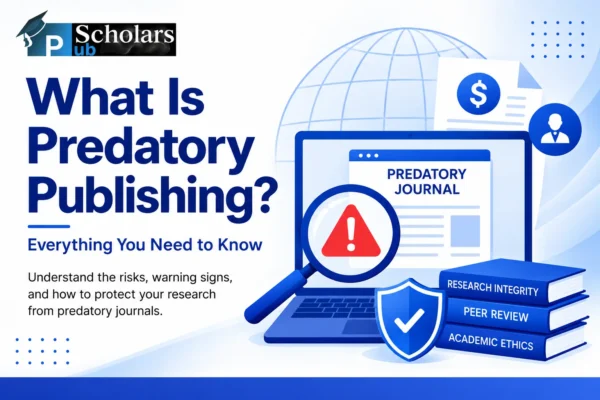
What Is a Predatory Journal?
A predatory journal is a publication that claims to be a legitimate peer-reviewed academic journal but does not actually deliver the services it advertises. Specifically, predatory journals:
- Collect article processing charges from authors
- Do not conduct genuine peer review (or conduct only a superficial simulation of it)
- Lack credible editorial boards
- Publish anything that arrives with payment, regardless of quality
- Misrepresent their indexing status, impact factors, or editorial processes
The term predatory was coined by librarian Jeffrey Beall, who maintained a widely used list of suspect publishers until 2017. The concept has since been refined and studied by researchers and institutions worldwide.
The Scale of the Problem
A 2019 study in Nature Medicine estimated that over 400,000 papers per year are published in predatory journals. A 2022 review found that predatory publication is increasing across all regions and disciplines, with particular prevalence in clinical medicine and materials science.
How Predatory Publishing Exploits the Open-Access Model
Legitimate open-access publishing is ethical, scientifically rigorous, and increasingly mandated by funders. The OA model funds publication through APCs paid by authors or their institutions, in exchange for immediately and freely accessible research.
Predatory publishing parasitises this model by mimicking its appearance — collecting APCs — without providing its substance: genuine peer review, editorial quality control, or reliable indexing. The predatory publisher profits from the author’s desire for publication and from the pressure academics face to produce published output.
The result is research published under the appearance of scientific legitimacy that has received no meaningful quality control.
Warning Signs of Predatory Journals
No single indicator is definitive on its own, but the following patterns — particularly in combination — are strong warning signs.
1. Unsolicited Email Invitations
Legitimate journals occasionally contact known experts. Mass emails to broad lists of researchers — often harvested from conference websites, academic directories, or recent publication records — are characteristic of predatory publishers. These emails often:
- Use flattering but generic language (“We were impressed by your expertise in…”)
- Offer unusually fast publication timelines
- Promise guaranteed acceptance
- Come from webmail addresses (Gmail, Yahoo) rather than institutional accounts
2. Implausibly Fast Acceptance
Peer review takes weeks to months. Acceptance within days of submission — especially without meaningful reviewer comments — indicates no genuine peer review occurred. Any journal offering “peer review in 3–5 days” or “guaranteed acceptance within 1 week” should be treated as highly suspect.
3. Very Broad or Vague Scope
Predatory journals often describe themselves as covering all of science, all of medicine, or entire multidisciplinary fields without a defined disciplinary focus. Legitimate journals have specific, well-defined scopes.
4. Fabricated or Unverifiable Editorial Board
A tell-tale sign is an editorial board listing that cannot be verified:
- Check whether each listed editor is a real researcher at a real institution
- Search for the listed researchers — do they acknowledge their role on this journal?
- Some predatory journals list distinguished researchers without their knowledge or consent
If you cannot independently verify that at least 3–4 listed editors are genuine researchers who acknowledge their roles, treat the journal as suspect.
5. Claimed Unofficial Impact Factors
Only Clarivate’s Journal Citation Reports publishes official impact factors. Some predatory journals claim “impact factors” from services such as Index Copernicus Value, Global Impact Factor, or Universal Impact Factor — none of which are legitimate bibliometric measures.
If a journal claims an impact factor, verify it exists in the Web of Science Master Journal List at mjl.clarivate.com. If the journal is not there, the claimed impact factor is not official.
6. Not Indexed in Major Databases
Verify database indexing directly:
- PubMed: nlm.nih.gov/journals (NLM catalogue)
- Web of Science: mjl.clarivate.com
- Scopus: scopus.com/sources
Absence from all major databases is a significant red flag. Note that new legitimate journals may not yet be indexed — but the absence of indexing combined with other warning signs is decisive.
7. Suspicious Contact and Payment Information
- Contact addresses that are webmail accounts or anonymous email services
- Physical addresses that cannot be verified as genuine publisher offices
- Payment requests via PayPal or informal channels rather than institutional invoicing systems
- Pressure to pay before or during peer review.
The Business Model Behind Predatory Publishing
Understanding why predatory publishing exists helps you recognise it. The business model is straightforward: charge article processing charges (APCs) to desperate or uninformed authors, provide minimal or no actual editorial service, and keep the difference as profit.
The growth of open-access publishing created a legitimate APC model that predatory publishers imitate. By mimicking the appearance of legitimate OA journals — journal websites, editorial board listings, peer review claims — predatory publishers can collect APCs from authors who do not know how to verify legitimacy.
The economics are compelling for predators: a journal charging $500 per paper that publishes 200 papers per year generates $100,000 with minimal overhead. Scaled to dozens or hundreds of such journals under one publisher umbrella, this becomes a very profitable enterprise.
Several known predatory publishing operations — OMICS International, MDPI (disputed — considered by some legitimate, by others borderline), and others — have been the subject of regulatory actions, including a US Federal Trade Commission case against OMICS in 2017 that resulted in a $50 million judgment.
How Predatory Publishers Harvest Author Information
Predatory publishers identify potential targets through:
Academic databases and directories: Researchers who publish in legitimate journals, present at conferences, or appear in faculty directories are systematically targeted. Your publications in legitimate journals become the source material for targeted invitation emails.
Conference attendee lists: Email lists from conferences are sometimes sold or harvested and used to send mass invitations.
Institutional websites: Faculty directories with email addresses are scraped for contact information.
ResearchGate and Academia.edu: Profiles on academic social networks are targeted.
The mass email system means researchers receive invitations for journals in completely unrelated fields — a geneticist receiving invitations to submit to a journal of economics or engineering is a tell-tale sign of automated, untargeted predatory outreach.
Borderline Publishers: The Grey Zone
Not all potentially problematic publishers fall neatly into “predatory” or “legitimate” categories. Some publishers are in a grey zone where practices are substandard but not fully fraudulent:
- Peer review occurs but is minimal and not rigorous
- Turnaround is fast but not implausibly fast
- Editorial boards are real but thin
- Indexing is in some databases but not major ones
Publishing in these borderline venues carries real risks — work may be poorly reviewed, less visible, and may be associated with lower prestige — without the outright fraud of predatory publishing. The Think. Check. Submit. checklist and DOAJ verification remain the most reliable screening tools for this grey zone as well.
Protecting Junior Researchers From Predatory Publishing
Early-career researchers face particular vulnerability to predatory journals because:
- Publication pressure at PhD and postdoc stage is intense
- They may not yet have the field knowledge to recognise legitimate vs. predatory venues
- They may be unfamiliar with legitimate journal selection processes
- Flattering invitation language appeals to researchers who feel uncertain about their work’s quality
Senior researchers and supervisors have a responsibility to:
- Discuss predatory publishing explicitly in research group meetings
- Review unfamiliar journals before junior researchers submit
- Teach the Think. Check. Submit. process as part of research training
- Normalise checking legitimacy as a standard step in journal selection
How to Verify a Journal’s Legitimacy
Think. Check. Submit. (thinkchecksubmit.org)
The most practical free verification resource. A structured checklist that walks you through the key questions to ask before submitting to any journal:
- Does the journal have a clear aim and scope?
- Is the editorial board accessible and verifiable?
- Is the journal indexed in relevant databases?
- Is the publisher a member of an ethical publishing organisation (COPE, OASPA, DOAJ)?
- Are the APCs transparently stated before submission?
Verify Database Indexing Directly
Search the journal name or ISSN in:
- mjl.clarivate.com (Web of Science Master Journal List)
- scopus.com/sources (Scopus source list)
- pubmed.ncbi.nlm.nih.gov (NLM Catalogue search)
A journal indexed in at least one major peer-reviewed database has passed a quality threshold that predatory journals do not meet.
Check COPE and OASPA Membership
Members of the Committee on Publication Ethics (COPE) and the Open Access Scholarly Publishers Association (OASPA) have committed to following ethical publishing standards and are subject to membership review processes. Membership is a positive signal, though not a guarantee.
Check the Directory of Open Access Journals (DOAJ)
DOAJ (doaj.org) is a curated list of open-access journals that have passed a quality assessment. Being listed in DOAJ is a positive legitimacy signal for OA journals.
The Consequences of Publishing in a Predatory Journal
The consequences are more severe than many researchers realise:
Invisibility: Work in predatory journals is typically not indexed in major databases and effectively invisible to the research community. Other researchers cannot find, cite, or build on your work.
Career damage: Tenure committees, grant reviewers, and hiring panels increasingly scrutinise publication venues. Papers in predatory journals may be explicitly excluded from evaluation or may raise concerns about judgment.
Financial loss: APCs for predatory journals typically range from $100 to $500 but can be higher. This money is spent with no legitimate return.
Reputational damage: Being associated with known predatory publishers damages your credibility with colleagues, editors, and evaluators.
Difficulty withdrawing: Once published, extracting your paper from a predatory journal is extremely difficult. Some predatory publishers refuse withdrawal requests; others ignore them entirely.
Conclusion
Predatory publishing is a growing, serious problem that exploits publication pressure and the openness of the APC-funded model. The best defence is awareness and verification: know the warning signs, always use the Think. Check. Submit. checklist for unfamiliar journals, verify indexing in major databases directly, and never trust unofficial claimed impact factors. A few minutes of verification before submitting can save you from consequences that are difficult and sometimes impossible to reverse.
Useful guides for researchers preparing to submit
These PubScholars resources can help you evaluate journals and prepare for successful publication:
- How Long Does Peer Review Take? — Know what to expect after submission.
- Does Impact Factor Affect Manuscript Acceptance Chances? — Learn how impact factor influences acceptance.
- What Is H-Index in Research? — Understand a key measure of research impact.
- SCImago Journal Rank vs Impact Factor — Compare two important journal metrics.
- What Is a Good Impact Factor for a Journal? — Learn how to assess journal quality.
Frequently Asked Questions
How can I tell immediately if a journal is predatory?
The three fastest checks: (1) Was it an unsolicited email invitation? (2) Is it indexed at mjl.clarivate.com or in Scopus? (3) Does it appear in the Directory of Open Access Journals (doaj.org)? A journal that fails all three checks requires extensive investigation before submitting.
Are all open-access journals potentially predatory?
No. The vast majority of legitimate journals — including Nature Communications, PLOS ONE, eLife, and thousands of DOAJ-listed journals — are fully OA with rigorous peer review. Predatory publishing exploits the OA model but represents only a small fraction of OA publishing. The key is verification, not avoidance of OA.
What if I have already published in a predatory journal?
Consult your institution’s research integrity office. There is limited recourse once published, but documenting that you were misled may mitigate reputational damage. For future submissions, implement a systematic verification process before every journal submission.
Can I retract a paper from a predatory journal?
You can request withdrawal before publication, but predatory publishers frequently ignore such requests. After publication, retraction requires the journal’s cooperation, which predatory publishers rarely provide. The primary protection is verification before submission.
How are predatory publishers being addressed at a systemic level? \
Several mechanisms: (1) Clarivate and Scopus actively delist journals that fail quality audits; (2) DOAJ continuously reviews and removes journals that no longer meet standards; (3) COPE issues guidance and maintains membership lists that predatory publishers cannot join; (4) Funder OA policies increasingly specify approved journal lists. The Federal Trade Commission action against OMICS International demonstrated that legal action is possible in egregious cases.

I am a seasoned professional with over 9 years of transformative experience in the domains of molecular biology, immunology, and clinical research. With a career that spans from 2006 to 2018, my journey has been marked by a relentless pursuit of scientific excellence and an unwavering commitment to improving healthcare outcomes through groundbreaking research. I have worked at one of India’s premier medical institutions, AIIMS(All India Institute of Medical Sciences), where I contributed significantly to the fields of molecular biology and clinical research. My expertise in protein analysis and genetic studies allowed me to identify potential biomarkers and improve diagnostic accuracy, contributing to better healthcare outcomes for patients. Notably, the research work has been published in prestigious scientific journals such as the Indian Journal of Ophthalmology and the British Journal of Ophthalmology.
Publication in these esteemed journals reflects my commitment to advancing medical science and sharing insights with the global research community. These publications highlight my expertise in areas ranging from gene polymorphism and immune response mechanisms to the effects of chronic drug therapy, all contributing to the larger body of scientific knowledge. My passion for scientific communication led me to pursue an Executive Diploma in Medical Writing from CliMed Research Solutions and Curio Training and Research Institute (CTRI), India. This certification has further refined my ability to bridge the gap between complex scientific research and its practical applications in healthcare. My passion for content writing drives me to continuously create content that derives engagement ,build trust, and leaves a lasting impression on readers”.