- The Core Principles of Research Publication Ethics
- 1. Originality
- 2. Honesty in Reporting
- 3. Transparency
- 4. Accountability
- Authorship: Who Qualifies and Who Does Not
- Ghost Authorship
- Honorary or Gift Authorship
- The CRediT System
- Plagiarism and Self-Plagiarism
- Plagiarism
- Self-Plagiarism (Text Recycling)
- Conflicts of Interest
- Common types
- Disclosure requirements
- Data Fabrication and Falsification
- Image manipulation
- Data availability requirements
- Duplicate and Redundant Publication
- What is acceptable
- What is not acceptable
- Ethical Requirements for Human and Animal Research
- Human research
- Animal research
- COPE Core Practices for Authors
- Authorship and contributorship
- Allegations of research misconduct
- Data and reproducibility
- Peer review
- Reporting Guidelines: Ethics in Practice
- COPE Guidelines: Your Primary Reference H2
- Research Integrity Training Resources
- The Rise of Institutional Research Integrity Offices
- Research Ethics in International Collaborations
- Consequences of Ethical Violations
- For authors
- For journals
- Conclusion
- Useful guides for researchers preparing to submit
- Frequently Asked Questions
- What is the most important publication ethics principle?
- What should I do if I discover an error in my published paper?
- How do I know if my study requires ethics approval?
- What counts as a conflict of interest that must be disclosed?
- Does disclosing a conflict of interest disqualify my paper?
Academic publishing rests on a foundation of trust. Readers trust that published research was conducted honestly, reviewed rigorously, and reported accurately. Editors trust that submissions represent original work. Colleagues trust that the literature they build on is reliable. When that trust is violated — through fabrication, plagiarism, ghost authorship, undisclosed conflicts, or predatory publishing — the entire enterprise of science is damaged.
Research publication ethics is the framework of principles, guidelines, and practices that govern how researchers report, submit, and publish their work. Understanding these principles is not only a matter of professional responsibility — it is essential for protecting your career, maintaining your institution’s reputation, and contributing honestly to your field.
This guide covers the core ethical obligations of authors, the most common violations and how to avoid them, and the resources available to researchers navigating difficult situations.
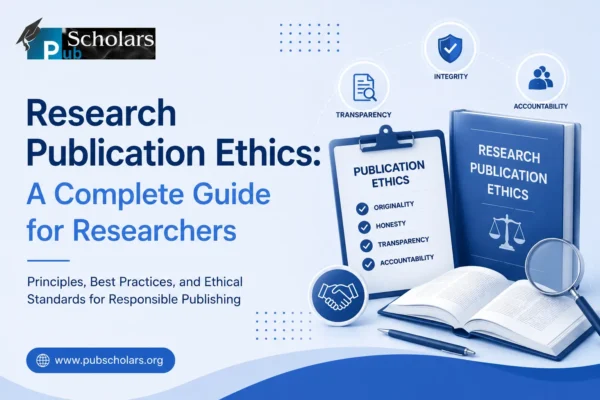
The Core Principles of Research Publication Ethics
The Committee on Publication Ethics (COPE) — the leading international body on publication ethics — defines the core responsibilities of authors. For researchers, the fundamental principles are:
1. Originality
Your work must be your own. Reproducing text, data, figures, or ideas from other sources without proper attribution constitutes plagiarism. Reproducing your own previously published material without disclosure constitutes self-plagiarism or duplicate publication.
Originality encompasses:
- The data and findings you report must be from research you actually conducted
- Theoretical ideas and frameworks attributed to others must be properly cited
- Language and phrasing taken from other sources must be quoted and attributed
2. Honesty in Reporting
Data must not be fabricated (invented), falsified (manipulated to support a predetermined conclusion), or selectively reported in ways that mislead readers. Statistical methods must be appropriate and correctly applied. Null results and negative findings should be reported if they affect the interpretation of your results.
The principle of honest reporting extends to:
- Not cherry-picking results that support your hypothesis while omitting contradictory data
- Not adjusting data points after seeing results (HARKing — Hypothesising After Results are Known)
- Not manipulating figures or images beyond what is scientifically appropriate
3. Transparency
Authors must disclose everything that could reasonably affect how readers interpret their research:
- All funding sources and potential conflicts of interest
- The precise methods used (in sufficient detail for replication)
- Any limitations of the study
- Ethical approvals obtained for studies involving humans or animals
- All contributors to the work through appropriate authorship and acknowledgements
4. Accountability
All authors take responsibility for the accuracy and integrity of the work. Co-authorship is not a courtesy — it carries shared responsibility. Every author must be able to defend the work publicly.
Authorship: Who Qualifies and Who Does Not
Authorship is one of the most frequently misused aspects of publication ethics. The ICMJE (International Committee of Medical Journal Editors) criteria — widely adopted across biomedical and many other fields — require that an author must meet ALL four criteria:
- Made substantial contributions to conception/design, data acquisition, or analysis/interpretation of data
- Drafted the work or critically revised it for important intellectual content
- Approved the final version for publication
- Agreed to be accountable for all aspects of the work, including accuracy and integrity
Ghost Authorship
Ghost authorship occurs when someone who qualifies as an author is excluded from the author list. This is most common when professional medical writers draft or substantially revise a manuscript but are not listed as authors, potentially concealing the involvement of parties with undisclosed conflicts of interest.
Honorary or Gift Authorship
Honorary authorship occurs when someone is listed as an author despite not meeting the ICMJE criteria — for example, a department head added to all papers from their group as a courtesy. This misrepresents who did the work and dilutes the responsibility that authorship implies.
The CRediT System
The Contributor Roles Taxonomy (CRediT) defines 14 specific contributor roles including conceptualisation, data curation, formal analysis, investigation, methodology, writing (original draft), and writing (review and editing). Authors assign roles to each contributor, and this information is published with the paper. CRediT does not replace authorship criteria — it supplements them by clarifying who did what among qualifying authors.
Plagiarism and Self-Plagiarism
Plagiarism
Plagiarism is representing another’s work, words, or ideas as your own without attribution. It ranges from verbatim copying to paraphrasing without citation to presenting another researcher’s ideas as original contributions.
Most journals use iThenticate/CrossCheck plagiarism detection software. A similarity report above approximately 20% typically triggers editorial review. However, similarity detection does not catch all forms of plagiarism — conceptual plagiarism (using someone’s ideas without credit) is harder to detect automatically.
Self-Plagiarism (Text Recycling)
Self-plagiarism refers to reproducing your own previously published text without disclosure. The most common instance is reusing methods sections from prior publications. Some degree of methods repetition is acceptable with proper disclosure (“Methods are as described in [citation]”). However, republishing the same data or findings as if they were new constitutes duplicate publication — a serious ethical violation.
Conflicts of Interest
A conflict of interest exists when financial, professional, or personal relationships could — or could reasonably appear to — inappropriately influence your research or reporting.
Common types
Financial conflicts: Research funding from companies with a financial stake in the results; employment, consultancy, stock ownership, or patents related to the research area; speaker fees or travel support from industry.
Non-financial conflicts: Personal relationships with study participants, collaborators, or competing researchers; prior public positions on the research question; academic rivalry with an author whose work you are critiquing.
Disclosure requirements
COPE and virtually all journals require full disclosure of all potential conflicts of interest at submission. These declarations are published with the paper. Disclosure does not disqualify research — it enables readers to calibrate their interpretation appropriately. Undisclosed conflicts destroy trust when discovered later and can trigger retraction.
Write specific, not vague, declarations: “One author has a financial relationship with industry” is inadequate. “Author X has received consultancy fees from Company Y, which manufactures the device evaluated in this study. Author Z holds stock in Company W. All other authors declare no conflicts of interest” is appropriate.
Data Fabrication and Falsification
Fabrication (inventing data that was never collected) and falsification (manipulating real data or images to misrepresent results) are the most serious violations in research ethics. They cause direct harm by polluting the literature with false information that may influence clinical decisions, policy, or further research.
Image manipulation
Image manipulation is an increasingly common form of falsification — adjusting gel images, microscopy data, or figures to misrepresent the original data. Many journals now use automated image screening tools. The following are always considered inappropriate: adjusting brightness or contrast selectively on part of an image; removing or adding elements; splicing images together without disclosure; using the same image to represent different experimental conditions.
Data availability requirements
Most journals now require authors to provide raw data on request, and many require deposit of data in public repositories as a condition of publication. This requirement supports replicability and transparency — and makes fabrication more likely to be detected.
Duplicate and Redundant Publication
Duplicate publication — publishing the same data or findings in two or more journals without appropriate disclosure — pollutes the literature by inflating the apparent evidence base for a finding.
What is acceptable
- A secondary publication with explicit disclosure, editor permission, and a citation to the primary source
- A translation of a published paper for a different language audience, with disclosure
- Conference abstracts followed by full journal articles (the standard pathway in many fields)
- Methods reuse with appropriate citation and disclosure
What is not acceptable
- Submitting the same manuscript to two journals simultaneously (duplicate submission)
- Publishing the same data twice without disclosure and editor permission
- Salami slicing — artificially dividing a coherent body of results into multiple small papers to maximise publication count
Ethical Requirements for Human and Animal Research
Human research
Studies involving human participants require:
- Ethical approval from an appropriate institutional or national ethics committee before data collection
- Informed consent from participants (with specific documentation requirements by study type)
- Data anonymisation unless participants have explicitly consented to identification
- Compliance with reporting standards: CONSORT (clinical trials), STROBE (observational studies), PRISMA (systematic reviews and meta-analyses)
Animal research
Studies involving animals require:
- Appropriate institutional animal welfare approval
- Adherence to the 3Rs (Replacement, Reduction, Refinement)
- Compliance with ARRIVE guidelines for reporting
Most journals require explicit statement of ethical approvals and consent in the manuscript. Missing declarations result in rejection or retraction.
COPE Core Practices for Authors
The Committee on Publication Ethics publishes Core Practices that define the minimum standards for ethical publishing. For authors, the most relevant are:
Authorship and contributorship
Authors must meet all four ICMJE criteria. Contributions must be accurately described. All individuals who contributed to the work must be appropriately acknowledged. Changes to authorship after submission require editor approval.
Allegations of research misconduct
Authors have an obligation to notify the journal if they discover errors or misconduct in their own published work. Institutions have an obligation to investigate allegations of misconduct by their members.
Data and reproducibility
Raw data should be made available to editors and reviewers on request. Where possible and appropriate, data should be deposited in publicly accessible repositories. Methods must be reported in sufficient detail for replication.
Peer review
Authors must not attempt to influence peer review inappropriately. Suggesting biased or unsuitable reviewers, providing false contact information for suggested reviewers, or attempting to identify or contact reviewers during review are all unethical.
Reporting Guidelines: Ethics in Practice
Following established reporting guidelines is both an ethical obligation and a practical one — journals increasingly mandate them. The major guidelines by study type:
| Study type | Guideline | Resource |
|---|---|---|
| Randomised controlled trials | CONSORT | consort-statement.org |
| Observational studies | STROBE | strobe-statement.org |
| Systematic reviews and meta-analyses | PRISMA | prisma-statement.org |
| Diagnostic accuracy studies | STARD | stard.equator-network.org |
| Qualitative research | SRQR / COREQ | equator-network.org |
| Animal experiments | ARRIVE | arriveguidelines.org |
| Case reports | CARE | care-statement.org |
| Prediction models | TRIPOD | tripod-statement.org |
All major reporting guidelines are compiled at the EQUATOR Network (equator-network.org) — the definitive free resource for research reporting standards.
COPE Guidelines: Your Primary Reference H2
The Committee on Publication Ethics (cope.org) provides:
- Core practices for editors, authors, and reviewers
- Decision flowcharts for handling suspected ethical violations
- Case studies illustrating how to respond to specific situations
- Guidance documents on authorship, peer review, data access, and more
COPE membership is held by thousands of journals worldwide. If you are unsure about an ethical question in your publication process, COPE guidance is the authoritative reference.
Research Integrity Training Resources
Research integrity is increasingly a formal requirement for postgraduate education and institutional employment. Key resources:
UK Research Integrity Office (UKRIO): ukrio.org — guidance documents, case studies, and self-assessment tools for researchers.
Committee on Publication Ethics (COPE): cope.org — Core Practices, guidance documents, and case studies for handling specific situations.
Office of Research Integrity (ORI, USA): ori.hhs.gov — guidance, case studies, and formal finding summaries for US-funded research.
Research Integrity (EU): enrio.eu — European Network of Research Integrity Offices, with links to national policies.
Modules on Research Ethics: Most major funders (Wellcome, NIH, UKRI) publish free online training modules. Some are mandatory for grant applicants.
The Rise of Institutional Research Integrity Offices
Most research-active universities now have a dedicated Research Integrity Officer or Office. Their functions include:
- Receiving and investigating allegations of research misconduct
- Providing confidential advice to researchers facing ethical dilemmas
- Delivering research integrity training
- Liaising with journals and funding agencies during investigations
- Advising on data management, authorship disputes, and conflict of interest declarations
If you face an ethical dilemma in your research or publication practice, your institution’s Research Integrity Officer is the appropriate first point of contact. Most provide confidential consultations that do not automatically trigger formal investigations.
Research Ethics in International Collaborations
International collaborations introduce additional ethical complexity because different countries operate under different research ethics frameworks, consent requirements, data protection laws, and institutional policies.
Key areas that require explicit attention in international collaborations:
Ethics approval across jurisdictions: A study approved by an ethics committee in one country may still require separate approval in a collaborating country. Multi-centre trials and population studies typically require ethics approval in every country where data are collected.
Data transfer and protection: The EU General Data Protection Regulation (GDPR) places strict requirements on transferring personal data outside the EU. Similar frameworks exist in Canada, Australia, and increasingly in other jurisdictions. Legal advice may be required for international data sharing.
Authorship attribution: Cultural norms around authorship vary. Some academic traditions include supervisors as authors more routinely than others. Establish explicit authorship criteria using international standards (ICMJE) from the outset of any international collaboration.
Publication rights: In some countries, institutional or government approval may be required before research can be submitted for publication. Address publication rights explicitly in collaboration agreements.
Consequences of Ethical Violations
For authors
- Retraction of the published paper
- Notification of institutional employers and research integrity offices
- Funding agency investigation
- Professional sanctions from professional societies
- Permanent reputational damage — retracted papers are visible to anyone searching the author’s record
- Career-ending consequences in cases of fabrication, falsification, or large-scale plagiarism
For journals
- Loss of indexing in major databases
- Suppression of impact factor by Clarivate
- Reputational damage affecting the ability to attract submissions
Conclusion
Research publication ethics is not bureaucratic box-ticking — it is the infrastructure that makes science trustworthy, reproducible, and genuinely useful. Authorship attribution, conflict of interest disclosure, data integrity, honest reporting, and ethical treatment of human and animal subjects are the foundations on which every paper you publish rests. Familiarise yourself with COPE guidelines, your institution’s research ethics policies, and the specific requirements of your target journals before every submission. The researchers who build the strongest long-term careers are those whose work is beyond question in terms of integrity.
Useful guides for researchers preparing to submit
These PubScholars resources cover the full journal selection and submission process:
How to Choose the Right Journal for Your Paper — a practical framework for matching scope, audience, and impact factor to your manuscript
How to Publish a Research Paper — the complete step-by-step guide from manuscript prep to post-publication promotion
Impact Factor vs CiteScore: Which Matters More? — how the two metrics differ and when to use each
Does Impact Factor Affect Manuscript Acceptance Chances? — What if signals about desk rejection rates and submission strategy
Which Journals Have the Highest Impact Factor? — field-by-field rankings across medicine, biology, chemistry, and physics
Frequently Asked Questions
What is the most important publication ethics principle?
Honesty — in reporting data, attributing authorship, disclosing conflicts of interest, and representing the originality of work. All other publication ethics principles can be understood as applications of this fundamental commitment.
What should I do if I discover an error in my published paper?
Contact the journal editor immediately. Describe the error clearly and explain its impact on your conclusions. Depending on severity, the editor will recommend a correction (erratum), expression of concern, or retraction. Self-initiated corrections are viewed far more favourably than forced ones.
How do I know if my study requires ethics approval?
Any research involving human participants (including surveys, interviews, and analysis of existing personal data) typically requires ethics review. Animal studies require animal welfare approval. Check your institution’s ethics review requirements early — before data collection begins. Retroactive ethics approval is not possible, and journals will reject manuscripts from studies conducted without appropriate prior approval.
What counts as a conflict of interest that must be disclosed?
Any financial relationship with an organisation that has a stake in your research findings (funding, employment, consultancy, equity, patents, royalties) within the preceding 36 months. Non-financial conflicts that could reasonably influence your objectivity — prior public positions on the research question, personal relationships with study subjects — should also be disclosed or at minimum considered. When in doubt, disclose.
Does disclosing a conflict of interest disqualify my paper?
No. Disclosure enables readers and evaluators to consider potential influence — it does not disqualify research. Undisclosed conflicts are the problem; disclosed conflicts are handled transparently.

I am a seasoned professional with over 9 years of transformative experience in the domains of molecular biology, immunology, and clinical research. With a career that spans from 2006 to 2018, my journey has been marked by a relentless pursuit of scientific excellence and an unwavering commitment to improving healthcare outcomes through groundbreaking research. I have worked at one of India’s premier medical institutions, AIIMS(All India Institute of Medical Sciences), where I contributed significantly to the fields of molecular biology and clinical research. My expertise in protein analysis and genetic studies allowed me to identify potential biomarkers and improve diagnostic accuracy, contributing to better healthcare outcomes for patients. Notably, the research work has been published in prestigious scientific journals such as the Indian Journal of Ophthalmology and the British Journal of Ophthalmology.
Publication in these esteemed journals reflects my commitment to advancing medical science and sharing insights with the global research community. These publications highlight my expertise in areas ranging from gene polymorphism and immune response mechanisms to the effects of chronic drug therapy, all contributing to the larger body of scientific knowledge. My passion for scientific communication led me to pursue an Executive Diploma in Medical Writing from CliMed Research Solutions and Curio Training and Research Institute (CTRI), India. This certification has further refined my ability to bridge the gap between complex scientific research and its practical applications in healthcare. My passion for content writing drives me to continuously create content that derives engagement ,build trust, and leaves a lasting impression on readers”.