- Step 1: Define Your Research Identity
- Step 2: Build a Tiered Publication Strategy
- Tier 1: Flagship publications (1–2 per major research cycle)
- Tier 2: Core publications (3–5 per year)
- Tier 3: Supporting publications (as appropriate)
- Review articles
- Step 3: Choose Journals Strategically
- Step 4: Build and Maintain Your Online Research Presence
- ORCID (orcid.org) — Essential
- Google Scholar Profile
- ResearchGate
- Institutional Profile and Lab Website
- Step 5: Promote Your Published Work
- Immediate actions (within 24 hours of publication)
- First week actions
- Ongoing
- Step 6: Collaborate Strategically to Expand Reach
- Step 7: Track and Manage Your Metrics
- The Compound Effect: Why Early Strategic Decisions Matter Most
- Managing Your Research Identity Across Career Transitions
- From PhD to postdoc
- From postdoc to faculty
- From early faculty to promotion
- Dealing With Publication Pressure
- Productive responses to publication pressure
- Common Mistakes That Weaken Publication Profiles
- Useful guides for researchers preparing to submit
- Frequently Asked Questions
- How many papers do I need for tenure?
- Should I publish fewer, higher-quality papers or more, lower-quality ones?
- How important is the h-index for early-career researchers?
- How do I build my citation count?
- How many papers do I need to build a strong publication profile?
- Should I prioritise first-author papers or collaborative papers?
- How do I build a research identity in a new area after a career pivot?
- How important is my institution for my publication profile?
- Conclusion
Your publication profile is your academic CV in its most visible form. It tells other researchers, institutions, funding bodies, and potential collaborators who you are as a scientist: what questions you ask, how you work, how the community has responded to your work, and where your trajectory is heading. A strong publication profile is rarely built by chance — it is the result of deliberate strategy applied consistently over years.
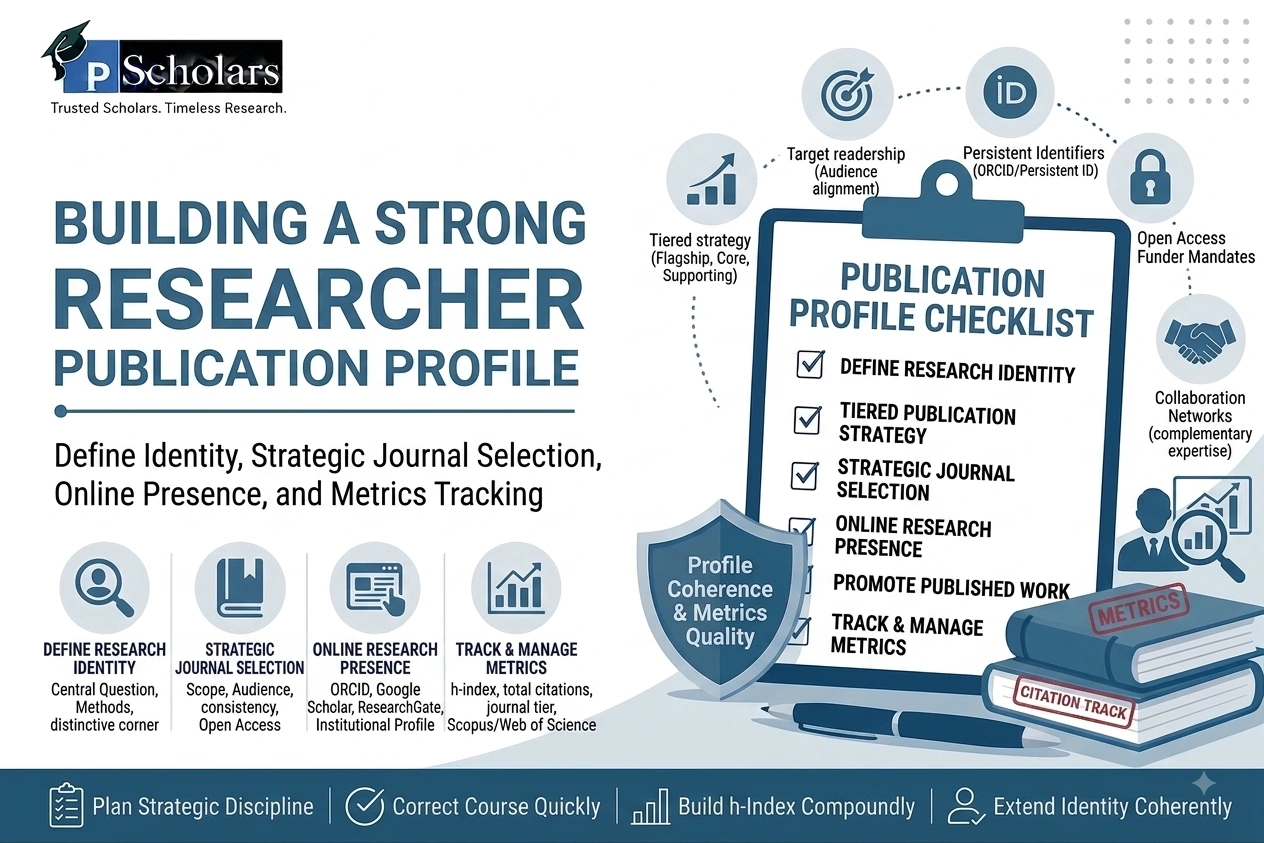
This guide covers everything that goes into building a compelling, cohesive, and metrics-strong publication profile: from defining your research identity to choosing the right journals, managing your online presence, and tracking the right numbers over time.
Step 1: Define Your Research Identity
The most fundamental building block of a strong publication profile is clarity about what you do and why it matters. Before worrying about journal tiers or citation counts, ask:
- What is the central research question or set of questions that defines your programme?
- What methodological approaches do you use that are distinctive?
- What is your field, and what specific corner of it do you occupy?
- What is the most important contribution you want your career to be associated with?
Researchers with coherent publication profiles — where each paper builds on the last and contributes to an identifiable research narrative — are evaluated more favourably by tenure committees, grant reviewers, and hiring panels than researchers with scattered, unconnected papers across multiple unrelated areas.
You can have multiple research threads, but they should be visibly connected. A researcher working on machine learning applications in genomics is clearly coherent. A researcher publishing on computational genomics, historical linguistics, and corporate governance in the same career period needs to explain that coherence explicitly.
Step 2: Build a Tiered Publication Strategy
Not every paper needs to be in a top journal. A tiered strategy produces a stronger overall profile than either a pure high-IF approach (with many rejected papers and delayed timelines) or an undiscriminating approach (where papers land wherever they will be accepted).
Tier 1: Flagship publications (1–2 per major research cycle)
Your most significant findings, sent to the highest-IF journal for which the paper has genuine merit. These papers carry the most weight in evaluations and justify the time cost of selective, competitive submission.
Tier 2: Core publications (3–5 per year)
Well-executed studies published in Q1 or high Q2 journals in your specific field. These are the backbone of your record: consistent quality, appropriate scope, reaching the right audience.
Tier 3: Supporting publications (as appropriate)
Methods papers, datasets, software publications, case studies, conference proceedings (in fields where these count), and invited book chapters. These demonstrate breadth, collaboration, and expertise without competing with your core research output for impact.
Review articles
Strategically placed reviews — particularly in well-regarded review journals in your field — serve multiple functions: they establish your expertise, generate citations, introduce your work to a wider audience, and create internal links to your original research. Invited reviews from reputable journals are a particularly strong signal of community recognition.
Step 3: Choose Journals Strategically
Journal selection is one of the highest-leverage decisions in building your publication profile. The right journal for each paper depends on:
Scope fit: Your paper must genuinely belong in the journal. A mismatched paper in a high-IF journal generates fewer relevant citations than a well-matched paper in a lower-IF but perfectly scoped specialist journal.
Audience alignment: Who reads this journal, and are those the people who most need to know about your findings? Papers reach the right audiences more effectively through well-matched journals.
Consistency with your research identity: Publishing consistently in 2–4 journals in your area builds name recognition with editors, reviewers, and regular readers. Scattering papers across 30 different journals builds none.
Open access requirements: If your funder mandates OA, factor this into journal selection from the beginning.
Turnaround time: Assess career stage demands realistically. A 12-month review cycle might be fine for a senior researcher; it may be career-limiting for someone on the job market in 8 months.
Step 4: Build and Maintain Your Online Research Presence
Your publication profile exists in multiple places, and each contributes to your discoverability.
ORCID (orcid.org) — Essential
ORCID provides a unique persistent identifier for researchers that distinguishes you from other researchers with similar names and connects your publications across databases and institutions. It takes 10 minutes to set up and is increasingly required by journals and funders.
Action: Set up ORCID if you do not have one. Link it to your current institution, all current and past publications, and your funding records. Maintain it as your career progresses.
Google Scholar Profile
Google Scholar automatically indexes your papers and calculates your h-index and citation counts. Claiming and completing your Google Scholar profile ensures that papers are correctly attributed to you and improves discoverability.
Action: Search for your papers in Google Scholar, claim your profile, and verify that all papers are correctly attributed. Set up citation alerts for notifications when your papers are cited.
ResearchGate
ResearchGate provides metrics, enables file sharing (within copyright limits), and facilitates researcher-to-researcher communication. Many researchers receive more engagement through ResearchGate than through their institutional page.
Action: Maintain an updated profile with your current publications and interests. Respond to researcher questions and contact requests.
Institutional Profile and Lab Website
Your institutional web presence is often the first result when someone searches your name. An updated, clearly written profile that describes your research in accessible language signals professionalism and commitment to your institution.
Action: Update your institutional profile after every significant publication. Link to preprints, datasets, and code repositories where available.
Step 5: Promote Your Published Work
Publication is the beginning of dissemination, not the end. Published papers that are not actively promoted reach only the subset of researchers who happen to find them through database searches.
Immediate actions (within 24 hours of publication)
- Share on LinkedIn and Twitter/X with a brief, accessible summary of the findings
- Email the paper directly to 5–10 researchers working in directly related areas
- Post to ResearchGate and Academia.edu
- Update your ORCID, Google Scholar, and institutional profiles
First week actions
- Write an accessible 200–400 word summary for your institution’s news channel, The Conversation, or a relevant science communication platform
- Submit to relevant preprint aggregators if posting wasn’t done before submission
- Flag for Altmetric tracking if your institution uses it
Ongoing
- Track citations monthly via Google Scholar alerts
- Reference your published work in relevant conference presentations
- Present at conferences where your target readership is present
Step 6: Collaborate Strategically to Expand Reach
Collaboration has measurable, documented benefits for publication profiles: collaborating researchers cite each other’s work, and papers with international co-authors consistently accumulate more citations than solo or nationally limited papers.
Identify collaborators whose methodological expertise complements yours — statisticians, clinicians, field experts, or computational researchers who add genuine value to your work and whose audiences partially overlap with yours.
Pursue international collaborations actively. Papers with authors from multiple countries are cited more frequently across a wider range of sources. International co-authorship is one of the most reliable predictors of citation impact.
Engage with interdisciplinary networks. Papers that bridge disciplines reach multiple citation communities simultaneously. A methodological paper that is relevant to both engineering and biology, for example, draws citations from both fields.
Step 7: Track and Manage Your Metrics
Knowing your metrics is not vanity — it is information you need to monitor the trajectory of your research programme and to present your record accurately in evaluations.
Track monthly or quarterly:
- Google Scholar: h-index, total citations, most-cited papers, recent citation trends
- ORCID: publication completeness
- ResearchGate research interest score (a rough engagement metric)
Track annually:
- Scopus h-index and total citations (more conservative than Google Scholar; useful for formal applications)
- Web of Science h-index (most conservative; used by many formal evaluation processes)
- Publication count by year and by journal tier
For grant applications and tenure packages, prepare:
- h-index from Web of Science, Scopus, and Google Scholar (specify database and date)
- Total citation count (specify database and date)
- List of your top 5–10 most cited papers with citation counts
- Quartile and IF for each journal in which you have published
The Compound Effect: Why Early Strategic Decisions Matter Most
The most consequential publication decisions are made early in a research career, because publication records compound. An early-career researcher who consistently publishes in Q1 specialist journals builds not just a publication list but:
- An h-index that grows faster because citations accumulate on more papers simultaneously
- A recognisable research identity within a specific community
- A network of reviewers, editors, and readers who know their work
- An invitation flow for collaborative projects, review articles, and editorial boards
By contrast, a researcher who publishes inconsistently — sometimes in high-tier journals, sometimes in low-tier ones, across disconnected areas — builds a publication record that is hard for evaluators to interpret and hard for citation networks to engage with.
The earlier you begin applying strategic discipline to your publication decisions, the more compounding this effect becomes over a career. This does not mean every decision must be optimal from day one — it means being intentional about where you publish and why, and correcting course quickly when you recognise a pattern that is not serving your goals.
Managing Your Research Identity Across Career Transitions
Your research identity needs to evolve as your career develops — but it should do so visibly and coherently, not chaotically.
From PhD to postdoc
Your PhD publication record establishes your initial research identity. Your postdoc is an opportunity to extend this identity — ideally into an adjacent area that broadens your expertise while remaining clearly connected to your core strengths. A clean extension (computational biologist developing machine learning expertise; ecologist adding remote sensing methods) reads as growth. A complete pivot (marine biologist pivoting to materials science) reads as a fragmented record without a clear programme.
If your postdoc genuinely involves pivoting to a substantially different area, write explicitly in your applications and research statements about why this pivot makes scientific sense — what question connects your previous and new work.
From postdoc to faculty
Your faculty application publication record needs to demonstrate that you can lead an independent research programme. This means: first and corresponding author papers from your postdoc period, a growing citation trajectory, and an identifiable research question that will anchor your independent group’s work.
From early faculty to promotion
By the time you reach your first major promotion review, your publication record should tell a coherent story of a research programme that has been built and executed — not just a list of papers in various journals. The best records at this stage have: flagship publications in leading journals, consistent output in Q1 specialist journals, growing citations, and at least one highly cited paper that has influenced subsequent work in the field.
Dealing With Publication Pressure
Academic publication pressure — driven by funding application requirements, tenure timelines, and the “publish or perish” culture — is real and has measurable effects on researcher wellbeing and research quality. Managing this pressure constructively is an important part of building a sustainable research career.
Productive responses to publication pressure
Maintain a healthy pipeline. Having 3–5 papers at various stages of preparation and submission at any time means that setbacks (rejections, long review cycles) for any one paper do not create immediate crisis.
Set realistic submission targets. Most researchers in biomedical sciences at established institutions aim for 3–6 peer-reviewed papers per year in steady-state production. In slower-citation fields, 1–3 high-quality papers may be the appropriate benchmark.
Distinguish quantity from quality in your own assessment. If you are publishing many papers but few are in Q1 journals and few are accumulating citations, more productivity in the same direction is unlikely to solve the underlying problem. Focus on improving the match between paper significance and journal tier.
Treat rejection as data, not verdict. Each rejection from an appropriate-tier journal tells you something about how your work is perceived by peer experts. That information has value.
Common Mistakes That Weaken Publication Profiles
Scattering papers across unrelated areas. A coherent narrative is more persuasive than a larger, scattered list.
Consistently undershooting journal tier. If all your papers are in Q3–Q4 journals when Q1 submission was reasonable, you are leaving recognition on the table.
Consistently overshooting journal tier. Spending months on repeated rejections by journals far above your paper’s significance level delays your timeline and accumulates nothing.
Neglecting online presence. A researcher who cannot be found easily by someone searching their name loses discoverability and potential collaborations.
Not promoting published work. Papers that are not actively shared reach smaller audiences and accumulate fewer citations.
Publishing everything as middle author. A record without first or corresponding author papers signals to evaluators that you are contributing to others’ programmes rather than leading your own.
Useful guides for researchers preparing to submit
These PubScholars resources cover the full journal selection and submission process:
How to Find Journal Metrics and Rankings Using the Best Tools — Learn how to evaluate academic journals using trusted metrics and ranking tools to identify high-quality publications for research and manuscript submission.
Understanding Journal Metrics for Tenure and Promotion — Discover how journal metrics influence tenure and promotion decisions and learn which indicators best demonstrate the impact and quality of your research publications.
Open Access vs Traditional Publishing: Which is Better for Researchers? — Compare open access and traditional publishing models to understand their benefits, limitations, costs, and impact on research visibility and academic success.
What Is h-Index in Research? A Complete Guide for Researchers — Learn what the h-index is, how it is calculated, and why it is an important metric for measuring a researcher’s academic impact and publication performance.
What to do When Research Paper is Rejected? — Learn how to respond to research paper rejection, improve your manuscript based on reviewer feedback, and increase your chances of acceptance in your next journal submission.
Frequently Asked Questions
How many papers do I need for tenure?
There is no universal number. Tenure expectations vary enormously by institution, discipline, and career stage. Ask your department’s most recently tenured colleagues, your departmental administrator, and review your institution’s formal guidelines.
Should I publish fewer, higher-quality papers or more, lower-quality ones?
Neither extreme is optimal. The most highly evaluated records consistently show a mix: several high-impact publications that demonstrate significance, plus consistent output at appropriate quality levels that demonstrates productivity and coherence.
How important is the h-index for early-career researchers?
Important but contextualised. What matters more at early career is trajectory — are you consistently producing cited work? — and the quality tier of your publications. An h-index of 5 after 3 years in a fast-citation field is normal and not concerning.
How do I build my citation count?
Writing accessible, clearly titled papers in appropriate journals, actively promoting your work after publication, writing review articles, and collaborating with researchers whose networks partially overlap yours are the most consistently effective strategies.
How many papers do I need to build a strong publication profile?
There is no universal target. What matters is that your papers form a coherent, growing research narrative, are in appropriate-quality journals for your career stage and field, and are accumulating citations. In biomedical sciences, a strong early-career profile might involve 8–15 first-author papers within 5 years post-PhD. In mathematics, 5–8 papers in that period might be equally strong. Quality and coherence matter more than absolute quantity.
Should I prioritise first-author papers or collaborative papers?
Both matter, but for different reasons. First-author papers demonstrate your ability to lead and execute research independently. Collaborative papers demonstrate breadth, network, and the ability to contribute effectively to larger programmes. The strongest records have both — a core of first-author papers that show your independent research programme, alongside collaborative papers that demonstrate engagement with the broader community.
How do I build a research identity in a new area after a career pivot?
Engage with the new community early: attend their conferences, read and cite their work, and make genuine connections before trying to publish into the area. A transitional paper that explicitly bridges your prior expertise and the new area — where you bring something the new community cannot easily provide for itself — is the most credible entry point.
How important is my institution for my publication profile?
Affiliation matters for prestige signalling and for access to collaborators and facilities. However, researchers at less prominent institutions consistently publish in top journals when their work has genuine merit. Institutional affiliation matters less than paper quality and research identity coherence for long-term publication profile strength.
Conclusion
A strong publication profile is built through consistent, strategic decisions made at every stage of the research and publication process: what you study, where you publish, how you promote your work, who you collaborate with, and how you present your record. The researchers who build the strongest profiles are those who treat publication not as an afterthought to their research but as an integral part of their scientific programme — planned, executed, and maintained with the same rigour as the research itself.

I am a seasoned professional with over 9 years of transformative experience in the domains of molecular biology, immunology, and clinical research. With a career that spans from 2006 to 2018, my journey has been marked by a relentless pursuit of scientific excellence and an unwavering commitment to improving healthcare outcomes through groundbreaking research. I have worked at one of India’s premier medical institutions, AIIMS(All India Institute of Medical Sciences), where I contributed significantly to the fields of molecular biology and clinical research. My expertise in protein analysis and genetic studies allowed me to identify potential biomarkers and improve diagnostic accuracy, contributing to better healthcare outcomes for patients. Notably, the research work has been published in prestigious scientific journals such as the Indian Journal of Ophthalmology and the British Journal of Ophthalmology.
Publication in these esteemed journals reflects my commitment to advancing medical science and sharing insights with the global research community. These publications highlight my expertise in areas ranging from gene polymorphism and immune response mechanisms to the effects of chronic drug therapy, all contributing to the larger body of scientific knowledge. My passion for scientific communication led me to pursue an Executive Diploma in Medical Writing from CliMed Research Solutions and Curio Training and Research Institute (CTRI), India. This certification has further refined my ability to bridge the gap between complex scientific research and its practical applications in healthcare. My passion for content writing drives me to continuously create content that derives engagement ,build trust, and leaves a lasting impression on readers”.