- What Counts as a Conflict of Interest?
- Financial Conflicts of Interest
- Non-Financial Conflicts of Interest
- How to Disclose a Conflict of Interest
- When to Declare
- What to Include
- What the ICMJE Form Covers
- The Time Window
- Conflicts of Interest for Peer Reviewers
- What Happens When Conflicts Are Not Disclosed
- Managing Conflicts Without Eliminating Them
- Industry-Funded Research: Managing Conflicts Without Suppressing Science
- Key principles for industry-funded research
- What industry funding does NOT imply
- Peer Review and Conflicts of Interest
- Useful guides for researchers preparing to submit
- Conclusion
- Frequently Asked Questions
- What is the difference between a conflict of interest and bias?
- Do I need to disclose past industry funding from years ago?
- What if my institution has the conflict, not me personally?
- Can a paper be published if all authors have conflicts of interest?
- What if I forget to disclose a conflict when submitting?
- Is having a conflict of interest the same as being biased?
- Do conference presentations require conflict of interest disclosure?
- How far back do I need to disclose financial relationships?
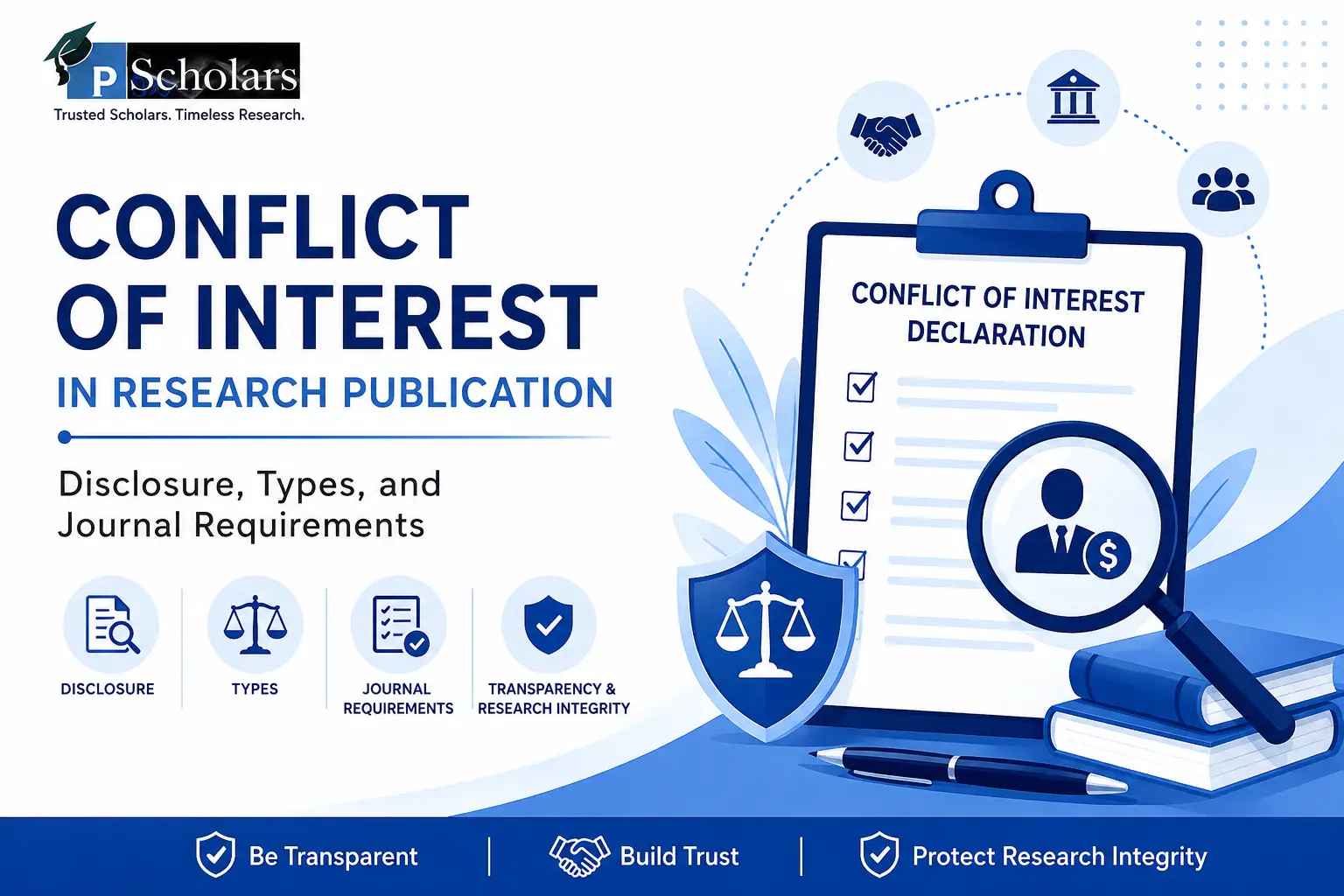
A conflict of interest in research publication exists whenever a financial, professional, or personal relationship could — or could reasonably appear to — influence how research is conducted, reported, or evaluated. Conflicts of interest are not inherently wrong. What is wrong is failing to disclose them.
Undisclosed conflicts have been at the centre of some of the most damaging scandals in modern research: biased clinical trials for pharmaceutical products, suppressed safety data, and papers that shaped medical guidelines while concealing industry relationships. Understanding what counts as a conflict, how to disclose it properly, and why transparency protects both the integrity of science and your own reputation is essential for every publishing researcher.
What Counts as a Conflict of Interest?
Conflicts of interest in research publication fall into two broad categories: financial and non-financial
Financial Conflicts of Interest
These are the most commonly regulated and the most clearly defined.
| Type | Examples |
|---|---|
| Research funding | Grant from a company with a financial stake in the research outcome |
| Employment | Current or recent employment at a company whose products/policies relate to the research |
| Consultancy | Paid advisory roles for companies in the relevant area |
| Stock and equity | Ownership of shares in companies whose products or reputation are affected by the research |
| Patents | Holding or pending patents on technologies or methods related to the research |
| Honoraria | Speaker fees, travel support, or payment for participation in advisory boards |
| Royalties | Income from products or licences that may be relevant |
Financial conflicts are the most significant concern because financial incentives have been empirically shown to correlate with research outcomes: industry-funded clinical trials, for example, consistently show more favourable outcomes for the funder’s products than independent trials of the same interventions.
Non-Financial Conflicts of Interest
These are less universally regulated but increasingly recognised as important.
| Type | Examples |
|---|---|
| Prior public positions | Having publicly and strongly advocated for or against the research conclusion before conducting the study |
| Personal relationships | Being the supervisor, mentee, close friend, or family member of a study participant or collaborator |
| Academic rivalry | Having an ongoing dispute or competitive relationship with an author or institution being critiqued |
| deological commitments | Strong prior beliefs about an outcome that could bias how results are interpreted |
| Institutional affiliation interests | Your institution has a financial or reputational stake in the outcome |
Non-financial conflicts are harder to assess but can be equally influential on research reporting. They are most commonly addressed in peer review rather than publication (reviewers are asked to declare conflicts when invited to review).
How to Disclose a Conflict of Interest
When to Declare
Most journals require conflict of interest declarations at submission, and the declaration is published with the paper. Disclose at submission — not just in the manuscript — because editorial processing may begin before the manuscript reaches reviewers who would see the manuscript text.
What to Include
A proper declaration is specific, not vague. Compare these examples:
Inadequate: “Two authors have a financial relationship with the pharmaceutical industry.”
Adequate: “Dr. Smith has received research grant funding from Company X for a study related to the intervention evaluated here, and has served on the advisory board of Company Y. Dr. Jones owns stock in Company Z. All other authors declare no conflicts of interest related to this work.”
Specificity matters because it enables readers to assess the potential direction and magnitude of influence. A vague disclosure does not give readers the information needed to calibrate their interpretation.
What the ICMJE Form Covers
Most biomedical journals use the ICMJE Conflict of Interest Disclosure Form, which asks authors to report, for each of the preceding 36 months:
- Grants received
- Consulting fees and honoraria
- Stocks and stock options
- Patents
- Any other financial or non-financial relationship
Many other journals use their own format but cover similar ground. Always check the specific journal’s requirements.
The Time Window
Most journals specify a time window — typically 36 months — within which to disclose financial relationships. A consultancy that ended 4 years ago generally does not need to be declared; one that ended 2 years ago typically does. Check your target journal’s specific requirements.
Conflicts of Interest for Peer Reviewers
Reviewers have their own conflict of interest obligations. Most journals ask reviewers to declare when invited whether they have:
- A personal or professional relationship with any author
- A financial stake in the research
- An ongoing collaboration with an author
- Published work that directly supports or contradicts the manuscript’s conclusions
- Knowledge of who wrote the paper that would compromise objective evaluation
Reviewers are expected to decline review invitations when a conflict exists that would compromise objectivity. Reviewing a paper despite a known undisclosed conflict is itself an ethical violation.
What Happens When Conflicts Are Not Disclosed
The consequences of undisclosed conflicts — discovered before or after publication — can be severe.
Before publication: Rejection if discovered during editorial processing.
After publication: Correction notices that are permanently attached to the paper; in serious cases, retraction of the paper.
Institutional consequences: Investigation by the research integrity office; potential findings of research misconduct.
Reputational consequences: Undisclosed industry ties that surface after publication have damaged or ended research careers. The reputational harm from discovered concealment is typically far greater than from transparent disclosure.
Legal consequences: In some jurisdictions and contexts (particularly regulated research environments), failure to disclose financial conflicts can have legal as well as professional implications.
Managing Conflicts Without Eliminating Them
In practice, industry funding and academic research often coexist — and not all industry-funded research is biased. The ethical obligation is transparency, not abstinence from industry relationships.
Practical steps for managing conflicts while maintaining research integrity:
- Ensure that funders do not have data access or publication approval rights that could allow suppression or manipulation of findings
- Pre-register clinical trials and major studies before data collection — this makes outcome switching and data cherry-picking detectable
- Publish regardless of results when a trial or study is registered — this counters publication bias
- Disclose all funding sources and relationships fully and specifically in every publication
- Separate intellectual independence from funding source — make explicit that the funder had no role in study design, data analysis, or publication decisions
Industry-Funded Research: Managing Conflicts Without Suppressing Science
Researcher-industry relationships are an important part of how scientific knowledge is translated into practical applications. The ethical obligation is not to avoid these relationships but to manage them transparently.
Key principles for industry-funded research
Pre-specify the research questions and outcomes. For clinical and applied research especially, registering the primary and secondary outcomes before data collection begins prevents outcome switching — the practice of reporting whichever outcomes support the funder’s preferred conclusion.
Maintain data ownership and publication rights. Research contracts should specify clearly that researchers retain the right to publish all findings regardless of direction, and that funders cannot suppress negative results. Read research contracts carefully before signing.
Full disclosure of funding in every publication. The funding source must be disclosed in every paper arising from the research, regardless of whether the funder was involved in study design, analysis, or reporting.
Independent analysis. For industry-funded clinical research especially, independent statisticians conducting analyses that have not been seen by the funder before pre-specified analysis provide an important integrity safeguard.
What industry funding does NOT imply
Receiving industry funding does not imply that your research is biased or that your results are untrustworthy. Many excellent, rigorous studies are industry-funded. The disclosure of the funding source enables readers to apply their own judgment — which is the appropriate outcome.
The problem is undisclosed industry funding, not disclosed industry funding.
Peer Review and Conflicts of Interest
Reviewers have their own conflict of interest obligations. When invited to review a manuscript, you should decline if:
- You have an ongoing close collaboration with any author
- You have a financial relationship with an organisation that has a stake in the research outcome
- You have a personal relationship (positive or negative) with an author that would compromise objective evaluation
- You are working on research that directly competes with the submitted manuscript
- You have already seen this manuscript in a previous form (e.g., as a conference paper) and would have difficulty evaluating it objectively
Revealing a conflict when declining a review invitation is handled confidentially by editors. Reviewing a paper despite a known undisclosed conflict is a serious breach of publication ethics.
Useful guides for researchers preparing to submit
These PubScholars resources cover the full journal selection and submission process:
How to Find Journal Metrics and Rankings Using the Best Tools — Learn how to evaluate academic journals using trusted metrics and ranking tools to identify high-quality publications for research and manuscript submission.
Understanding Journal Metrics for Tenure and Promotion — Discover how journal metrics influence tenure and promotion decisions and learn which indicators best demonstrate the impact and quality of your research publications.
Open Access vs Traditional Publishing: Which is Better for Researchers? — Compare open access and traditional publishing models to understand their benefits, limitations, costs, and impact on research visibility and academic success.
What Is h-Index in Research? A Complete Guide for Researchers — Learn what the h-index is, how it is calculated, and why it is an important metric for measuring a researcher’s academic impact and publication performance.
What to do When Research Paper is Rejected? — Learn how to respond to research paper rejection, improve your manuscript based on reviewer feedback, and increase your chances of acceptance in your next journal submission.
Conclusion
Conflicts of interest in research publication are normal — what matters is whether they are disclosed. Transparent, specific disclosure enables readers, editors, and evaluators to interpret findings appropriately and make informed judgments about potential influence. Concealment, when discovered, causes damage that disclosed conflicts never would. Treat every conflict of interest declaration as an act of professional integrity: specific, complete, and submitted at the time of submission, not as an afterthought.
Frequently Asked Questions
What is the difference between a conflict of interest and bias?
A conflict of interest is a relationship or circumstance that creates a risk of bias. Bias is what can result from an undisclosed or unmanaged conflict. Disclosing a conflict of interest does not mean you are biased — it means you are transparent about a situation where bias could reasonably be perceived.
Do I need to disclose past industry funding from years ago?
Most journals require disclosure of relationships within the preceding 36 months. Check your specific journal’s policy. When in doubt, disclose — excess transparency is far less risky than discovered concealment.
What if my institution has the conflict, not me personally?
Institutional conflicts — your university holding stock in a company whose product you are evaluating, for example — should also be disclosed. The ICMJE form includes a section for institutional financial interests.
Can a paper be published if all authors have conflicts of interest?
Yes. Disclosure enables readers to assess the potential for influence. Journals often require that at least one author is independent of the commercial interest in the research, but full disclosure of conflicts does not prohibit publication.
What if I forget to disclose a conflict when submitting?
Contact the journal’s editorial office immediately and provide the correct declaration. Journals handle timely, proactive corrections of omissions far more leniently than discovered omissions. Waiting until an omission is discovered is far riskier than self-reporting it.
Is having a conflict of interest the same as being biased?
No. A conflict of interest is a circumstance that creates a risk of bias. Disclosure enables transparent evaluation. Many researchers with significant conflicts of interest produce rigorous, unbiased research. The system relies on transparency to allow readers and evaluators to make informed assessments.
Do conference presentations require conflict of interest disclosure?
Yes — most academic conferences now require conflicts of interest disclosure alongside abstract submission. Industry-sponsored symposia at conferences typically have explicit disclosure requirements. Norms vary by field but disclosure requirements are expanding.
How far back do I need to disclose financial relationships?
Most journals specify the preceding 36 months. Some specify 24 months. Check your specific journal’s policy. When in doubt, err toward disclosing — excess transparency is always safer than discovered omission.

I am a seasoned professional with over 9 years of transformative experience in the domains of molecular biology, immunology, and clinical research. With a career that spans from 2006 to 2018, my journey has been marked by a relentless pursuit of scientific excellence and an unwavering commitment to improving healthcare outcomes through groundbreaking research. I have worked at one of India’s premier medical institutions, AIIMS(All India Institute of Medical Sciences), where I contributed significantly to the fields of molecular biology and clinical research. My expertise in protein analysis and genetic studies allowed me to identify potential biomarkers and improve diagnostic accuracy, contributing to better healthcare outcomes for patients. Notably, the research work has been published in prestigious scientific journals such as the Indian Journal of Ophthalmology and the British Journal of Ophthalmology.
Publication in these esteemed journals reflects my commitment to advancing medical science and sharing insights with the global research community. These publications highlight my expertise in areas ranging from gene polymorphism and immune response mechanisms to the effects of chronic drug therapy, all contributing to the larger body of scientific knowledge. My passion for scientific communication led me to pursue an Executive Diploma in Medical Writing from CliMed Research Solutions and Curio Training and Research Institute (CTRI), India. This certification has further refined my ability to bridge the gap between complex scientific research and its practical applications in healthcare. My passion for content writing drives me to continuously create content that derives engagement ,build trust, and leaves a lasting impression on readers”.