- What Is a Retraction?
- Common Reasons for Retraction
- Honest Error
- Research Misconduct
- Other Grounds
- The Retraction Process
- Who Initiates a Retraction?
- The Investigation Phase
- The Retraction Notice
- Database Marking
- The Scale of Retractions
- How Retractions Affect Authors
- Career Consequences
- Citation Consequences
- Institutional Consequences
- How Retraction Watch Changed the Landscape
- Best Practices to Prevent Needing a Retraction
- Data management
- Image handling
- Statistical analysis
- Pre-submission checks
- How to Check If a Paper Has Been Retracted
- Retraction Watch Database (Free)
- PubMed
- CrossMark
- The Journal Itself
- What to Do if You Discover a Problem in Your Own Published Work
- Useful guides for researchers preparing to submit
- Frequently Asked Questions
- Does a retraction mean the research was fraudulent?
- Can a retracted paper be republished?
- Should I still cite a paper that has been retracted?
- How long does a retraction stay on a paper?
- How common are retractions?
- Does a retraction mean I can no longer publish?
- How do I find out if a paper I want to cite has been retracted?
- What is an Expression of Concern and when is it issued?
- Can I publish in a journal after one of my papers has been retracted?
- Conclusion
A retraction is the formal withdrawal of a published research paper because its findings are no longer considered reliable. It is one of the most significant events in academic publishing — both for the authors involved and for the scientific record. Retractions represent a quality control mechanism for the published literature: a correction to the permanent record when something has gone fundamentally wrong.
Understanding what triggers retractions, how the process works, what the consequences are, and how to check whether a paper has been retracted gives you a more realistic picture of how the published scientific record is maintained — and what your obligations are if problems arise in your own work.
What Is a Retraction?
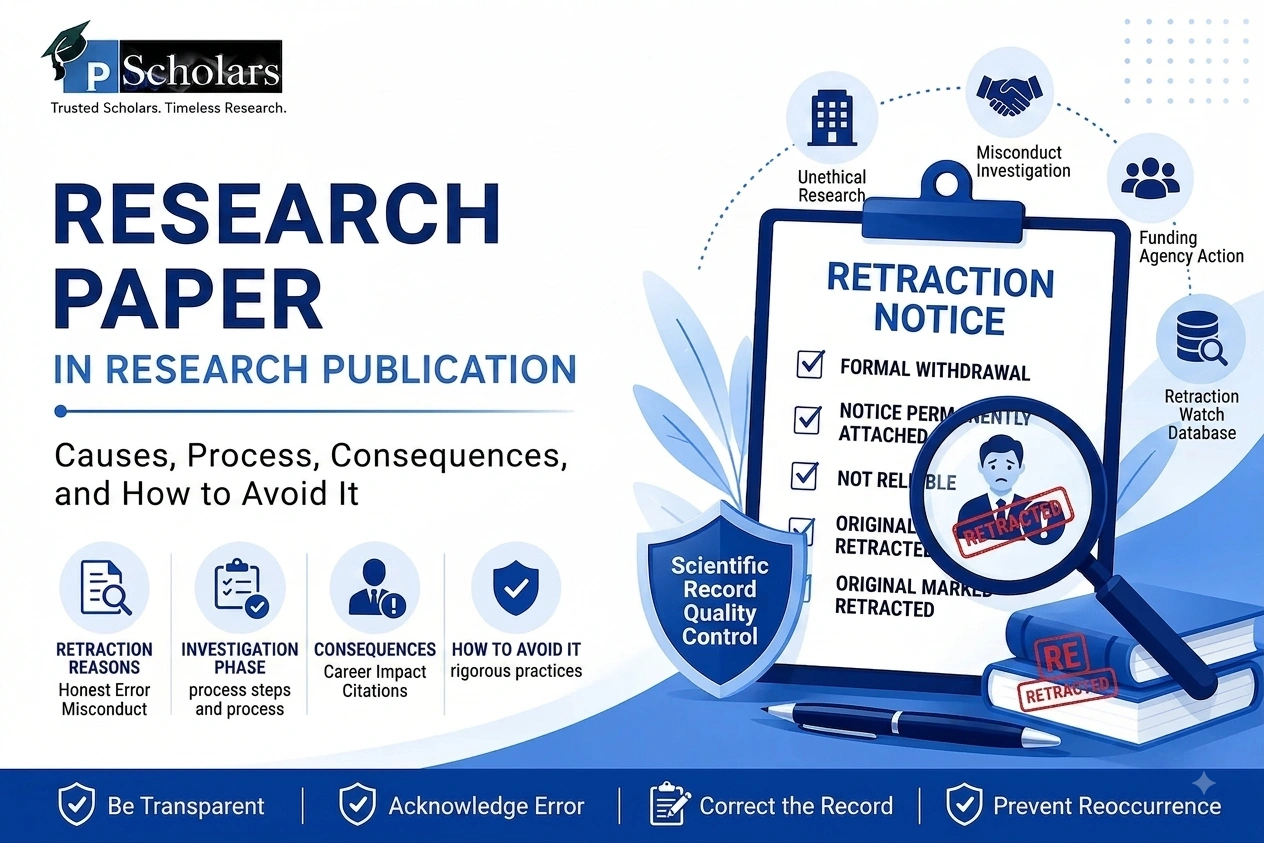
A retraction is a formal notice attached permanently to a published paper stating that the paper has been withdrawn and that its findings should not be cited as reliable evidence. The original paper typically remains visible in databases but is marked clearly as retracted.
Retractions are distinct from other types of published corrections:
| Type | What it means | When issued |
| Retraction | Findings are fundamentally unreliable; paper withdrawn from the literature | Major error, misconduct, data problems, or ethical violations |
| Expression of Concern | Editors have concerns about the paper’s integrity but investigation is ongoing | When full information is not yet available |
| Correction (Erratum/Corrigendum) | A specific error in the published paper has been identified and corrected | Minor, unintentional errors that do not invalidate conclusions |
| Withdrawal | The paper is removed before publication is complete | Pre-publication; equivalent to retraction |
An erratum corrects a specific mistake; a retraction withdraws the entire paper. The distinction matters because a corrected paper remains part of the literature; a retracted paper is explicitly marked as unreliable.
Common Reasons for Retraction
Retractions occur for two broad categories of reasons: honest error and misconduct. The relative proportions vary by study, but misconduct-driven retractions are more common in high-profile journals.
Honest Error
- Data errors: Computational mistakes, incorrect data entry, or inadvertent data corruption that fundamentally affects conclusions
- Reagent or materials problems: Cell lines discovered to be contaminated or misidentified after publication
- Statistical errors: Fundamental methodological errors in analysis discovered after publication
- Image errors: Accidental mixing up of figures from different experiments
When retraction is due to honest error, authors typically initiate or cooperate with the retraction and the retraction notice acknowledges the non-fraudulent nature of the problem.
Research Misconduct
- Data fabrication: Inventing data that was never actually collected
- Data falsification: Manipulating data, images, or results to misrepresent findings
- Plagiarism: Substantial uncredited copying from another’s work
- Duplicate publication: Publishing the same data in multiple journals without disclosure
- Unethical research: Using data collected without ethical approval or informed consent
Misconduct-based retractions are generally more damaging to authors’ careers because they represent intentional wrongdoing rather than inadvertent error.
Other Grounds
- Failure to declare significant conflicts of interest that would have affected editorial decisions
- Author disputes that cannot be resolved (disputes about who has the right to publish the data)
- Copyright issues (data or material belonging to a third party)
- Institutional requests following formal research misconduct investigations
The Retraction Process
Who Initiates a Retraction?
Retractions can be initiated by:
- Authors themselves: The most straightforward case, typically following discovery of an honest error or under institutional pressure after investigation
- Journals/editors: When concerns are reported by readers, reviewers, or other researchers, or when the journal’s own investigation identifies problems
- Institutions: Following a formal research misconduct investigation, the institution notifies the journal
- Funding agencies: In some cases, funders who identify problems in funded research notify publishers
The Investigation Phase
Most journals do not retract papers without investigation. When a concern is raised:
- The editor notifies the authors of the concern
- The authors are asked to respond
- In serious cases, the journal issues an Expression of Concern while investigation proceeds
- The institution may conduct a parallel formal investigation
- Based on findings, the editor decides whether to correct, issue an expression of concern, or retract
The Retraction Notice
COPE guidelines specify that retraction notices should:
- Be permanent and freely available (not behind a paywall)
- Clearly state the reason for retraction
- Identify who initiated the retraction (authors or editors)
- Be linked to the original paper in all databases
- Be consistent across all versions of the paper (print, online)
The retraction notice is published in the journal where the original paper appeared and is permanently linked to the paper in all major databases.
Database Marking
Retracted papers are marked in PubMed, Scopus, and Web of Science. A retraction notice is indexed separately and linked to the original. The original paper typically remains visible but clearly labelled as RETRACTED — it is not deleted, because other papers may have cited it and the retraction record itself is scientifically important.
The Scale of Retractions
Retractions are increasing. Retraction Watch, a blog that monitors and reports on retractions, has tracked over 50,000 retractions in its database as of 2025. Annual retraction rates across all journals are approximately 0.02–0.05% of published papers — a small fraction, but representing tens of thousands of papers.
High-profile cases have involved hundreds of papers by single authors: Yoshitaka Fujii (183 retractions), Joachim Boldt (96), and Diederik Stapel (58) are among the most notable. These extreme cases involve systematic, long-term fabrication across an entire research programme.
How Retractions Affect Authors
Career Consequences
Retractions — particularly misconduct-based ones — can be career-ending. The retraction is permanently and publicly linked to the paper and the author’s record. Every subsequent publication and grant application is scrutinised against a retracted paper.
Even honest-error retractions have reputational costs, though these are typically proportional to the seriousness of the error and how the author handled it. Authors who promptly and transparently initiate retractions of their own errors fare better than those who resist or delay.
Citation Consequences
Studies show that papers continue to receive citations even after retraction — often because citers are unaware of the retraction. A 2022 study found that approximately 10–15% of citations to retracted papers in biomedicine occur after the retraction date. This is why checking retraction status before citing any paper is important.
Institutional Consequences
A retraction triggers institutional review in most research settings. Depending on the reason for retraction and the findings of investigation, consequences may include formal misconduct findings, withdrawal of grants, and dismissal.
How Retraction Watch Changed the Landscape
Retraction Watch (retractionwatch.com), launched in 2010 by science journalists Ivan Oransky and Adam Marcus, transformed the visibility of retractions in academic publishing. Before Retraction Watch, retractions were handled quietly and were difficult to find without specifically knowing where to look. Retraction Watch made each retraction a news event — reported, analysed, and archived.
The effect was significant:
- Journals became more rigorous in issuing retractions rather than quietly correcting papers
- Authors became more aware that retractions would be publicly reported and scrutinised
- The scientific community developed much greater awareness of retraction rates and patterns
- Post-publication scrutiny — researchers checking papers after publication — became normalised
The Retraction Watch Database (retractiondatabase.org), launched in collaboration with CrossRef, now provides a searchable, free database of over 50,000 retracted papers.
Best Practices to Prevent Needing a Retraction
Most retractions can be prevented by rigorous practices at the research and writing stage.
Data management
- Use version-controlled data storage (e.g., Git, OSF, institutional repositories) to maintain complete audit trails of data and analysis
- Never analyse or modify raw data — always keep raw data unchanged and work with processed copies
- Document all data cleaning decisions with explanations
- Store data in non-proprietary formats that can be verified by others
Image handling
- Keep original unprocessed images and document any adjustments made for presentation
- Follow journals’ specific guidelines on permitted image adjustments (typically: brightness and contrast adjustments to the entire image only; no selective adjustment or removal of elements)
- Use image analysis software that maintains audit trails
Statistical analysis
- Pre-register primary hypotheses and analysis plans before data collection where possible
- Document all analysis code and use literate programming approaches (R Markdown, Jupyter notebooks) that interleave analysis and interpretation
- Have statistical analyses independently reviewed before submission for high-stakes clinical or applied research
Pre-submission checks
- Verify all factual claims in the paper against primary sources
- Check all figures against original data files
- Verify that all co-authors have reviewed and approved the final version
- Confirm that ethics approvals cover the exact study as conducted
How to Check If a Paper Has Been Retracted
Retraction Watch Database (Free)
Retraction Watch maintains the most comprehensive publicly accessible database of retracted papers at retractiondatabase.org. Search by author, journal, or paper title. Updated continuously.
PubMed
Search your paper in PubMed and look for the “Retracted Publication” filter or publication type tag. Retracted papers are clearly labelled.
CrossMark
Many journals implement CrossMark — a button embedded in PDFs and online articles that, when clicked, shows the current status of the paper including any retractions, corrections, or expressions of concern.
The Journal Itself
If you have a specific paper and want to check its status, search the journal’s website directly for the paper title.
What to Do if You Discover a Problem in Your Own Published Work
If you discover a significant error in your own published work:
- Notify your co-authors immediately
- Contact the journal editor directly — do not wait for someone else to discover it
- Provide full details of the error and your assessment of whether a correction or retraction is needed
- Cooperate fully with any editorial or institutional investigation
Self-initiated retractions and corrections are viewed significantly more favourably than forced retractions. The research community respects authors who take responsibility for errors — it does not respect authors who fight legitimate concerns.
Useful guides for researchers preparing to submit
These PubScholars resources cover the full journal selection and submission process:
How to Find Journal Metrics and Rankings Using the Best Tools — Learn how to evaluate academic journals using trusted metrics and ranking tools to identify high-quality publications for research and manuscript submission.
Understanding Journal Metrics for Tenure and Promotion — Discover how journal metrics influence tenure and promotion decisions and learn which indicators best demonstrate the impact and quality of your research publications.
Open Access vs Traditional Publishing: Which is Better for Researchers? — Compare open access and traditional publishing models to understand their benefits, limitations, costs, and impact on research visibility and academic success.
What Is h-Index in Research? A Complete Guide for Researchers — Learn what the h-index is, how it is calculated, and why it is an important metric for measuring a researcher’s academic impact and publication performance.
What to do When Research Paper is Rejected? — Learn how to respond to research paper rejection, improve your manuscript based on reviewer feedback, and increase your chances of acceptance in your next journal submission.
Frequently Asked Questions
Does a retraction mean the research was fraudulent?
Not necessarily. Retractions occur for both honest errors and intentional misconduct. The retraction notice usually specifies which. An honest-error retraction is far less damaging professionally than a misconduct-based one.
Can a retracted paper be republished?
Occasionally, a corrected version of a paper that was retracted due to honest error can be republished with appropriate notification and corrections. This is rare and requires editor approval. Papers retracted for misconduct are never republished in that form.
Should I still cite a paper that has been retracted?
Only to reference the retraction itself. Do not cite retracted findings as supporting evidence. Always check retraction status for any paper you intend to cite as evidence.
How long does a retraction stay on a paper?
Permanently. Retraction notices are not removed from the literature. The paper remains accessible but is marked as retracted indefinitely.
How common are retractions?
Approximately 0.02–0.05% of published papers are retracted annually — a small fraction, but representing thousands of papers. Retraction rates are rising, partly due to improved detection tools and partly due to the normative shift toward more systematic scrutiny of published research.
Does a retraction mean I can no longer publish?
Not necessarily. Authors who retract due to honest error, cooperate fully with the journal’s process, and demonstrate ongoing commitment to rigorous practice can often continue productive careers. Authors retracted for fabrication or falsification face far more severe and lasting consequences that may include formal findings of research misconduct and career termination.
How do I find out if a paper I want to cite has been retracted?
Check retractiondatabase.org (free), search in PubMed with the Retracted Publication filter, or look for the CrossMark button on the published paper. If you are citing important evidence, verify retraction status before finalising your manuscript.
What is an Expression of Concern and when is it issued?
An Expression of Concern is issued when editors have concerns about a paper’s integrity but do not yet have sufficient evidence to retract it — typically while an investigation is ongoing. It signals to readers that the paper’s findings should be interpreted cautiously. Expressions of Concern may be upgraded to retractions or removed when the investigation concludes.
Can I publish in a journal after one of my papers has been retracted?
Yes, if the retraction was due to an honest error handled responsibly. Most journals evaluate each submission on its own merits. A history of retraction due to misconduct will be scrutinised by editors, but a single honest-error retraction is not typically a permanent barrier to future publication.
Conclusion
Retractions are a necessary mechanism for correcting the scientific record — not a sign that science is failing, but evidence that it has functional quality controls. Understanding how retractions happen, what they mean, and how to check for them makes you a more careful consumer and producer of scientific literature. For your own work, the best protection is rigorous data management, thorough documentation of all methods and results, and the willingness to correct errors promptly and transparently when they are discovered.

I am a seasoned professional with over 9 years of transformative experience in the domains of molecular biology, immunology, and clinical research. With a career that spans from 2006 to 2018, my journey has been marked by a relentless pursuit of scientific excellence and an unwavering commitment to improving healthcare outcomes through groundbreaking research. I have worked at one of India’s premier medical institutions, AIIMS(All India Institute of Medical Sciences), where I contributed significantly to the fields of molecular biology and clinical research. My expertise in protein analysis and genetic studies allowed me to identify potential biomarkers and improve diagnostic accuracy, contributing to better healthcare outcomes for patients. Notably, the research work has been published in prestigious scientific journals such as the Indian Journal of Ophthalmology and the British Journal of Ophthalmology.
Publication in these esteemed journals reflects my commitment to advancing medical science and sharing insights with the global research community. These publications highlight my expertise in areas ranging from gene polymorphism and immune response mechanisms to the effects of chronic drug therapy, all contributing to the larger body of scientific knowledge. My passion for scientific communication led me to pursue an Executive Diploma in Medical Writing from CliMed Research Solutions and Curio Training and Research Institute (CTRI), India. This certification has further refined my ability to bridge the gap between complex scientific research and its practical applications in healthcare. My passion for content writing drives me to continuously create content that derives engagement ,build trust, and leaves a lasting impression on readers”.